
Dividend Yield Calculator & Payout Ratio Formula Explained
Contents
Whenever bank deposit rates fall, interest in dividend investing surges—buying stocks that pay you cash every month or quarter like a steady second paycheck.
But plenty of investors have bought a stock after hearing "this one pays big dividends," only to get burned when the company cuts or suspends its dividend because earnings fell or the share price gets cut in half. This guide takes a close, three-dimensional look at the financial formulas for dividend yield and payout ratio—the foundation and survival compass of dividend investing—and how to read healthy ratios.
Important Financial & Investment Disclaimer The dividend yield and payout ratio results from this simulation are a general investment information aid, mechanically calculated from historical disclosed financial statement indicators (DPS, EPS). Whether you actually receive a dividend per share in the future can change at any time—dividends may be cut or eliminated (a dividend cut)—depending on approval of the dividend resolution by the company's board of directors and that year's net operating profit. Before you make a final decision to buy a stock, be sure to cross-check the relevant disclosures and the details in the company's quarterly reports.
Summary ① Dividend Yield: the annual dividend per share (DPS) expressed as a percentage of the share price, calculated with the formula
(DPS ÷ current share price) × 100. ② Dividend Payout Ratio: the share of a company's net profit (EPS) paid out to shareholders, calculated with the formula(DPS ÷ EPS) × 100. ③ Investment health check: A payout ratio of 30%–60% is ideal. Above 90%, the company has no cash left to reinvest, its growth engine stalls, and the share price is at greater risk of falling. ④ With the Dividend Yield & Payout Ratio Calculator, you can enter the share price, dividend per share (DPS), and earnings per share (EPS) to see the payout ratio in real time and get a health check on the dividend in one second.
1. The Math Behind Dividend Yield and Payout Ratio
To assess a dividend stock from every angle, you need to compare two measures: how the dividend stacks up against the share price and how it stacks up against earnings.
Dividend Yield Formula
This is a "value for money" measure. It shows the annual dividend return you get relative to your principal, the share price. Dividend yield (%) = dividend per share (DPS) ÷ current share price × 100
- Example: If a stock trading at
50,000 wonpays an annual dividend of2,500 wonper share, the dividend yield is (2,500 ÷ 50,000) × 100 = 5.0%.
Dividend Payout Ratio Formula
This is a "dividend staying power" measure. It tracks whether the company is paying dividends within the profits it honestly earned, without stretching itself. Payout ratio (%) = dividend per share (DPS) ÷ earnings per share (EPS) × 100
- Example (for the 5.0% dividend stock above, with earnings per share of 5,000 won):
- Payout ratio: (2,500 ÷ 5,000) × 100 = 50.0% What this means: The company earned 5,000 won of net profit per share. It paid exactly half—50%—to shareholders as dividends and kept the other 50% inside the company to fund future factory expansion or research and development. This is a very healthy, sustainable, and ideal dividend company model.
2. What Each Payout Ratio Range Means for Investment Appeal
Even if a dividend yield looks extremely high—above 10%—an abnormal payout ratio makes it likely to be a landmine stock.
- Payout ratio 0%–20% (low dividend / growth):
- What it means: These are growth stocks that pay little or no dividend but put all their profits into technology development (for example, big tech IT companies). The right approach is to focus on future share price gains (capital gains), not dividends.
- Payout ratio 30%–60% (ideal dividend stock):
- What it means: A high-quality value stock with the best balance between shareholder returns and retained earnings for growth. Its dividend growth is highly reliable.
- Payout ratio 90%–100% or higher (warning sign):
- What it means: The company is paying out more than it earns. It can't invest in facilities for the future, so its product competitiveness will weaken over time, future earnings will fall, and it carries a very heavy risk of a double loss: a dividend cut and a share price plunge.
How to Use the Dividend Yield & Payout Ratio Calculator
If it's a hassle to manually divide historical disclosures and apply ratio formulas to test whether a dividend is sustainable, use our free Dividend Yield & Payout Ratio Calculator.
Free · no sign-up · enter share price, DPS, and EPS to get an instant payout ratio and investment safety rating
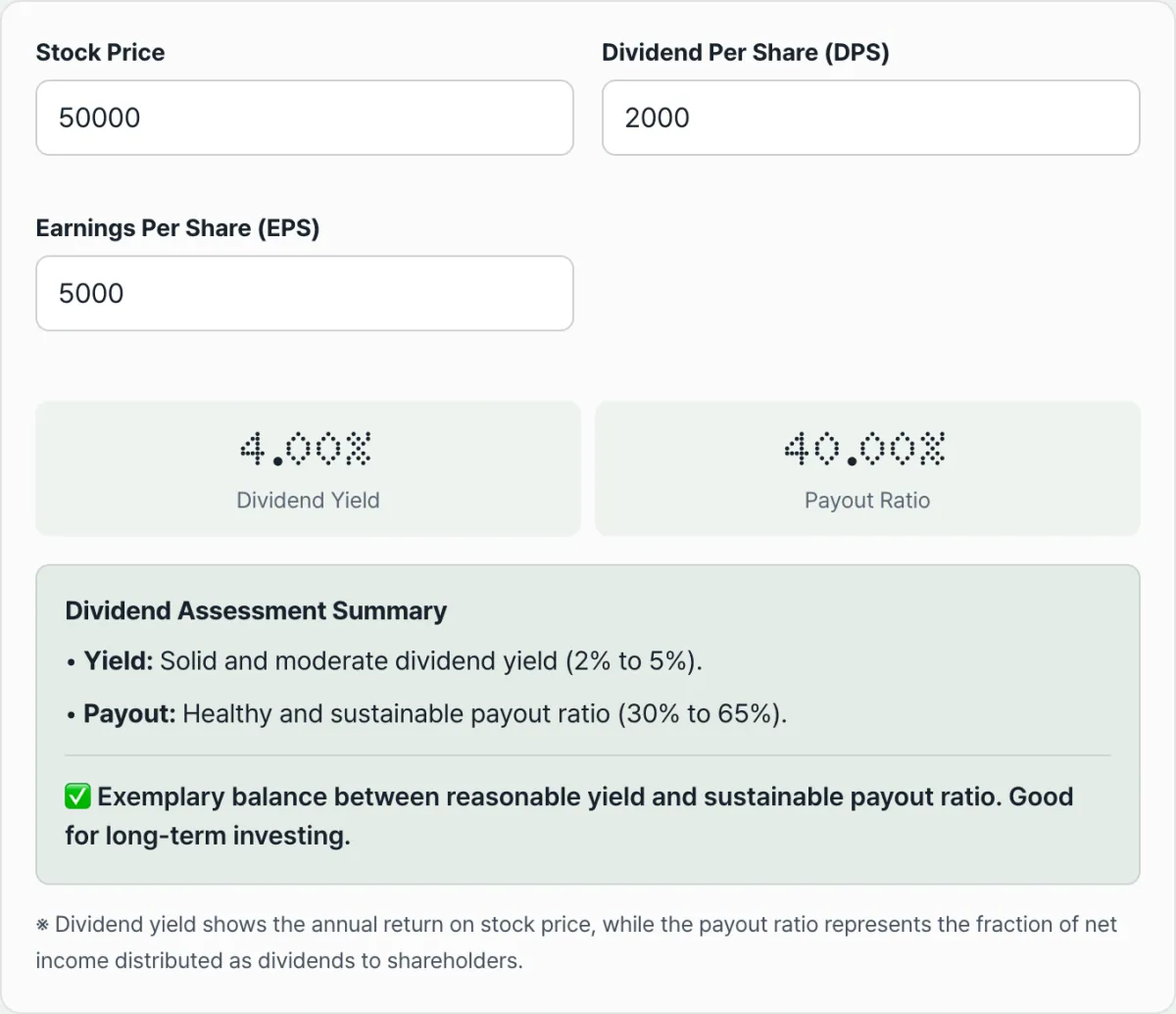
The tool is laid out clearly.
- Enter basic stock data: Enter the current trading price per share (share price), the total annual dividend you receive per share (dividend per share, or DPS), and the company's earnings figure (earnings per share, or EPS).
- As you enter the numbers, the dashboard report on the right immediately shows your pre-tax dividend yield (%) and final payout ratio (%).
- At the same time, the 'Dividend assessment summary' section at the bottom shows a dividend yield assessment, a payout ratio assessment, and an overall diagnosis message (✅ Stable · ⚠️ Needs attention · 💡 For reference) in text. This helps you judge whether the company has room to grow its dividend or is at risk of a dividend cut.
The Bottom Line
The key to successful dividend investing is not getting dazzled by a high yield on the surface. It's checking "sustainability" by calculating whether the payout ratio is healthy relative to the company's net profit power (EPS). Before you buy a stock you're interested in, be sure to open the Dividend Yield & Payout Ratio Calculator and check the payout ratio. Then build a smart pipeline approach that defends against share price declines and dividend cuts before they happen.
Free · no sign-up · enter share price, DPS, and EPS to get an instant payout ratio and investment safety rating
Frequently Asked Questions
What dividend income tax rate is withheld per person in Korea, and what is the threshold for comprehensive financial income taxation?
Here's how the tax works when dividends land in your stock account.
- Dividend income tax rate: Under Article 129(1)(2) of the Income Tax Act, 15.4% (14% dividend income tax + 1.4% local income tax) is withheld by default, and only the after-tax balance is deposited.
- Comprehensive financial income taxation: Once your combined annual dividend and interest income exceeds 20 million won, you become subject to comprehensive taxation. The excess is added to your other employment or business income and taxed at progressive rates of up to 49.5%, so it's important to manage your total income bracket.
When is the last day to buy a dividend stock to receive the dividend?
You must complete your purchase and hold the shares in your account by the day before the ex-dividend date—the last day to buy shares with the dividend attached—because that is when your legal right to the dividend is fixed.
- For example, if a company's disclosed shareholder register closing date (dividend record date) is December 31, the stock market's T+2 settlement rule—which sets the buying deadline three business days before the record date—means you must hold the shares by the end of the business day on December 29 to be officially listed on the dividend shareholder register and earn the right to the dividend. If you buy on the ex-dividend date itself, you have no right to the dividend, so you won't get a dividend notice.
This article draws on standard disclosure guidelines under the Republic of Korea's Capital Markets Act and investment guide data for stocks listed on the Korea Exchange (KRX).
This article was adapted from our Korean original. Read the Korean original