
4:6 Pour Over Recipe: Brew Ratio Formula and Timer
Contents
1. The Hand-Drip Brew Ratio Formula for a Precise-Tasting Cup
For espresso and brewed coffee alike, the core formula for extracting a high-quality, consistent essence is the physical law of proportional weight.
Total water volume formula:
total water to pour (ml) = coffee bean weight (g) × brew ratio(Here, the "brew ratio" determines how strong the coffee is, and the standard range is between 12x and 18x.)Worked example (20g of beans at a 1:15 ratio):
- The math:
20g × 15 = 300mlReading the result: set the water temperature to 92°C and split a total of 300ml into pours, and you get a filter coffee with the most balanced TDS concentration.
- The math:
2. The Math Behind Tetsu Kasuya's "4:6 Rule"
Invented by Tetsu Kasuya, winner of the World Brewers Cup Championship, this rule splits the whole brew into two big phases.
The First 40% of the Water (Designing the Balance of Sweetness and Acidity)
- You pour 120ml — 40% of the total 300ml — in two pours (60ml + 60ml).
- More acidity: increase the first pour and decrease the second.
- More sweetness: decrease the first pour (say 50ml) and increase the second (say 70ml).
The Last 60% of the Water (Designing Strength and Body)
- How many times you split the remaining 180ml — the other 60% — determines the body (the sense of density) of the coffee.
- Mild / soft: dump all 180ml in a single pour to keep it light.
- Strong / bold: split the 180ml into 3 pours (60ml each) to maximize how much you extract from the grounds.
The formula looks complicated, but once you work out the number of pours and the amount for each one in advance, it's much easier to reproduce the same conditions every time.
How to Use the Drip Coffee Recipe & Brewing Timer
If you've been staring at a stopwatch counting seconds while doing mental math on the scale's readout in real time — head spinning, coffee ruined — try the interactive real-time timer module.
Free · no sign-up · enter your bean weight and get the 4:6 pour schedule plus a built-in timer right away
Using the tool is laid out very clearly.
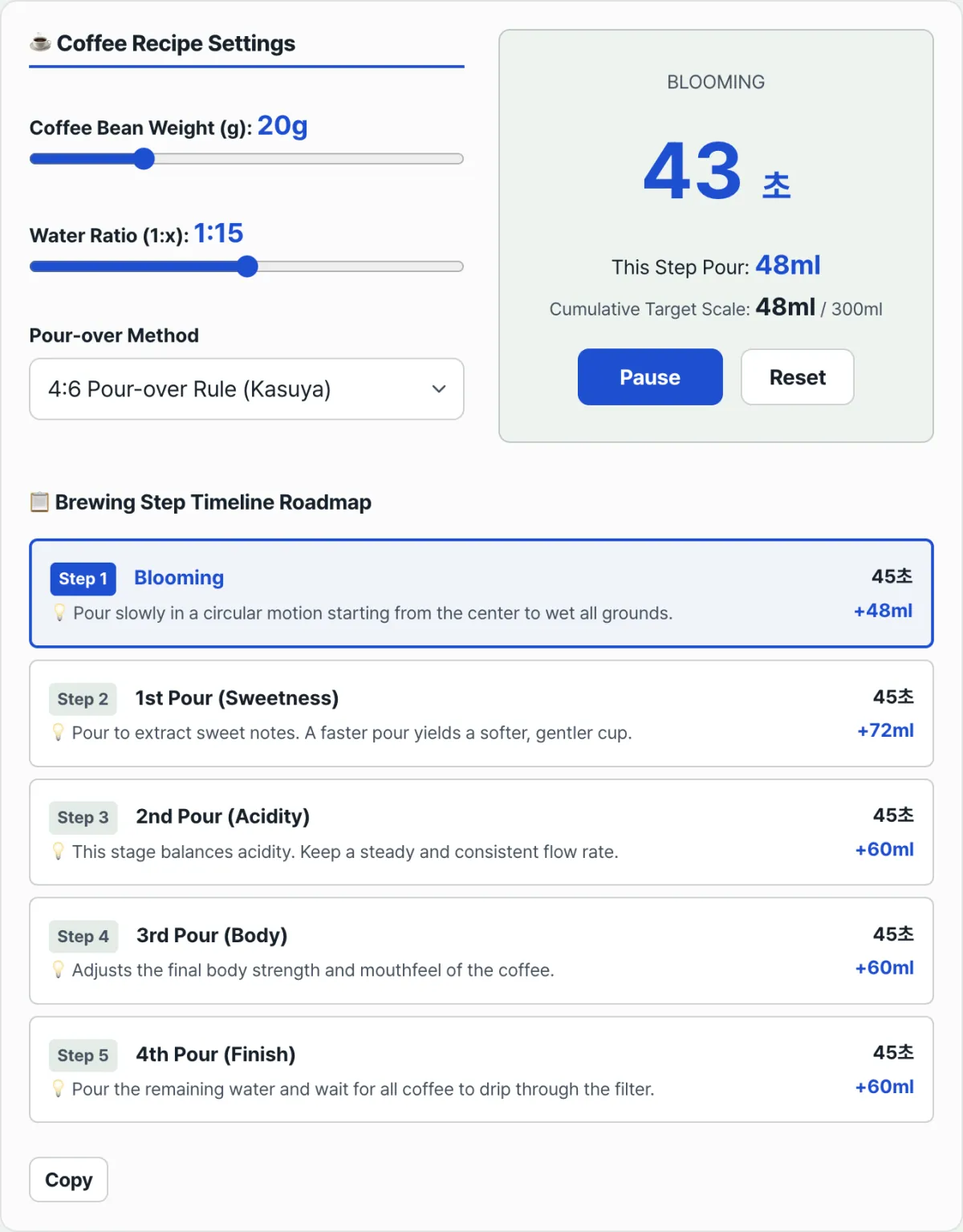
- Setup: drag the sliders to set the exact weight (g) of your ground beans and the brew ratio you want (for example, 1:15), then pick a recipe preset (4:6 method or standard method).
- Automatic timeline scheduling: the moment you enter your numbers, the entire pouring timeline is calculated and mapped for you, from Step 1 (bloom) through Step 5 (final pour), with the ml target for each pour.
- Run the timer: press the "Start Brew" button and the real-time countdown starts. A beep marks the end of each step and the switch to the next one, so all you have to do is watch the scale and pour.
Wrap-Up
Hand-drip coffee is a matter of feel, but it's also a physical and chemical extraction process governed by contact time and the weight proportions of water and beans. The brewing timer is an assistant that works out the water amount and timing for each step based on your dose and brew ratio — the actual taste can still vary with bean condition, water temperature, pouring speed and other variables.
Free · no sign-up · enter your bean weight and get the 4:6 pour schedule plus a built-in timer right away
Frequently Asked Questions
What is the ideal water temperature for hand-drip coffee?
The ideal temperature for the chemical reactions of coffee extraction is between 90°C and 94°C.
- If you pour boiling water (100°C) straight onto the grounds, the over-extracted compounds and burnt elements that cause bitterness dissolve too heavily, and the cup turns harsh and astringent.
- Conversely, water that's too cool — below 85°C — can't dissolve the aromatic acidity and sweetness compounds that make coffee what it is, so you end up with a thin, watery, under-extracted cup. One good tip: boil the water, transfer it to your kettle, let it sit for about a minute, then start brewing.
Should I pour the next round of water before the previous one has drained through the filter?
It depends on the method, but in Tetsu Kasuya's 4:6 technique the rule is to start the next pour after the water has fully drained from the coffee bed in the filter.
- Waiting for the water to drain lets the coffee particles shrink and swell again and again, which pushes the rich flavor even further.
- In a standard Hario pour-over, on the other hand, the recommendation is to pour without a break so the grounds stay submerged in water — that keeps the fines clinging to the filter wall from drying out and gives you a more even balance.
This article is based on the Specialty Coffee Association (SCA) Golden Cup brewing standards and the "4:6 method" devised by Tetsu Kasuya.
This article was adapted from our Korean original. Read the Korean original