
Exam Cram Study Time Allocation by Subject
Contents
When midterms or finals approach, college students everywhere find themselves short on time, staring at a clock that won't cooperate, unsure which subject to open first.
"How should I split tonight's study time between a required major course that's 3 days out and an elective that's 7 days out?" "Can I model each subject's weak spots and my current progress mathematically and optimize the schedule?" This post breaks down the golden-time cramming formula built on a weighted academic-performance model, plus practical time management techniques for college students.
Summary ① Golden-time weight model: Study allocation follows a formula that multiplies three things per subject — a difficulty weight (high/medium/low), the portion you haven't studied yet (1 − progress), and D-Day urgency (1 ÷ √days remaining) — to produce a score. ② Time split formula: Multiply the cumulative budget, derived from your daily available study hours, by each subject's share of the total score to get the final hours per subject. ③ The limits of cramming: Drastically cutting sleep is worse than front-loading the subjects with high urgency and high difficulty. Scheduling those first gives you a better expected score for the hours you have left. ④ With the Exam Timetable & Study Scheduler, you just enter the exam date and time, perceived difficulty (high/medium/low), and progress rate, and it calculates each subject's allocated study hours instantly.
1. The Math Behind Golden-Time Proportional Allocation
Here's how a weighted proportional allocation algorithm that optimally divides your effective study time during exam week is designed.
Per-subject score (W) formula: W = difficulty weight × (1 − progress) × (1 ÷ √days remaining) (Difficulty weight is high = 3.0, medium = 2.0, low = 1.0, and progress is a decimal from 0.0 to 1.0. Days remaining is the time until the exam date and time, calculated down to decimals; when it's close to 0, as on exam day, the urgency value is fixed at its maximum of 5.0. The fewer days remaining, the higher the urgency, so scores rise quickly.)
Per-subject allocated study time formula: Total budget = daily available study hours × 3 (the cumulative budget for the next 3 days) Subject's allocated time = total budget × (that subject's W ÷ sum of all subjects' W)
Worked example (a student who sets daily available study hours at 8, with these two exams coming up):
- Data Structures: difficulty high (3.0), D-Day in 3 days, progress 30% W(Data Structures) = 3.0 × (1 − 0.3) × (1 ÷ √3) = 3.0 × 0.7 × 0.577 ≈ 1.212
- Databases: difficulty medium (2.0), D-Day in 5 days, progress 60% W(Databases) = 2.0 × (1 − 0.6) × (1 ÷ √5) = 2.0 × 0.4 × 0.447 ≈ 0.358
- Study time split (total budget = 8 hours × 3 = 24 hours)
- Data Structures allocation: 24 hours × (1.212 ÷ (1.212 + 0.358)) ≈ 24 × 0.772 ≈ 18.5 hours
- Databases allocation: 24 hours × (0.358 ÷ (1.212 + 0.358)) ≈ 24 × 0.228 ≈ 5.5 hours Reading the result: plug values into this formula and most of the budget goes to Data Structures, which has a tight D-Day and high difficulty, while the rest goes to Databases, which has more room.
2. Time Management That Maximizes Cramming Efficiency
No amount of cramming gets around the physiological limits of the human brain, so you need tactics that manage your focus alongside it.
- Borrowing the Pomodoro technique: Rather than grinding through 4 straight hours, it's said that 25 minutes of intense focus followed by a 5-minute break, repeated four times with a 20-minute long break, helps you hold your concentration.
- Sleep control on exam day: Staying up all night before the exam to squeeze in more material and sleeping only 1 hour hurts calculation and logical reasoning, which means more careless mistakes. To give short-term memories time to consolidate into long-term memory, keep at least some sleep even the night before the exam.
How to Use the Exam Timetable & Study Scheduler
If you can't sort out which subject to open first, and building the weeks, D-Days, and difficulty formula yourself in a spreadsheet sounds miserable, try the dedicated cramming scheduler.
Free · no sign-up · enter your exam info and get a daily per-subject study time chart and roadmap right away
Using the tool is straightforward.
- Set your daily available study hours: Enter the effective study hours you can actually put in today.
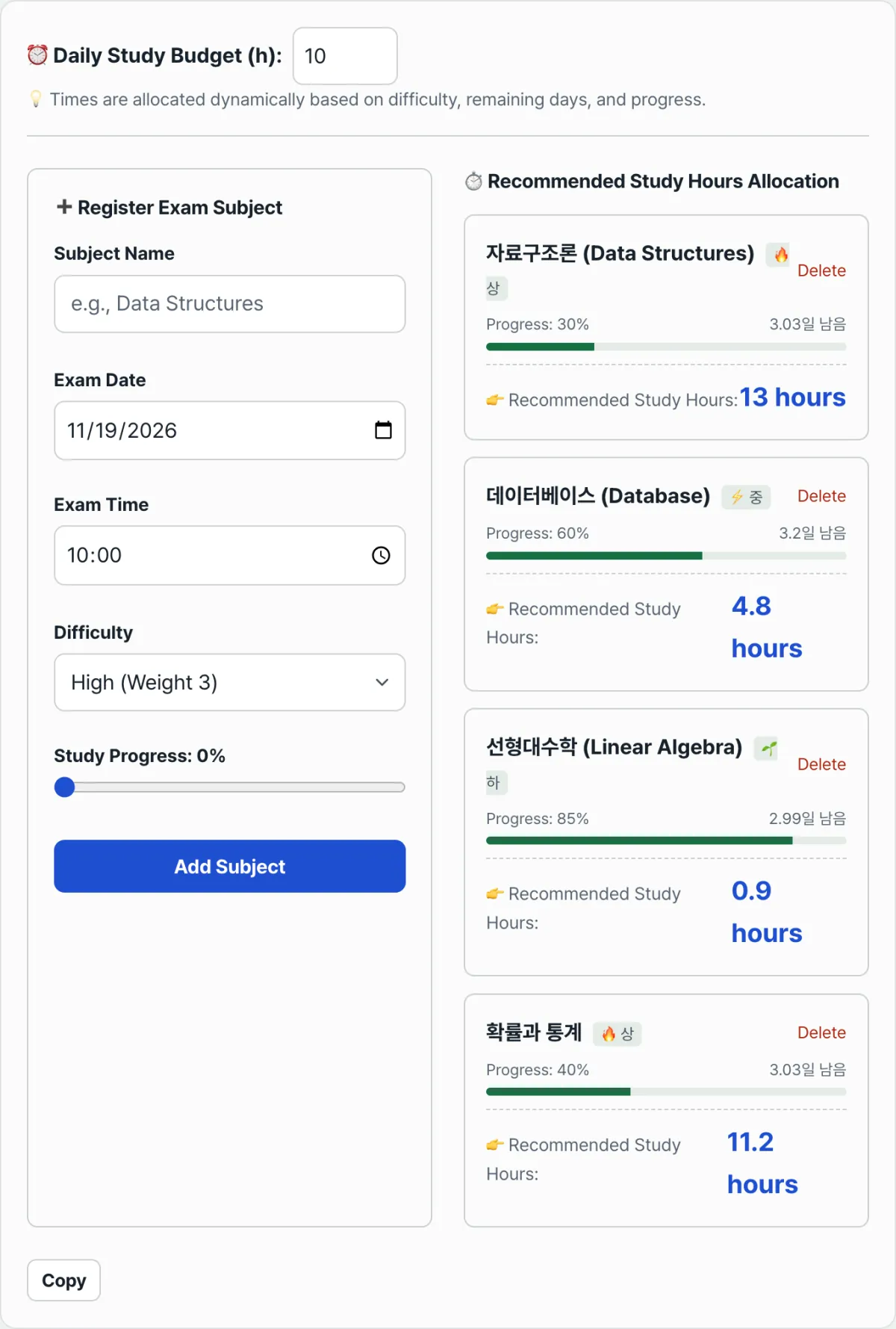
- Add your exam subjects: Enter the subject name, exam date and time, perceived difficulty (high/medium/low), and your progress so far (%) into the fields.
- The dashboard calculates each subject's allocated time as you type and sorts them into cards.
- On each subject card you can see the D-Day, progress, and the recommended study hours (h) together.
The Bottom Line
Cramming for college exams is an allocation problem: deciding which subject gets your limited time first. The scheduler does that allocation for you, based on a score that multiplies difficulty, D-Day, and progress.
Free · no sign-up · enter your exam info and get a daily per-subject study time chart and roadmap right away
Frequently Asked Questions
Which scores higher: a low-difficulty subject with an exam right around the corner, or a high-difficulty subject with plenty of time left?
The formula multiplies difficulty weight, the unstudied share, and urgency (1 ÷ √days remaining), so if one factor is large but another is small, the score won't jump much.
- Urgency scales inversely with the square root of days remaining, so when a D-Day is one or two days away, even a low-difficulty subject's score climbs fast.
- On the flip side, even with high difficulty (3.0), a comfortable D-Day and high progress (a small unstudied share) keep the score low.
- The only way to know the exact ranking is to enter both subjects' difficulty, D-Day, and progress — the three factors are multiplied together, so mental math won't settle it.
What does the calculation look like when a subject I've barely studied, under 10% progress, is suddenly due tomorrow at D-1?
As D-Day approaches 0, the urgency value grows, and on exam day (0 days remaining) urgency is fixed at its maximum of 5.0.
- Add 10% progress, and the unstudied share is a large 0.9, so a subject with high difficulty (3.0) scores far above the others and most of the allocated time lands on it.
- That said, this calculation only produces the proportion of time. How much of the exam scope you actually get through in that time depends on the subject and the person.
Results vary from person to person depending on study habits and the subject.
This article was adapted from our Korean original. Read the Korean original