
Fahrenheit to Celsius Formula: Conversion Steps Explained
Contents
To convert a Fahrenheit (°F) value from a U.S. weather forecast or an overseas oven recipe into Celsius, you only need to know one formula correctly: °C = (°F − 32) × 5/9, and the order matters — subtract 32 first, then multiply by 5/9.
This post walks through where that formula comes from and the spots where mental math goes wrong most often.
Summary ① Fahrenheit → Celsius is °C = (°F − 32) × 5/9, and the reverse, Celsius → Fahrenheit, is °C × 9/5 + 32. ② Kelvin is K = °C + 273.15, a scale that sets absolute zero (−273.15°C) at 0. ③ Most mental math mistakes come from swapping 9/5 and 5/9, or from losing track of the order when 32 gets added.
When You Run Into Fahrenheit in U.S. Forecasts and Overseas Recipes
Open a local weather app while planning a trip to the United States and temperatures show up in Fahrenheit. Seeing "82°F" only tells you it's probably hot — to know exactly how many degrees Celsius that is, you have to do the math.
Oven preheat temperatures in overseas baking recipes are often written in Fahrenheit too. A recipe may say "350°F," but most ovens in Korea show only Celsius, so you have to convert before you can bake as written.
What you need in these moments isn't a rough guess. It's the exact formula and a reliable order for applying it.
How to Calculate It Yourself (Without a Tool)
Celsius and Fahrenheit divide the same temperature into different numbers of intervals. Celsius puts water's freezing point at 0 and its boiling point at 100, splitting that range into 100 steps. Fahrenheit splits the same range from 32 to 212 — that is, into 180 steps.
Because the two scales divide the same temperature range into 100 steps and 180 steps, the ratio of one step to the other is 180/100 = 9/5. Add or subtract Fahrenheit's starting point (32) to that ratio and the conversion formula is complete.
Celsius → Fahrenheit, Fahrenheit → Celsius
To go from Celsius to Fahrenheit, multiply by the step ratio (9/5) first, then add the starting point (32).
°F = °C × 9/5 + 32
To go from Fahrenheit to Celsius, the order is reversed. Subtract the starting-point difference (32) first so you're lined up at 0, then multiply by the step ratio (5/9).
°C = (°F − 32) × 5/9
Break that order and you get a different number. For example, 82°F gives 82 − 32 = 50, and 50 × 5/9 ≈ 27.8°C. Multiply by 5/9 before subtracting 32 and you get a number that isn't even close.
Why Do We Add 273.15 for Kelvin?
In Kelvin, each step is exactly the same size as a Celsius degree. When the Celsius temperature rises by 1 degree, Kelvin rises by exactly 1 as well. The only difference is where the scale starts.
Zero on the Kelvin scale is absolute zero, the theoretical point where a substance's thermal motion can't decrease any further, and that point is −273.15°C in Celsius. So you just add 273.15 to a Celsius value to get Kelvin.
K = °C + 273.15
There's no separate formula that goes straight from Fahrenheit to Kelvin. Convert Fahrenheit to Celsius first, then add 273.15 to that result — two steps.
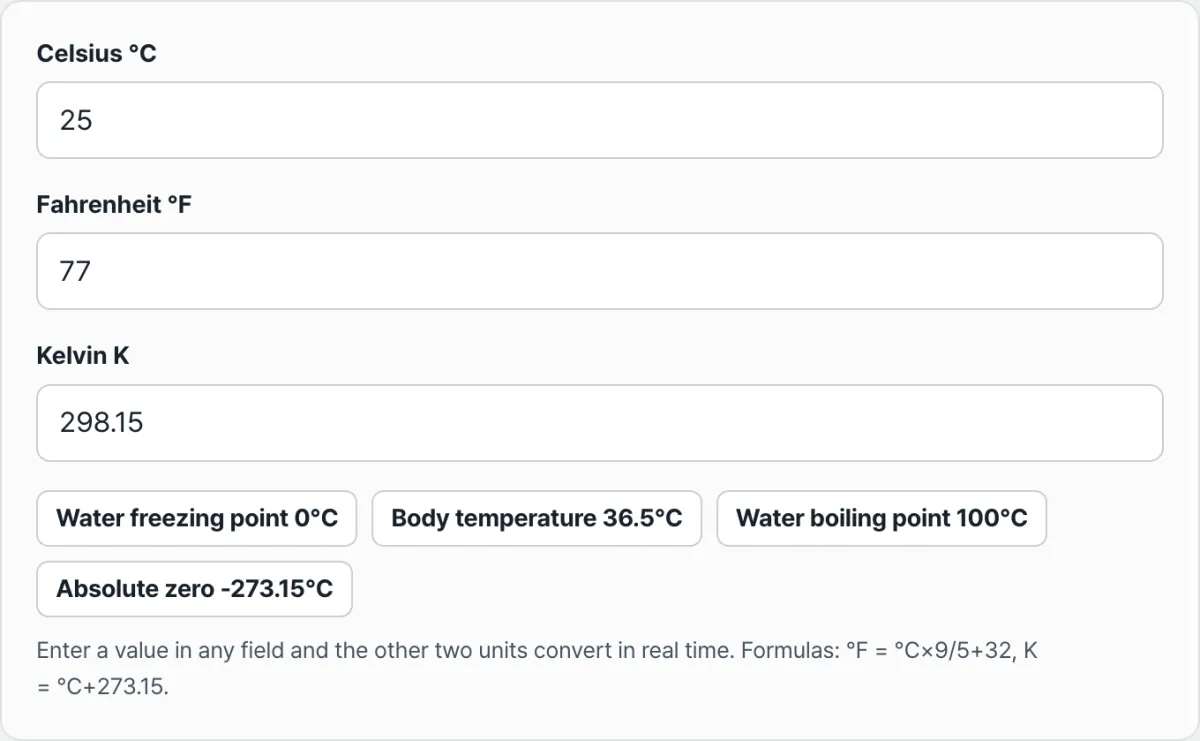
Check it with our tool.
Enter one value in Celsius, Fahrenheit, or kelvin and the other two units are calculated right away.
Common Mistakes: Ratio, Order, and Rounding
The mistakes people make converting Fahrenheit to Celsius mostly come down to three things: using the ratio (9/5, 5/9) backwards, skipping the order and subtracting 32 at the wrong time, or rounding off values partway through the calculation.
| Mistake type | Wrong calculation (based on 82°F) | Correct calculation |
|---|---|---|
| Ratio used backwards | (82−32) × 9/5 = 90°C | (82−32) × 5/9 ≈ 27.8°C |
| Subtracting 32 too late | 82 × 5/9 − 32 ≈ 13.6°C | (82−32) × 5/9 ≈ 27.8°C |
| Rounding in the middle | Rounding 27.8 up to 28 → using 28 in later steps | Round only the final result |
9/5 and 5/9 are reciprocals, so it's easy to mix up the direction. Going from Celsius to Fahrenheit, the number of steps grows from 100 to 180, so you multiply by the larger number, 9/5.
Going from Fahrenheit to Celsius, the number of steps shrinks, so you multiply by the smaller number, 5/9. Remembering it that way makes the direction easy to settle.
5/9 and 9/5 usually don't divide evenly, so the decimals run long. If you round a value in the middle and carry that rounded number into the next step, the error piles up in your final answer. It's more accurate to round once, at the very end, after all the calculating is done.
Recap
- Fahrenheit → Celsius: °C = (°F − 32) × 5/9; Celsius → Fahrenheit: °F = °C × 9/5 + 32
- Kelvin is K = °C + 273.15, with absolute zero (−273.15°C) as the reference point
- When converting Fahrenheit to Celsius, subtract 32 first and multiply by 5/9 second
- 9/5 and 5/9 are reciprocals, so use the one that matches the direction you're converting
- Don't round mid-calculation; round only the final result
Enter one value in Celsius, Fahrenheit, or kelvin and the other two units are calculated right away.
Frequently Asked Questions
What is 100°F in Celsius?
(100 − 32) × 5/9 ≈ 37.8°C. Subtract 32 first to get 68, then multiply by 5/9.
What happens if I enter a negative number in the Kelvin field?
0K (= −273.15°C) is absolute zero, and physically there is no temperature lower than that. If a negative Kelvin value appears in the tool, a message appears asking you to check your input again.
I can never remember whether to use 9/5 or 5/9
Celsius divides the same range into 100 steps and Fahrenheit into 180. Going from Celsius to Fahrenheit means the step count grows, so you multiply by the larger number, 9/5. Going from Fahrenheit to Celsius means the step count shrinks, so you multiply by the smaller number, 5/9. That's the easiest way to remember it.
Is what I type sent to a server?
No. All three fields — Celsius, Fahrenheit, and Kelvin — are calculated instantly inside your browser, and your input is never sent to or stored on a server.
This article was adapted from our Korean original. Read the Korean original