
Intermittent Fasting Timeline: Metabolic Stages and Autophagy
Contents
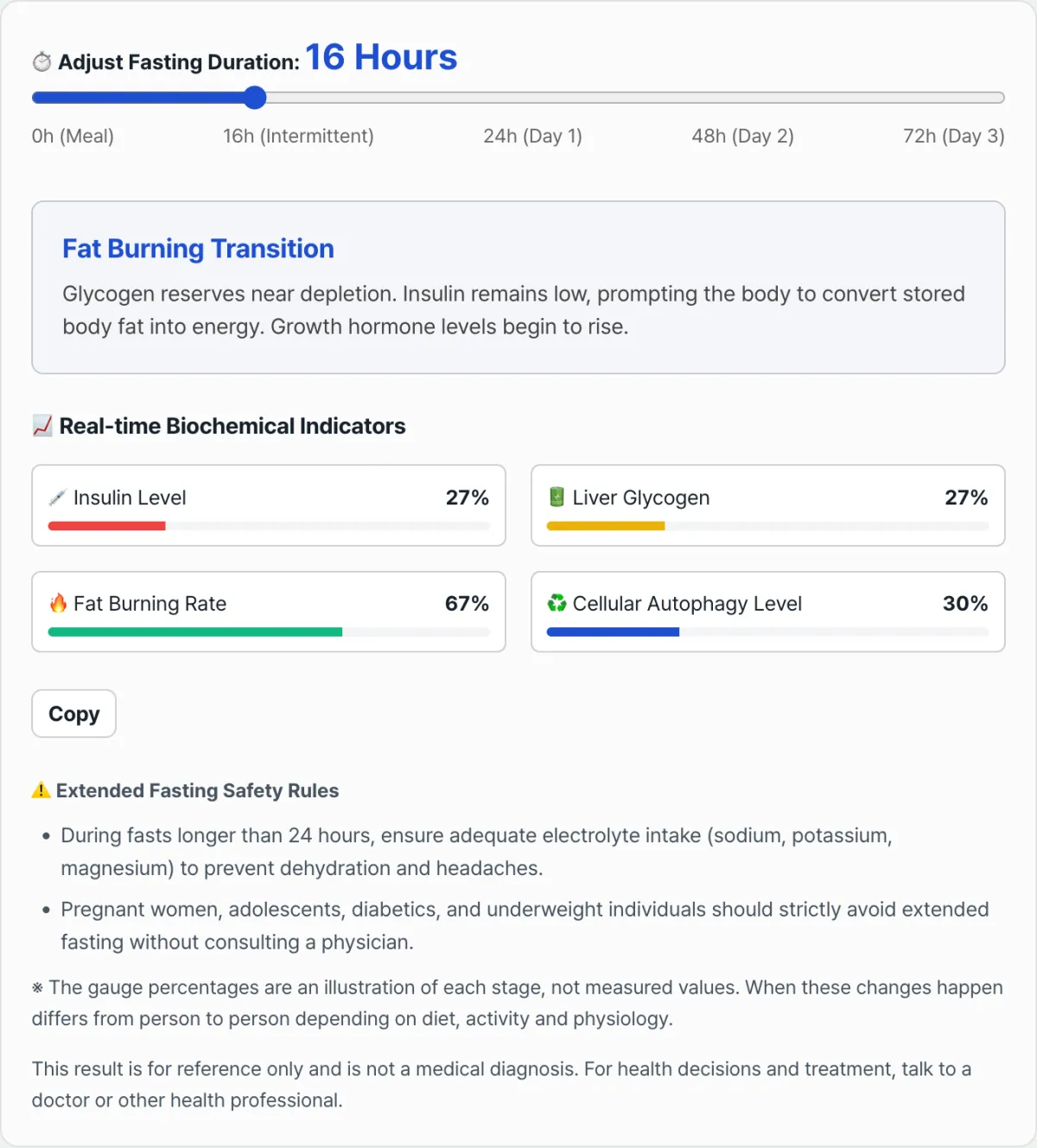
During an intermittent fast, your body shifts fuel roughly in this order: digesting food → using liver glycogen → burning more fat → making more ketones. But the hour when each stage kicks in varies from person to person, depending on what you ate, how active you are, and your body type. The gauge percentages in the Intermittent Fasting Metabolic Simulator are not measurements. They are a conceptual illustration of each stage.
Autophagy (the cell's self-cleaning process) often comes up in talk about fasting. But the finding that it increases around 24 to 48 hours comes mainly from animal studies. Researchers still haven't clearly established when, or by how much, it increases in people. This article covers the stages the simulator shows and how strong the evidence behind each one is.
Caution This article and the Intermittent Fasting Metabolic Simulator offer general reference information. They are not a medical diagnosis or treatment. If you have diabetes (especially if you take blood sugar–lowering medication or insulin), are pregnant or breastfeeding, are a teenager who is still growing, are underweight, or have an eating disorder, you risk low blood sugar and other problems. Talk to your doctor before you fast.
Summary ① A few hours after eating: Food is absorbed, blood sugar and insulin rise, and your body mainly burns carbohydrate. ② As the fast gets longer: Insulin drops, and your body uses the glycogen stored in your liver. Then it relies more and more on breaking down fat. After about a day, the ketones your liver makes also increase. ③ Autophagy: The 2016 Nobel Prize in Physiology or Medicine (Yoshinori Ohsumi) went to research that uncovered how autophagy works in yeast. The increase around 24 to 48 hours of fasting has been observed in animal studies. The timing and extent in people have not been confirmed. ④ When you move the elapsed time in the simulator, the stage name, description, and conceptual gauges change.
What happens in your body at different points in a fast?
The Intermittent Fasting Metabolic Simulator splits 0 to 72 hours into six stages. The time ranges below are rough guides for explanation. In real life, they can shift a lot in either direction from person to person.
0–4 hours: Digesting food
- Carbohydrate from your food is absorbed as glucose, your blood sugar rises, and insulin is released.
- Your body uses the incoming glucose as its main fuel and stores extra energy as glycogen and fat.
4–12 hours: Early fasting
- Once absorption ends, blood sugar and insulin fall.
- Your body breaks down glycogen stored in the liver to keep blood sugar steady. Glycogen is stored with water, so a lot of the early weight loss in a fast is water.
12–24 hours: More fat burning and rising ketones
- As liver glycogen runs down, your body relies more on breaking down fat.
- Your liver starts making ketones from fatty acids, and blood ketones rise the longer you go without food. The simulator splits this range into 12 to 18 hours, "Fat burning begins," and 18 to 24 hours, "Entering ketosis."
After 24 hours: Extended fasting
- Ketones keep rising, and fat becomes the main fuel.
- Animal experiments have shown autophagy increasing around this point. But researchers still haven't clearly established when or by how much it increases in people, or whether inflammation markers go down.
- The simulator's 48 to 72 hour range includes a note about immune regeneration. Don't take this as an established effect in people either.
How do you use the Intermittent Fasting Metabolic Simulator?
If you want to see at a glance which stage matches your elapsed time, use the simulator.
Free · No sign-up · See metabolic stages and conceptual gauges for your fasting time right away
- Set the elapsed time: Use the slider to choose how many hours have passed since your last meal (0 to 72 hours).
- Check the stage: The stage name and description for that hour appear.
- Read the conceptual gauges: Bars show insulin, liver glycogen, fat burning, autophagy, and ketones. These percentages are a conceptual illustration of the direction of change at each stage. They are not actual measurements.
Wrapping up
During a fast, your body shifts its fuel from glucose to glycogen, and then to fat and ketones. This general flow is well known. But the timing of each stage differs from person to person, and the timing and effects of autophagy haven't been confirmed in people. Think of the simulator as a reference picture for understanding this flow.
Free · No sign-up · See metabolic stages and conceptual gauges for your fasting time right away
Frequently asked questions
Does bulletproof coffee or Diet Coke break a fast?
Bulletproof coffee has quite a few calories from the butter and oil, so strictly speaking it isn't a fast with zero calories. It's mostly fat, so it doesn't raise insulin much. But that also means your body burns the fat you drank instead of the fat stored on your body. Diet soda has almost no calories. But very little is known in people about how artificial sweeteners affect cell-level responses such as autophagy. Decide based on what you're fasting for.
Is a longer fast better?
There isn't enough evidence to say so. The longer you fast, the higher the risks of muscle loss, dizziness, electrolyte shortfalls, and low blood sugar. If you fast for more than 24 hours, take in electrolytes such as salt along with water. If any of the groups mentioned above apply to you (diabetes, pregnancy, adolescence, or being underweight), don't do a long fast without talking to your doctor.
What does 100% autophagy on the gauge mean?
It's the maximum value on a conceptual illustration drawn to explain the stages. It isn't a measurement. The number doesn't tell you your actual autophagy level, and researchers still haven't clearly established when or by how much it increases in each person.
This article was adapted from our Korean original. Read the Korean original