
Frequency and Wavelength Calculator: c = f × λ Explained
Contents
When you study waves — light, radio, sound, anything that fills the world around us — physics and engineering treat two quantities as the most important: frequency and wavelength.
Questions like "Why does 5G coverage shrink as the radio frequency goes up?" and "How do you prove the color of light or the pitch of a sound with a wave equation?" all come down to the same basics. Here's the inverse relationship at the heart of every wave, plus the speed constants for electromagnetic waves and sound waves, explained with the math laid out step by step.
Summary ① The inverse relationship: A wave's speed (v) always equals frequency (f) times wavelength (λ). When speed is fixed, a higher frequency means a shorter wavelength. ② Electromagnetic waves (speed of light): Calculations for radio waves and visible light use the speed of light in a vacuum, c ≈ 3×10⁸ m/s. ③ Sound waves: Calculations for ultrasound and audio frequencies use the speed of sound, which depends on the medium's temperature and density (about 343 m/s in 20°C air at room temperature). ④ With the Frequency and Wavelength Calculator, you set the medium, enter either frequency or wavelength, and get the equivalent value back in about a second, plotted as a waveform.
1. The Inverse Relationship and the Basic Wave Equation
Every wave travels through space at a specific speed. Frequency (oscillations per second) and wavelength (distance from one crest to the next) are tied together by that fixed speed.
Basic wave equation: v = f × λ (v is wave speed in m/s, f is frequency in Hz, and λ (lambda) is wavelength in m.)
Frequency formula: f = v / λ
Wavelength formula: λ = v / f
These formulas show that when a wave's speed (the medium) is fixed, a higher frequency (f) forces a geometrically shorter wavelength (λ). There's no other way for the equation to balance.
2. Electromagnetic Waves vs. Sound Waves: Comparing the Speed Constants
The speed v you plug into the formula depends entirely on what kind of wave you're dealing with.
Electromagnetic waves (light, radio, X-rays, etc.)
- These travel through a vacuum with no medium at all, at the speed of light (c), the ultimate speed limit in nature.
- Speed of light constant: c ≈ 299,792,458 m/s (about 3×10⁸ m/s)
- Example: A 2.4 GHz Wi-Fi signal works out to a wavelength of about 12.5 cm, which sets the baseline for antenna design.
Sound waves (audio, ultrasound)
- These travel by vibrating a medium — air, water, steel — and cannot travel through a vacuum.
- Speed of sound in air formula: v = 331.5 + 0.6 × T (T is temperature in °C)
- Example: At 20°C, sound travels at about 343.5 m/s (the calculator uses a fixed 343 m/s). At 20,000 Hz, the top of the human hearing range, the wavelength is only 1.7 cm.
How to Use the Frequency and Wavelength Calculator
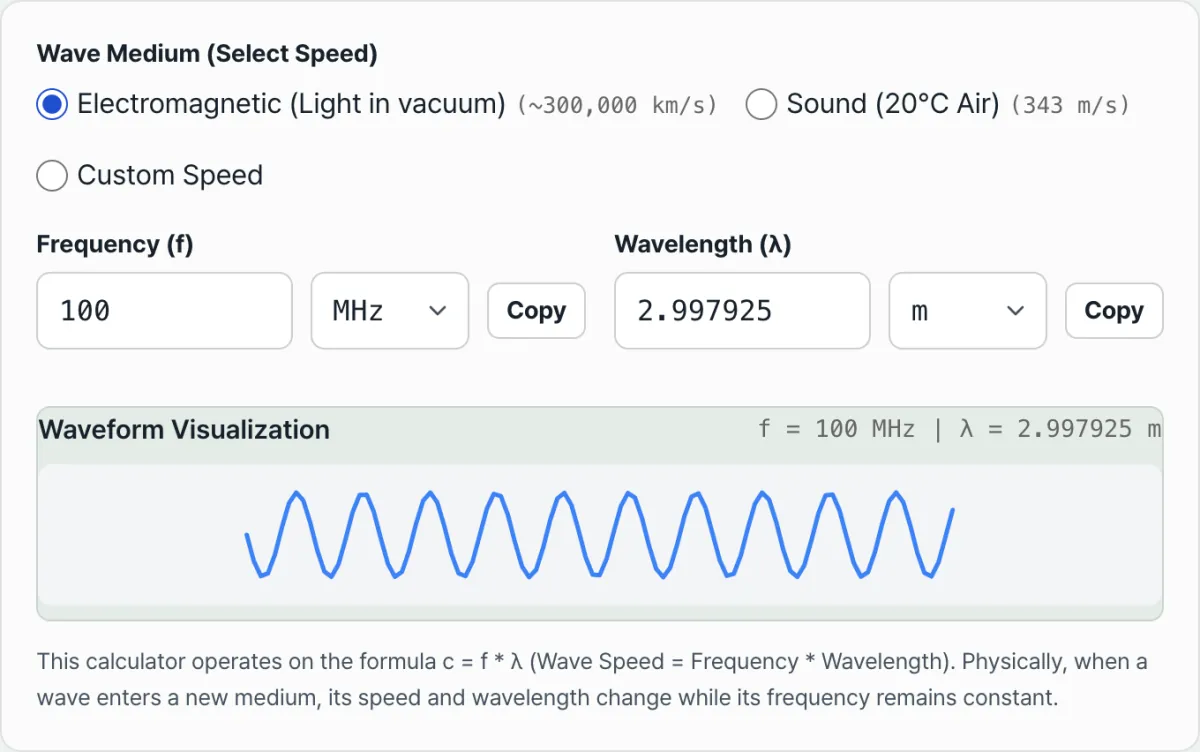
If you'd rather not hand-calculate light-speed division out to eight decimal places, or look up a speed constant for every medium, try the dedicated Frequency and Wavelength Calculator.
Free · No sign-up · Converts frequency and wavelength both ways, based on the medium, with a visual waveform
The workflow is straightforward.
- Pick the wave type: electromagnetic (fixed speed of light in a vacuum), sound (fixed 343 m/s in 20°C air), or custom (enter any speed you want as a number).
- Enter a value: type in the frequency you know (Hz, kHz, MHz, or GHz) or the wavelength you know (m, mm, cm, or nm).
- The matching wavelength or frequency is converted automatically, out to 6 decimal places, as you type.
- Once both fields are filled, a graph appears at the bottom showing the wave's period as a sine wave, along with a note explaining the formula (c = f × λ).
Wrapping Up
Frequency and wavelength are two sides of the same coin, and they underpin wave physics everywhere — from designing wireless networks to audio engineering to optical analysis. The Frequency and Wavelength Calculator lets you convert between them quickly using the right physical constant for each medium, and it's a handy reference when you're analyzing signal attenuation or acoustic reflection.
Free · No sign-up · Converts frequency and wavelength both ways, based on the medium, with a visual waveform
Frequently Asked Questions
Why does 5G at 28 GHz get blocked by obstacles and drop out so much more than LTE at 800 MHz?
It comes down to diffraction, which depends on the inverse relationship between frequency and wavelength.
- How diffraction works: The closer a wave's length is to the size of an obstacle — or the longer it is — the more it bends around behind the obstacle.
- The LTE advantage: Lower-frequency LTE has a wavelength of about 37.5 cm, long enough to bend around building walls and corners.
- The 5G limitation: 28 GHz 5G has a wavelength of only about 10.7 mm (1.07 cm). When it hits an obstacle it can't bend, so it reflects or gets absorbed and dies out. That's why carriers have to install base stations much more densely to keep coverage gaps closed.
When sound travels through water, how do frequency and wavelength differ from air?
When sound enters water, the frequency doesn't change, but the wavelength gets about 4.4 times longer than in air.
- Frequency stays fixed: When a wave crosses into a different medium, its frequency (f) — a fundamental property of the source — never changes physically.
- Why the wavelength grows: Sound travels much faster in water (about 1,500 m/s) than in air (about 343 m/s). Since λ = v / f, holding f constant while v rises about 4.4 times stretches λ by the same 4.4 times. That's the physical reason whale calls can carry across long distances along the ocean floor.
This article was adapted from our Korean original. Read the Korean original