
Fuel Economy Conversion: km/L to L/100km to MPG Explained
Contents
1. What Each Fuel Economy Unit Means Physically, and the Conversion Formulas
Each fuel economy unit uses a different length basis (kilometers vs. miles) and volume basis (liters vs. gallons), so the mathematical conversion factor has to be derived differently for each pair.
Kilometers per liter (km/L) ↔ Liters per 100 km (L/100km)
- The physical difference: These two units are reciprocals of each other — the value sits in the denominator in one and the numerator in the other.
- Conversion formulas:
L/100km = 100 ÷ km/L⟺km/L = 100 ÷ L/100km - Example: If your imported car is listed at 8.0 L/100km, the per-liter figure comes out directly as 100 ÷ 8.0 = 12.5 km/L.
Kilometers per liter (km/L) ↔ US MPG (MPG US)
- Conversion constants: 1 mile = 1.609344 km, 1 US gallon (gal) = 3.785411784 L
- Conversion formulas:
MPG US = km/L × 2.35215⟺km/L = MPG US ÷ 2.35215 - Example: If a US eco-friendly car is rated at 35 MPG US, the figure in Korean terms is 35 ÷ 2.35215 = 14.88 km/L.
US MPG (MPG US) ↔ UK MPG (MPG UK)
- Watch out: The UK gallon (imperial gallon) is about 4.54609 L, roughly 20% larger than the US gallon. So even for the same car driving the same miles, the UK MPG number is always the higher one.
- Conversion formulas:
MPG UK = MPG US × 1.20095⟺MPG US = MPG UK ÷ 1.20095
How to Use the Fuel Economy Converter
If you'd rather not juggle reciprocal division across four different units and check decimal places on a scientific calculator for the US/UK gallon factors (2.352, 1.201, and so on), try our Fuel Economy Converter.
Free · no install · real-time bidirectional conversion across European, US, and UK fuel economy standards
The way the tool works is very straightforward.
- Pick the unit you're entering: Type the fuel economy value you already have (say, 30 MPG US) into the input field exactly as given.
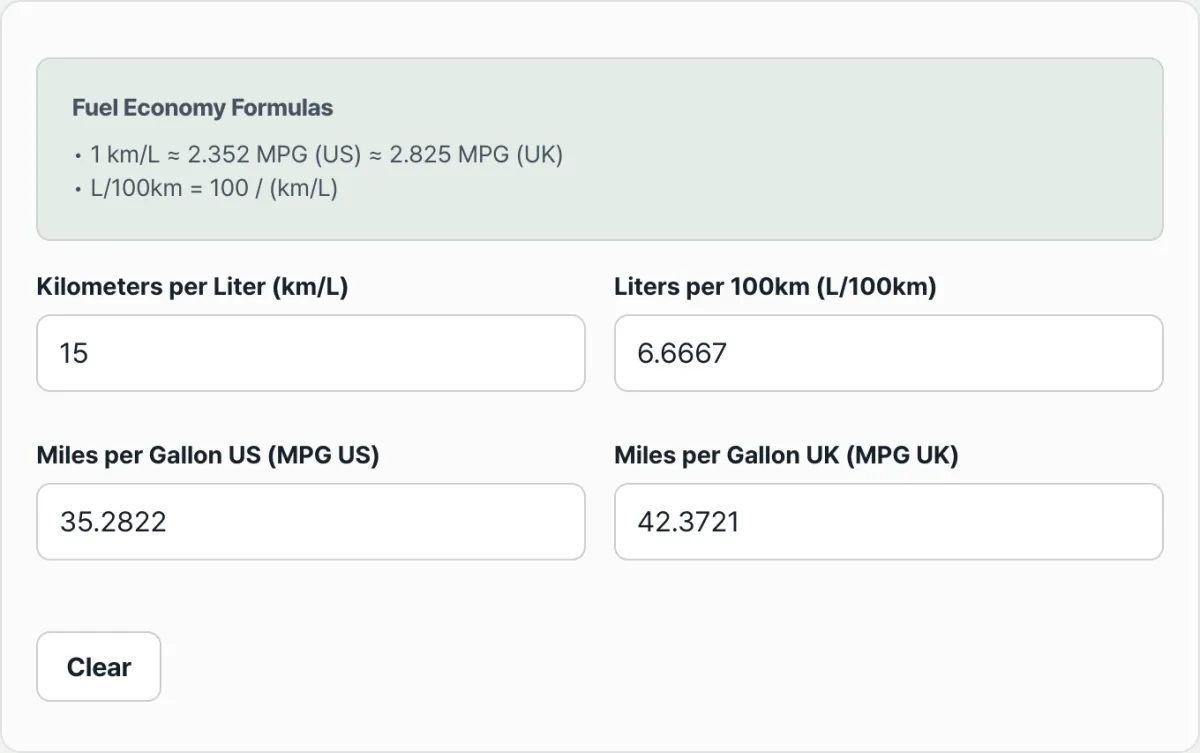
- The moment you type, the dashboard report shows km/L, L/100km, MPG US, and MPG UK values in a grid, all calculated at once in real time.
- That lets you compare the numbers side by side and see how economical the car is by another country's standard — a sensible reference point for analyzing imported car specs or picking a car for an overseas assignment.
Wrapping Up
Unit conventions evolved differently from country to country, and they all come down to how a gallon and a mile are defined physically. With the Fuel Economy Converter, you can turn an unfamiliar number into another country's standard unit and check it right away.
Free · no install · real-time bidirectional conversion across European, US, and UK fuel economy standards
Frequently Asked Questions
Why do European Union (EU) countries use the reciprocal L/100km instead of km/L?
Because it's much more intuitive for consumers trying to predict their actual fuel budget in a straight line.
- The problem with km/L (distorted fuel economy): Going from 10 to 15 km/L and going from 30 to 35 km/L do not save the same amount of fuel, which is the distortion people talk about.
- The strength of L/100km (linearity): With L/100km, dropping from 8L to 6L over 100km means exactly 2L saved, mapped linearly with no mental division involved. A driver planning 1,000km a week or a month can multiply out the fuel cost easily — which is why European governments adopted it as the standard for fuel economy labeling.
When I import a hybrid myself, why is there a gap between the US EPA-rated MPG and Korea's combined km/L rating?
It comes down to differences in each environmental agency's city/highway test cycle (simulator profile) and weighting.
- Different test profiles: The US Environmental Protection Agency (EPA) and Korea's Ministry of Environment measure fuel economy using different splits of city and highway driving, different acceleration/deceleration patterns, and different rules for running the air conditioning or heater.
- Hybrid characteristics: In a hybrid, how much energy regenerative braking recovers depends on how much of the drive is acceleration/deceleration versus steady cruising, so test conditions affect hybrids more than most cars. As a result, the number you get from a simple physics conversion can differ from the government-rated km/L figures in each country.
The conversion formulas in this post are based on the international standard physical conversions between miles and kilometers and between gallons and liters.
This article was adapted from our Korean original. Read the Korean original