
International Shoe & Clothing Size Conversion: US, EU, UK, KR
Contents
1. Global Shoe Size Conversion Principles and Standard Formulas
The gaps in shoe size labeling come from differences in which measurement unit (centimeters vs. inches) and reference point (last length) were used to design the actual foot length.
US Shoes ↔ Korean Shoes (mm) Conversion Rules
Historically, US and UK shoe sizes used the length of one barleycorn — 1/3 inch (about 8.46mm) — as a single size increment and built up from there.
Simplified women's shoe formula (based on Korean mm):
US women's size ≈ (Korean size (mm) - 200) ÷ 10 + 3.0- Example: A Korean women's 240mm shoe converts to (240 - 200) ÷ 10 + 3.0 = US 7.0.
Simplified men's shoe formula (based on Korean mm):
US men's size ≈ (Korean size (mm) - 200) ÷ 10 + 2.0- Example: A Korean men's 270mm shoe converts to (270 - 200) ÷ 10 + 2.0 = US 9.0.
European Shoes (EU) ↔ Korean Shoes (mm)
- Paris point: European sizes define 2/3 cm (about 6.67mm) as one size step.
- European shoe conversion formula:
EU size ≈ Korean size (cm) × 3 ÷ 2 + 2- Example: A 260mm (26cm) shoe maps to 26 × 3 ÷ 2 + 2 = EU 41.
2. Women's and Men's Clothing Size Standards by Country
For clothing, labels evolved in many different ways depending on which body measurements were used (bust, waist) and whether converted inch values were applied.
Typical Women's Tops Comparison
- Korean 44 (XS) ➔ US US 2 ➔ Europe EU 32 ➔ UK UK 4
- Korean 55 (S) ➔ US US 4–6 ➔ Europe EU 34–36 ➔ UK UK 6–8
- Korean 66 (M) ➔ US US 8–10 ➔ Europe EU 38–40 ➔ UK UK 10–12
- Korean 77 (L) ➔ US US 12–14 ➔ Europe EU 42–44 ➔ UK UK 14–16
Typical Men's Tops (Jackets/Coats) Comparison
- Korean 95 (M) ➔ US US S(36) ➔ Europe EU 46 ➔ UK UK 36
- Korean 100 (L) ➔ US US M(38–40) ➔ Europe EU 48–50 ➔ UK UK 38–40
- Korean 105 (XL) ➔ US US L(42–44) ➔ Europe EU 52–54 ➔ UK UK 42–44
How to Use the Size Converter
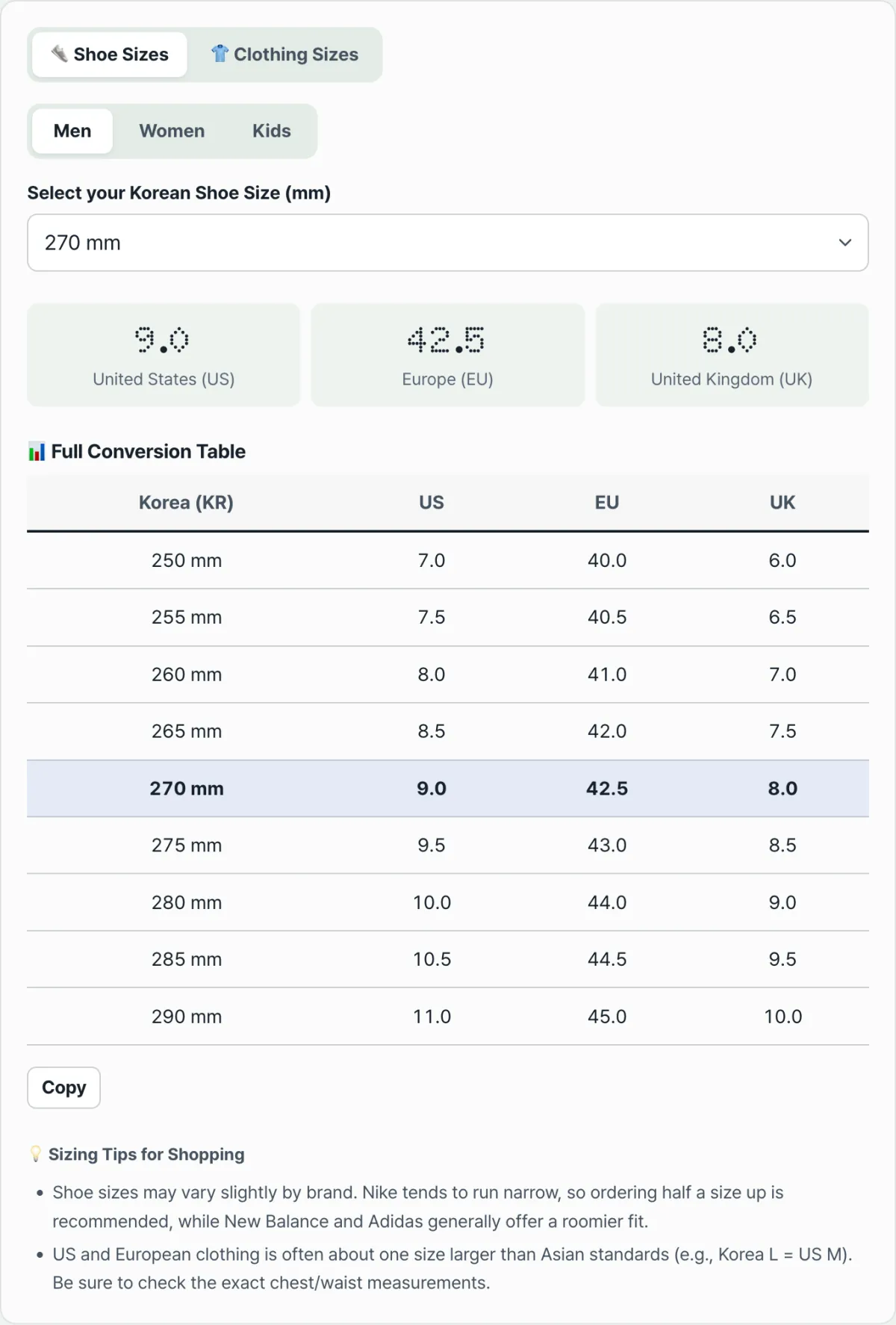
If you're tired of typing "US shoe 8.5 Korean size" into Google every time and hunting through blog comparison tables, try the International Clothing & Shoe Size Converter.
Free · real-time conversion across each country's size standards by gender and garment type, plus tips for mapping the best fit when you shop abroad
The tool is designed to be straightforward.
- Select a conversion category: Choose shoes (men's/women's/kids) or clothing (men's tops, women's tops, men's bottoms, women's bottoms).
- Select the source standard: Pick the base size you already know (for example, Korean 270mm or Korean 55 clothing) from the selector.
- As soon as you choose, the result card shows US, EU, and UK sizes in real time (plus JP sizes for clothing categories), and the matching row in the full conversion table is highlighted too.
- You'll also see tips on how shoe width differs by brand (Nike runs narrow; New Balance and Adidas run roomier) and on how overseas clothing tends to run one size large, so you can use them when deciding your final cart size.
Summary
Differences in national size standards began with the history of measurement systems — inches and centimeters. With the International Clothing & Shoe Size Converter, you can quickly compare sizes every time you shop internationally, which can help reduce the chance of paying return shipping fees.
Free · real-time conversion across each country's size standards by gender and garment type, plus tips for mapping the best fit when you shop abroad
Frequently Asked Questions
When buying clothes from US brands, what exactly is different about the "Petite" and "Tall" lines compared with regular sizes?
It's not just bust measurements — it's vertical body-proportion specs like sleeve length, total length, and rise.
- Petite (for shorter body types): Aimed mainly at women 160cm and under, with shoulder width and bust the same as standard US specs but sleeve length, pants rise, and dress length shortened by 5–8cm. This can be an alternative when US oversized regular fits feel too long for Korean women's body proportions.
- Tall (for taller body types): Designed for heights of 175cm and up, with extended total length and sleeve and leg length. Considering your height and body proportions and checking the sub-fit tag (Petite/Regular/Tall) along with the letter size can help reduce size errors when shopping internationally.
Why do Italian shoe brands offer densely spaced "37.5" half sizes next to standard EU sizes (e.g., 37)?
Luxury handmade shoe brands in Italy and elsewhere regularly build "half Paris points in 3.33mm increments" into their specs to precisely account for slight leather shrinkage and differences in foot shape between Asian and Western wearers.
- Dense, even spacing: Regular off-the-shelf sneakers are produced in 5mm size jumps, but European luxury dress shoes from long-established shoemaking traditions offer half-size (0.5 step) lines to minimize pressure on instep height and foot width.
- Note: If you have wide feet, choosing a half size up from your true size can help reduce pressure from the narrow last silhouette typical of Italian shoes (varies by body type and brand).
This guide summarizes common clothing and shoe size labeling practices used in different countries. Actual measurements may vary by brand and product.
This article was adapted from our Korean original. Read the Korean original