
Shoe Width Formula: Measure Your Foot and Read D, 2E, 4E Codes
Contents
1. Measuring Your Foot Shape and the Width Ratio Formula
To figure out which overseas shoe spec will fit your foot perfectly, you first need standardized 3D projection measurements of your foot.
The Three Key Foot Measurements
- Prep: Lay a blank sheet of paper on the floor, stand barefoot on it, hold a pen at a strict 90-degree angle, and carefully trace the outline of your foot.
- Length (L): Measure the straight-line distance (mm) from the rearmost point of your heel to the tip of your longest toe (big toe or second toe).
- Width (W): Find the maximum horizontal width (mm) between the big-toe joint and the little-toe joint, where the bones under your toes stick out the most on each side.
The Foot Width Ratio Formula
An absolute width number alone can't give you a grade. You need the ratio relative to your foot length to get a reliable call.
Foot width ratio (%) = (foot width W ÷ foot length L) × 100
- Example (a man with a foot length of 260mm and a foot width of 108mm):
- Plugging into the formula: (108 ÷ 260) × 100 ≈ 41.5%
- Reading the result: If your width ratio is over 40%, you'll often feel pressure on the sides of your foot in a standard Western
Dwidth shoe. In that case, when buying from overseas, consider a2E(Wide)or wider option, or going up half a size (5mm).
2. Alphabet Width Grading Systems by Global Brand
US and European sportswear brands print their own alphabet width fitting on shoes to protect customers from fit mistakes.
- Women's width spectrum:
- 2A (Narrow) ➔ B (Medium) ➔ D (Wide) ➔ 2E (Extra Wide)
- Men's width spectrum:
- B (Narrow) ➔ D (Medium) ➔ 2E (Wide) ➔ 4E (Extra Wide) ➔ 6E (Super Wide)
Performance running lineups from New Balance, Brooks, ASICS, and others tool separate D, 2E, and 4E lasts from the insole and upper design stage onward, so it's satisfying to track down the shoe that precisely matches your grade.
How to Use the Global Shoe Width Checker
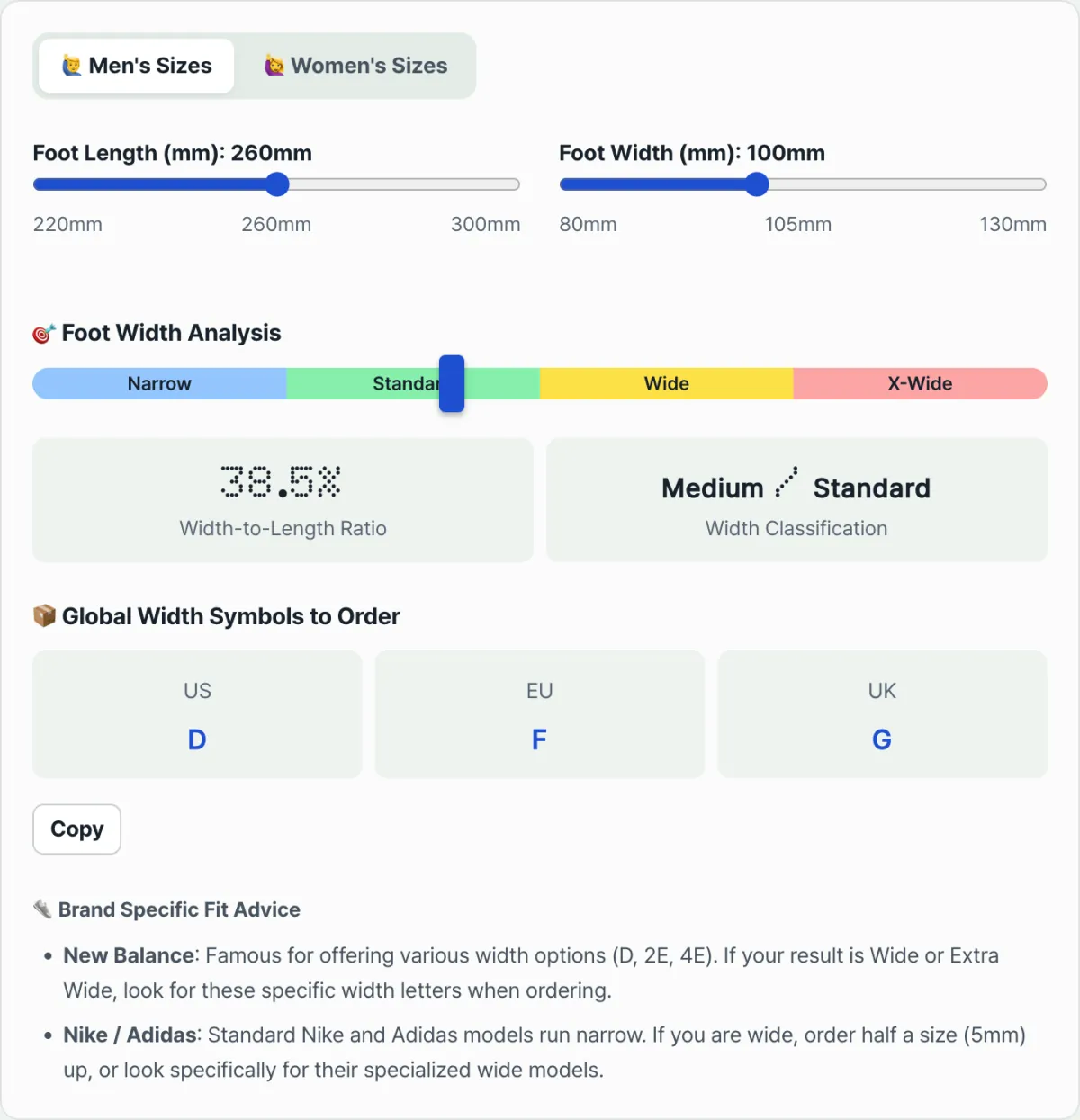
If you don't want to squint at decimal values in width tables that shift by gender and country, try the dedicated width checker.
Free · automatic calculation of your foot width percentage from mm measurements, plus fit recommendations by brand
Using the tool takes just a few steps.
- Set your profile: Choose your gender (men/women) and enter your measured foot length (mm) and maximum width (mm).
- As soon as you type, the dashboard report calculates and displays your foot's width-to-length percentage (%).
- Based on that number, it issues a precise US sizing verdict: Narrow, Medium, Wide, or Extra Wide alphabet code (B, D, 2E, 4E).
- It also shows fit tendency guides for major brands such as adidas, Nike, and New Balance, so you get a clear indicator for deciding whether to stay true to size or go up one.
Summary
Shoe fit only gets comfortable when you consider width along with length. Enter your foot measurements into the International Shoe Width Estimator to see your foot's geometric grade, and use it as a reference when picking sizes for overseas orders. That said, actual fit can vary by brand, model, and material, so the result alone can't settle every case.
Free · automatic calculation of your foot width percentage from mm measurements, plus fit recommendations by brand
Frequently Asked Questions
Which sportswear brands are notoriously narrow for Asian feet, and which ones run wide for broad feet?
Nike and adidas tend to stick to Western-style narrow lasts, while New Balance and ASICS offer plenty of wide-width models that suit Asian foot shapes.
- Nike: The instep is low, the arch line is cut deep, and the overall width is trimmed narrow, so broad-footed users who buy true to size often end up blowing out the sides.
- New Balance: It's just about the only brand in the industry that makes separate width grades (D, 2E, 4E) even for everyday shoes (574, 990, etc.) and stocks them in stores, so wide-footed wearers widely treat it as an oasis.
What should I do if the overseas site I'm buying from only lists shoe length and gives no width option (B, D, 2E, etc.) at all?
Those models are usually made in a single standard width: Medium (D for men, B for women). If your width ratio is Wide or above, consider going up half a size (5mm to 10mm).
- Typical pattern: When a shoe gets longer, the toe box tends to gain some width along with that extra length. That said, how much varies a lot with each brand's and model's last design, so it's hard to pin down an exact number.
- The trade-off: Sizing up can leave extra room (heel slip) in front of your toes, but the side pressure on your width tends to ease. Which one feels better depends on your foot shape and the shoe material, so try them on in person if you can.
This guide is based on the general shoe-fitting concept of width-to-length ratio and the alphabet width labeling conventions overseas brands commonly use.
This article was adapted from our Korean original. Read the Korean original