
Visa-Free Countries by Passport: Rankings and 6-Month Rule
Contents
1. How Is a Passport Power Ranking Calculated?
The Henley Passport Index is one of the most commonly cited measures when the travel industry compares the "power" of passports. The method is fairly simple.
- How it's counted: The index adds up the number of destinations worldwide that you can enter without getting a visa in advance. That includes visa-free entry, visa on arrival, and electronic travel authorization. The total is the passport's score.
- What counts toward the score: Visa-free entry, a visa issued immediately on arrival, and an electronic travel authorization (eTA) issued immediately. In all three cases, you don't need to visit a consulate before departure.
- What doesn't count: A visa that requires a consulate visit or a separate review before departure (Visa Required) is not included.
In the October 2026 edition of the Henley Passport Index, the South Korean passport ranks tied for 2nd with Japan and the United Arab Emirates, with access to 188 destinations. Singapore is 1st (193 destinations). The United States is tied for 10th with 180 destinations. The index is updated several times a year, so check the Henley & Partners release for the latest ranking.
| Passport | October 2026 Rank | Destinations You Can Visit |
|---|---|---|
| Singapore | 1st | 193 |
| South Korea, Japan | Tied for 2nd | 188 |
| United States | Tied for 10th | 180 |
2. The 4 Entry Types and How They Differ
When you choose a destination, the visa types you need to check fall into four main groups.
- Visa-Free: For tourism, you can stay without a visa for anywhere from 30 days (for example, China's temporary visa-free policy) to 90 days (for example, Japan and Thailand), depending on the country. Russia also allows South Korean passport holders to stay visa-free for up to 60 days at a time under an agreement.
- Electronic travel authorization (eTA / ESTA / ETA): This isn't a formal visa, but you must apply online and get approved before you leave. (Examples: the US ESTA, Canada eTA, Australia ETA, and UK ETA. Starting in 2025, South Koreans need a UK ETA to stay up to 6 months.)
- Visa on Arrival: You pay a fee and submit documents at the airport immigration counter, and the visa is issued on the spot. (Examples: Egypt, the Maldives, and others.)
- Visa Required: You must get a visa before departure from an embassy or consulate, or through an e-visa. (Example: traveling to China or Brazil on a US passport.)
How to Use the Visa-Free Country Checker
Entry policies change often, so it's important to check the latest requirements. If looking up each country on the South Korean Ministry of Foreign Affairs overseas travel safety website is a hassle, we recommend using the checker below to scan visa-free conditions for your passport first. Then confirm with official guidance before you leave.
Free · Check visa-free, visa on arrival, and electronic travel authorization rules by country for South Korea, US, and Japan passports
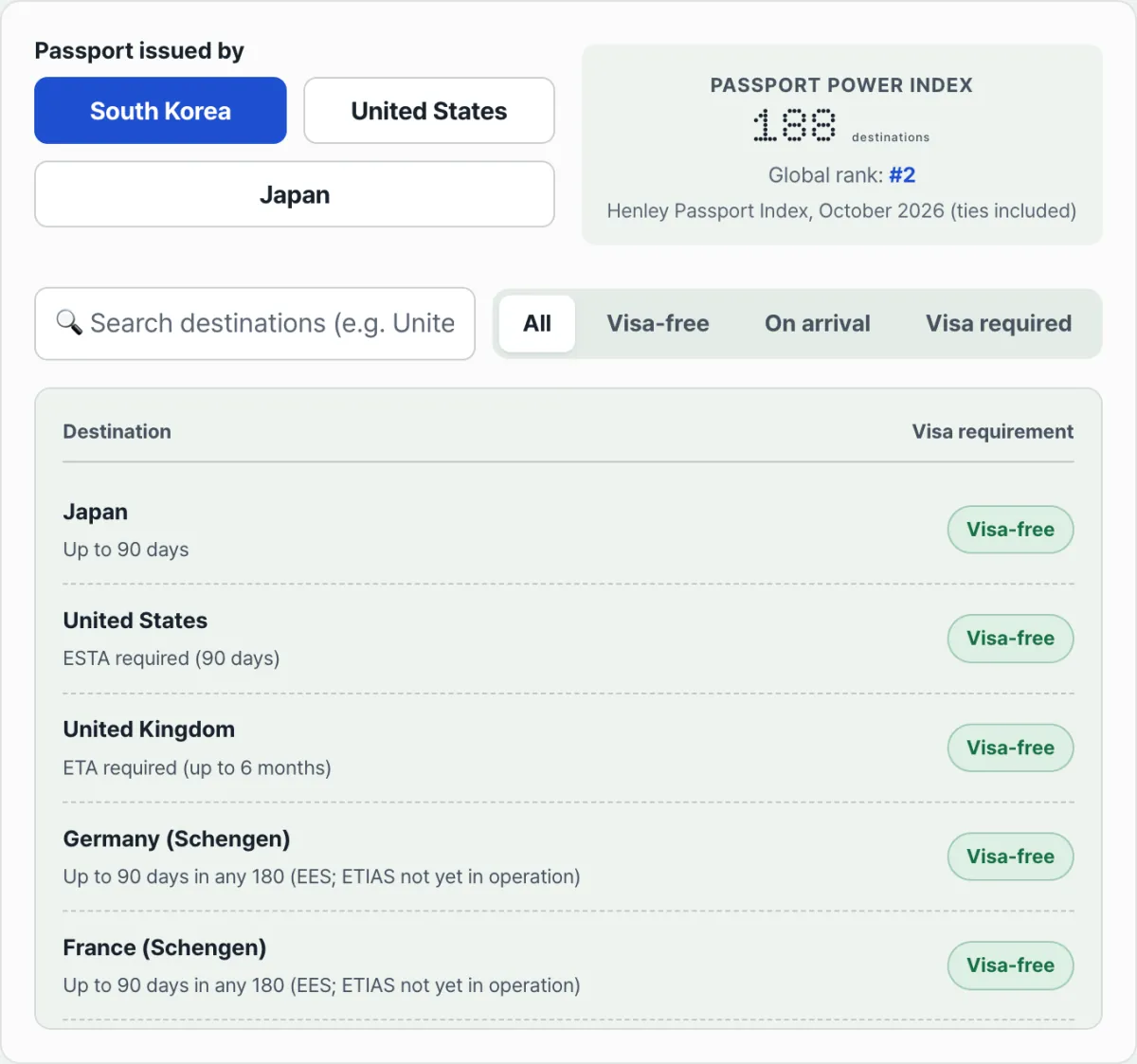
Here's how to use the Global Visa-Free Passport Checker:
- Set your passport country: South Korea is the default. Select the US or Japan if you need to.
- Search for your destination: Type the name of the country you plan to visit (for example, Japan, Vietnam, or Thailand) into the search box. You can also narrow the list with the visa-free, visa on arrival, and visa required filters.
- The search results show each country's visa-free, visa on arrival, or visa required status, along with the permitted length of stay or whether an electronic travel authorization is required.
- The conditions shown are for reference only. The tool doesn't cover items such as remaining passport validity or safety information. Check those again before departure with the destination country's embassy or the South Korean Ministry of Foreign Affairs overseas travel safety notices.
Summary
Passport power shows how many destinations you can visit with that passport. When you choose a destination, check its visa requirements and also your passport's remaining validity (at least 6 months is usually recommended). Use the Global Visa-Free Passport Checker to scan the conditions first. Before you leave, confirm the latest information with official guidance.
Free · Check visa-free, visa on arrival, and electronic travel authorization rules by country for South Korea, US, and Japan passports
Frequently Asked Questions
My passport has 3 months of validity left. Can I still be denied entry to a visa-free country?
Yes. Most countries require your passport to have at least 6 months of validity remaining on your entry date. Even if a country is visa-free for you, you can be denied boarding or entry if you don't meet this requirement.
- Why the 6-month rule exists: Immigration authorities in many countries require a buffer in case your stay gets extended by an accident or natural disaster, or in case you need to have your passport reissued.
- How to check: Look up your passport's expiration date before you travel. If it has less than 6 months of validity left on your entry date, it's safer to renew your passport before you leave.
Can a US ESTA application be denied?
Yes. Even if you're a citizen of a Visa Waiver Program (VWP) country, you can be required to get a regular visa instead of an online ESTA if you've traveled to certain countries.
- Common reasons for denial: If you've visited certain travel-restricted countries designated by the US government, your ESTA application is automatically denied, and you must go through an interview for a regular visitor visa (B1/B2). The list of countries and the exceptions change often, so check the latest criteria on the official ESTA website of the US Department of Homeland Security.
- What to do if you're denied: Instead of reapplying online, you need to apply for a regular tourist or business visa at the US Embassy in Seoul and go through the interview process before you can enter.
How long is China visa-free?
China has announced a temporary 30-day visa-free policy for South Korean and Japanese passports through December 31, 2026. As of November 17, 2026, no extension for 2027 has been announced. If you're traveling in 2027, check the Chinese Embassy's notices again.
Do I need an ETIAS to travel to Europe (Schengen)?
As of November 2026, ETIAS hasn't taken effect, and no start date has been set. Instead, the Entry/Exit System (EES), which registers biometric data, was introduced in October 2025. The visa-free stay of 90 days within any 180-day period hasn't changed, but your fingerprints and face are registered at the border check.
How many days can I stay in Thailand without a visa?
A South Korean passport gets 90 days under the visa exemption agreement between the two countries. Thailand cut its general visa-free period from 60 days to 30 days starting September 15, 2026. That change applies to passports such as Japan's and the US's. It doesn't apply to South Korea, which has an agreement.
Sources (checked 2026-11-17)
- Henley Passport Index, October 2026 edition: https://cdn.henleyglobal.com/storage/app/media/HPI/Henley%20Passport%20Index%202026%20October%20Global%20Ranking.pdf
- South Korean Ministry of Foreign Affairs overseas travel safety, visa exemption status by country (as of November 2026): https://www.0404.go.kr/bbs/contsPst/MST0000000000113/13/detail
- UK ETA (gov.uk): https://www.gov.uk/eta
- China Ministry of Foreign Affairs visa-free extension notice (2025-11-03): https://www.mfa.gov.cn/wjbzwfwpt/kzx/tzgg/202511/t20251103_11746081.html
- EU ETIAS information: https://home-affairs.ec.europa.eu/policies/schengen/smart-borders/european-travel-information-authorisation-system_en
The visa-free and visa on arrival conditions shown are for reference only, and each country's entry requirements can change at any time. Before you leave, check the latest notices on the South Korean Ministry of Foreign Affairs overseas travel safety website or from the destination country's embassy.
This article was adapted from our Korean original. Read the Korean original