
Feet/Inches to cm and lbs to kg Conversion Formulas & BMI
Contents
Whether you're watching a British or American show on Netflix, checking a Premier League footballer's physical profile card, or buying workout clothes from a US site like Amazon, there's one thing that keeps tripping you up: body measurements written in Imperial units.
"Someone's 5 foot 9 — how many centimeters is that?" "The barbell, or my own body weight, is 150 pounds (lbs) — what's the multiplication to get kilograms (kg)?" Here's a friendly, clear walkthrough of the exact math for converting height and weight between Imperial and metric units, plus the simple logic behind a BMI reading.
Summary ① Height conversion (feet/inches ↔ cm): Apply the physical constants — 1 foot (ft) is
30.48 cmand 1 inch (in) is2.54 cm— and add them together. ② Weight conversion (pounds ↔ kg): 1 pound (lb) equals about0.4536 kg, and going the other way, 1 kilogram works out to about2.2046 lb. ③ Stone: In Commonwealth countries, people still like to use 1 stone (st) =14 pounds (about 6.35 kg)for body weight, so be careful when comparing. ④ With an Imperial ↔ metric converter, you type any height in feet/inches or any weight in pounds/stones and instantly get the metric equivalent plus a simple BMI reading, calculated automatically in one second.
1. The Math: Converting Height and Weight Between Imperial and Metric
Anglo-American body measurements come down to physical constants — the inch-to-centimeter ratio and the pound-to-kilogram factor — which you can derive and plug into a simple pair of linear equations.
Height: Feet/Inches (ft/in) ➔ Centimeters (cm)
- Conversion constants: 1 inch (in) = 2.54 cm (international legal definition), 1 foot (ft) = 12 inches (30.48 cm)
- Height formula:
height (cm) = feet (ft) × 30.48 + inches (in) × 2.54 - Worked example (height of a foreign actor listed as 6 ft 1 in):
- Plug into the formula:
(6 × 30.48) + (1 × 2.54) - Add it up:
182.88 + 2.54 = 185.42 cm - Reading the result: a player listed at "6 foot 1" on a US profile is actually about 185.4 cm in metric terms.
- Plug into the formula:
Weight: Pounds (lbs) ↔ Kilograms (kg)
- Conversion constant: 1 pound (lb) = 0.45359237 kg (international avoirdupois pound)
- Both directions:
weight (kg) = pounds (lb) × 0.45359↔weight (lb) = weight (kg) ÷ 0.45359 - Worked example (a gym dumbbell stamped 45 lb):
- Plug into the formula:
45 × 0.45359 ≈ 20.41 kg - Reading the result: lifting a 45-pound plate at a gym abroad gives you almost the same resistance as a 20 kg barbell back home.
- Plug into the formula:
2. The Simple BMI and Healthy Weight Math
Once you've converted Imperial measurements into centimeters and kilograms, you can immediately plug them into the body mass index (BMI) formula, which tells you whether your weight is in a physiologically healthy range.
- BMI formula (applied after converting to metric):
BMI = weight (kg) ÷ height (m)² - Cutoffs:
- Below 18.5: underweight
- 18.5 – 24.9: normal weight
- 25.0 – 29.9: overweight
- 30.0 and above: obese
How to Use the Imperial ↔ Metric Converter
If multiplying feet by 12 and punching 0.4536 into your phone calculator to work out pounds down to the decimal sounds like a hassle, try a dedicated converter.
Free · converts ft/in/lbs ↔ cm/kg both ways at once, with automatic BMI and body weight category analysis
The tool is set up to be clear and straightforward.
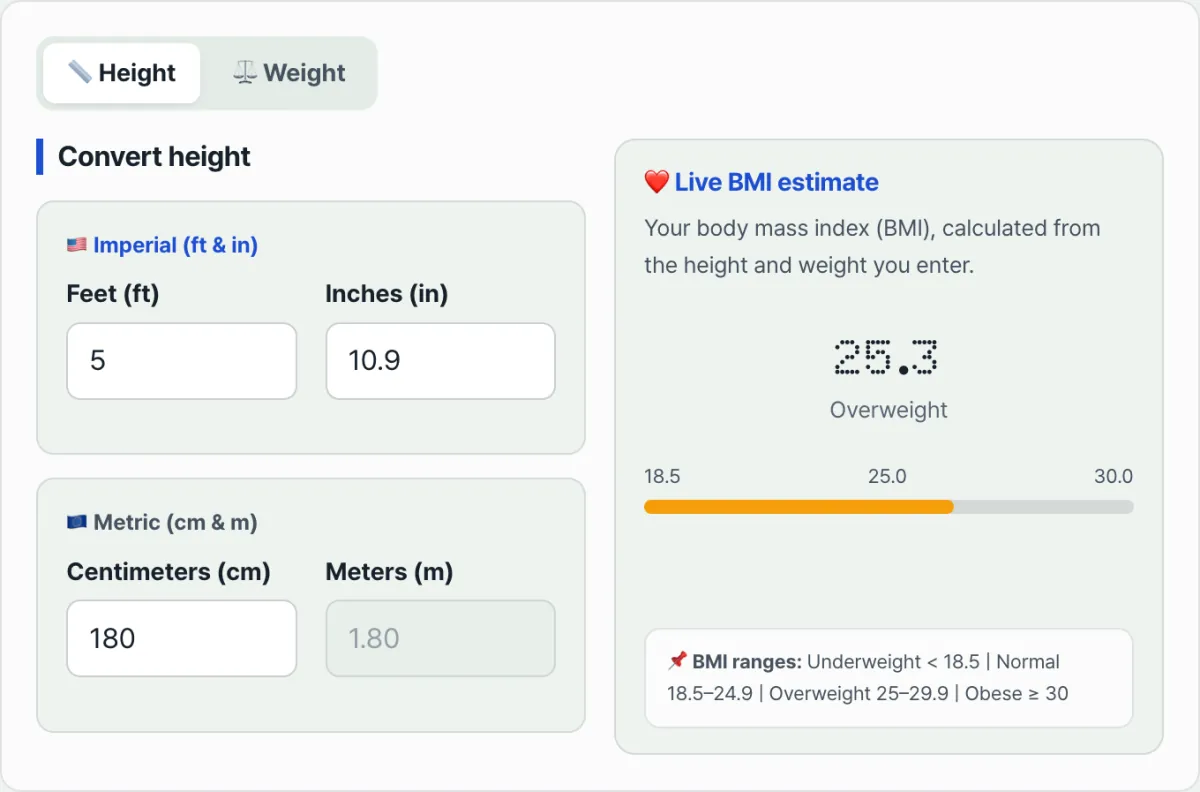
- Pick a direction: choose the tab for entering feet/inches and pounds, or the one for entering cm and kg.
- Enter your measurements: type your height (ft, in) and weight (lbs) into those fields.
- As soon as you type, the dashboard report shows your height in cm and weight in kg, calculated live and output accurately.
- Plus, a card at the bottom shows your BMI and weight category on a gauge marked at the 18.5, 25.0, and 30.0 lines, so you can use it when setting diet goals or comparing clothing sizes from overseas.
The Bottom Line
Imperial units are the product of a long history of weights and measures and of habit, and they can feel like a wall if you were raised on metric. With the Height & Weight Imperial ↔ Metric Converter, you can get a precise conversion right away — no separate calculation — every time you shop overseas or check a global sports profile.
Free · converts ft/in/lbs ↔ cm/kg both ways at once, with automatic BMI and body weight category analysis
Frequently Asked Questions
Why does the US still stubbornly stick with feet and pounds in daily life, when the world's scientific community and international measurement standards have consolidated around the metric system?
Because of the enormous penalty of replacing everyday infrastructure and the path dependency of public sentiment.
- Infrastructure replacement cost: Converting every highway mile marker, speed limit sign, construction spec (feet/inches), factory manufacturing line, and aircraft instrument panel across the US to metric would require astronomical federal tax spending.
- Public resistance: In 1975 the federal government passed the Metric Conversion Act to push a nationwide switch to metric, but ran into public backlash — "throwing away traditional American units damages our national identity" — and confusion in education, so it retreated to a voluntary, non-mandatory rule. U.S. Customary Units have stayed entrenched to this day.
What is the "stone" unit I keep hearing when UK or Australian fitness YouTubers talk about their weight, and how do I enter it in the calculator?
The stone (symbol st) is a unit used mainly in the UK and Ireland for measuring body weight, and exactly 14 pounds (about 6.35 kg) makes 1 stone.
- Stone conversion rules: Say an Australian fitness athlete lists their weight as
12 stone 7 lbs:- Total pounds:
(12 st × 14 lbs) + 7 lbs = 168 + 7 = 175 lbs - Metric kg:
175 lbs × 0.45359 ≈ 79.38 kg
- Total pounds:
- Convenience: The converter has separate fields where you can enter stones and pounds at the same time, so you can enter them live and get your final weight in kilograms exactly, with no 14-times mental math.
This article was adapted from our Korean original. Read the Korean original