
Houseplant Watering Schedule: Formula and Season Chart
Contents
The most common reason beginners kill their houseplants isn't underwatering. It's overwatering — watering too often and rotting the roots.
Every plant comes from a different native climate, and every spot in your home dries out at a different rate. A fixed rule like "once every 7 days" won't fit most plants. Here's how to calculate your next watering date using plant type, season, and indoor conditions together.
1. How Watering Intervals Are Calculated: Why Every Plant Is Different
Everything starts with a season-by-season base interval that varies by plant. Plants with big leaves that burn through water need more frequent watering in summer, while drought-tolerant succulents need less frequent watering in the rainy season to avoid sitting wet. Because each plant responds differently to the seasons, the base days per season are set differently too.
- Monstera: spring and fall 7 days, summer 5 days, winter 12 days
- Succulents: spring and fall 20 days, summer and winter 30 days (longer, not shorter, to prevent overwatering in the rainy season and the dry winter)
Then you adjust with two indoor conditions.
- Sunlight: strong sun (by a window) moves it up one day (−1 day); shade (deep inside the room) pushes it back two days (+2 days).
- Airflow: good ventilation moves it up one day (−1 day); a closed-off space pushes it back three days (+3 days).
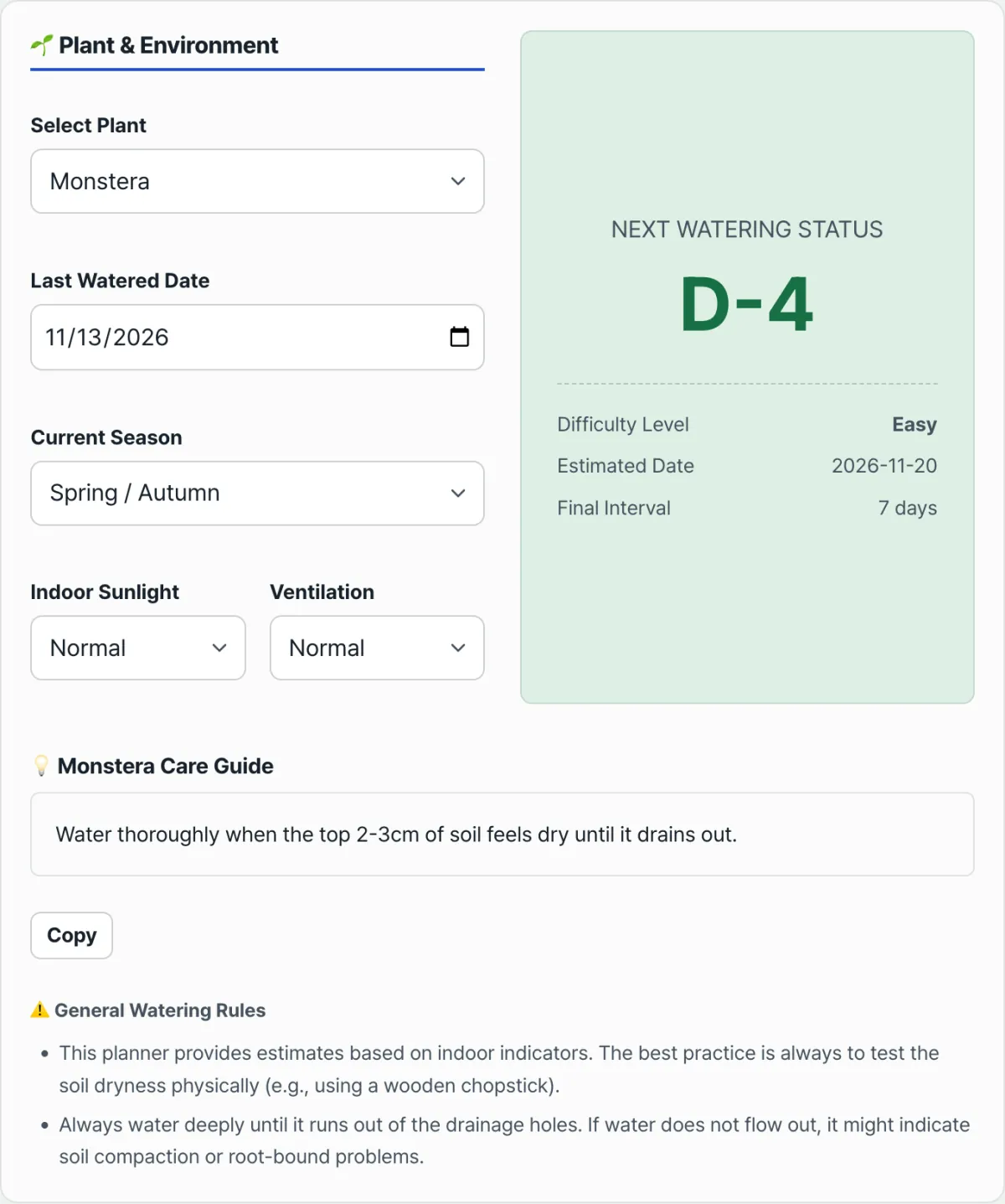
The final interval is "base days for plant and season + sunlight adjustment + airflow adjustment," and it never drops below 1 day. For example, a Monstera in spring in a living room with average sunlight and average airflow gets an adjustment of 0, so the interval stays at the base 7 days.
2. How to Judge Soil Moisture by Plant Type
Separate from the math, checking the soil yourself and adjusting the D-Day is the surest way to prevent overwatering.
- Water when the top layer is dry: For thin-leaved plants with big leaves like Monstera, the standard is to water when the top 2–3 cm of soil feels crumbly and dry. For pothos, the signal is the moment the leaves start to droop slightly as the soil dries.
- Water when the soil is dry all the way down: For plants from dry climates — succulents, snake plants, Stuckyi — push a wooden chopstick or moisture meter deep into the pot. Only count it as a watering D-Day when the soil at the bottom is thoroughly dry.
Note When you do water, soak it until water runs out the drainage hole. If water doesn't drain out well, that's a sign the water is only finding a path down one side of the pot, or that the drainage layer has a problem. In that case, check your drainage first.
If doing the math yourself sounds like a hassle, just pick your plant type, the last day you watered, and your indoor conditions to see your next watering date right away.
Pick your plant type, season, and indoor conditions (light and airflow) to see the next ideal watering date.
3. Telling Overwatering and Underwatering Apart
- Overwatering symptoms: Leaves turn yellow starting at the tips, then go limp and drop off. If the pot smells musty or moldy, or the roots have turned black, root rot has already started.
- Underwatering symptoms: Leaf edges turn brown and crispy. The good news is that leaves often perk back up within a few hours of watering, so it's easier to reverse than overwatering.
Summary
- Your watering interval is set by four things: plant type, season, sunlight, and airflow.
- More reliable than any number is sticking your finger (or a chopstick) into the soil. Big, thin leaves? Check the top layer. Succulents and dry-climate plants? Wait until the soil is dry all the way down.
- Yellow, drooping leaves mean overwatering. Brown, crispy leaves mean underwatering. Identify the cause from the symptoms first, then adjust your schedule — that's the order that saves the roots.
Just pick your plant type, the last day you watered, and the season, sunlight, and airflow, and it calculates your next watering date as a D-Day.
Pick your plant type, season, and indoor conditions (light and airflow) to see the next ideal watering date.
Frequently Asked Questions
Should I water on the exact D-Day the planner gives me, no matter what?
No. The whole point of houseplant watering is that it flexes with conditions. Treat the D-Day as a reminder to check the soil. Before you actually water, poke a chopstick into the pot and confirm the soil is dry enough — that's the best way to prevent overwatering.
What information do I need to enter to use the planner?
Pick the type of houseplant you're growing (Monstera, succulent, Stuckyi, and so on), the last date you watered it, the current season (spring/fall, summer, or winter), plus the sunlight (strong/average/shade) and airflow where the plant sits. Those five values go into the final watering interval and your next watering D-Day.
Do drought-tolerant plants like succulents get calculated the same way?
Yes, but the base seasonal interval itself is set differently for each plant. Big-leaved plants that use a lot of water, like Monstera, are calculated to be watered more often in summer, while succulents are calculated to have a longer summer interval (30 days) than their spring/fall interval (20 days) to prevent overwatering in the rainy season. That said, even among dry-climate plants, Stuckyi and snake plants are preset to go the other way — from 30 days in spring/fall down to 25 days in summer — so "drought-tolerant plants get watered less in summer" doesn't apply to every species the same way.
This article was adapted from our Korean original. Read the Korean original