
UK, Germany, Canada Take-Home Pay: Tax Formulas Compared
Contents
Maybe you just got a job offer from a fintech startup in London. Maybe you're about to relocate to a global IT company in Berlin. Or maybe you're planning a new business after immigrating to Toronto. In each case, one number tends to catch people off guard: your take-home pay after tax.
These developed countries have much more granular income tax brackets than Korea. They also take a large share of your pay for social security contributions, which cover things like pensions and health insurance. Even with a high salary, what lands in your account can be close to half of the gross. This article explains how progressive income tax is calculated in the UK, Germany, and Ontario, Canada, and how each country's tax system works.
International Tax Disclaimer The income tax and social security deduction figures for the UK, Germany, and Canada (Ontario) in this article are simplified, for reference only, and based on the standard rates and basic deduction rules of each country's tax authority (HMRC, BZSt, CRA). Your actual withholding (Pay As You Earn) can differ significantly depending on your marital status, number of dependents, private pension contribution claims, non-resident tax status, and any changes to local rules in your province or state. Before you sign an employment contract or file a tax return, consult a local professional such as a chartered accountant (ACA), a Steuerberater, or a CPA.
Summary ① UK: After subtracting the
Personal Allowance(tax-free up to£12,570), the remaining income is taxed byBandat rates from 20% up to 45%. National Insurance (NI) is deducted separately. ② Germany: It uses one of the most refined nonlinear, continuous-function income tax systems in the world. Your tax class (Steuerklasse 1–6) depends on marital status, and church tax (Kirchensteuer) and the solidarity surcharge are added on top. ③ Canada, Ontario: Federal tax and Ontario provincial tax are calculated independently and then added together. Canada Pension Plan (CPP) and Employment Insurance (EI) are then withheld. ④ With the Global Income Tax Estimator, you enter your salary in pounds, euros, or Canadian dollars and instantly see a summary report of local income tax, social insurance deductions, and take-home pay.
1. Standard Income Tax Formulas for the Three Countries
Each country's personal income tax formula is shaped by its own deduction thresholds and, in some cases, a combined federal-plus-local tax structure.
UK: The HMRC Band Formula
- Basic tax-free allowance: Personal Allowance = £12,570 (reduced by £1 for every £2 of income above £100,000)
- Taxable income formula: Taxable income = Gross salary − Personal Allowance
- Income tax bands:
- Basic Rate (20%): £12,571 – £50,270
- Higher Rate (40%): £50,271 – £125,140
- Additional Rate (45%): Over £125,140
- National Insurance (NI, employee): For 2026/27, 8% on earnings between £12,570 and £50,270, and 2% above that
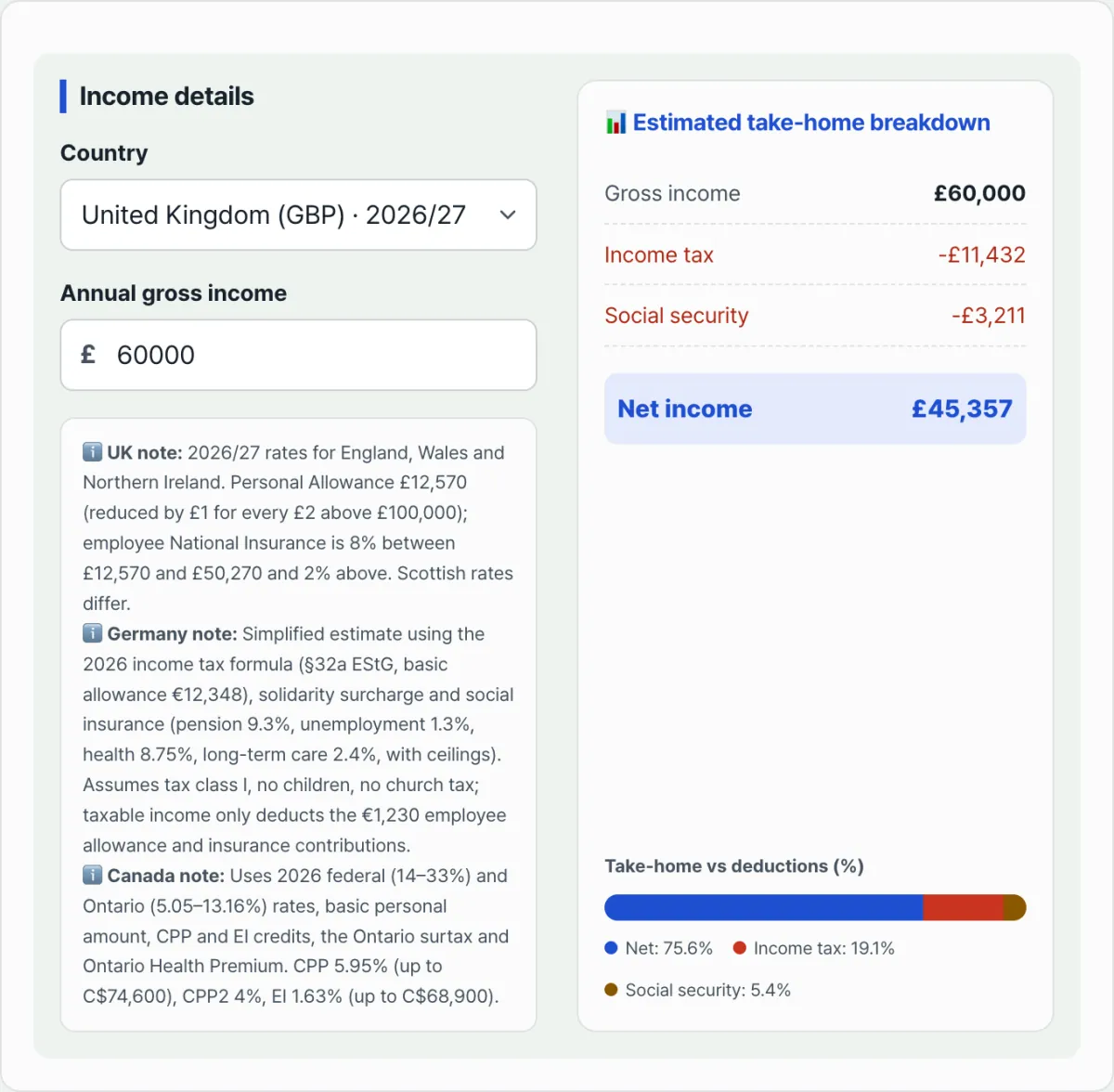
- Example (£60,000): Income tax £11,432 + NI £3,210.60 → take-home pay of about £45,357
Germany: The Steuerklasse (Tax Class) Formula
Germany sorts taxpayers into six Steuerklasse (tax classes) based on marital status and whether they have children. Each class applies different calculation weights.
- Steuerklasse 1: Single, divorced, or widowed (the standard single-person household, with the heaviest tax burden)
- Steuerklasse 3 & 5: Better when spouses' incomes differ a lot (the higher-earning spouse chooses class 3 to reduce withholding)
- Steuerklasse 4: Applies when spouses earn about the same
- Surcharges: If you are registered with a church, 8–9% of your income tax is added as church tax (Kirchensteuer). If your income tax exceeds €20,350 (2026, single), a 5.5% solidarity surcharge (Solidaritätszuschlag) is added on that income tax (with a phase-in relief just above the threshold).
- 2026 income tax formula: Under Section 32a of the Income Tax Act (EStG), taxable income up to €12,348 is taxed at 0. Above that, the rate follows a function that rises continuously from 14% to 42%, and it is 45% from €277,826.
- 2026 social insurance (employee share): Pension 9.3% and unemployment 1.3% (up to €101,400 per year); health 7.3% plus an average additional contribution of 1.45%, and long-term care 1.8% (2.4% if you have no children) (up to €69,750 per year)
Ontario, Canada: The Dual Progressive Tax Formula
In Canada, both the federal government and the provincial government tax your total income. That makes it a multi-layered structure.
- Final income tax formula: Total income tax = Federal progressive income tax + Ontario progressive income tax
- 2026 federal rates: 14% up to C$58,523, 20.5% up to C$117,045, 26% up to C$181,440, 29% up to C$258,482, and 33% above that (basic personal amount C$16,452)
- 2026 Ontario rates: Five brackets, from 5.05% up to C$53,891 to 13.16% above C$220,000. The provincial basic personal amount is C$12,989. The Ontario surtax and the Ontario Health Premium (OHP) are added on top.
- Social security deductions: CPP at 5.95% (on earnings above C$3,500, up to C$74,600), CPP2 at 4% (C$74,600 to C$85,000), and EI at 1.63% (up to C$68,900) come out of your pay.
What Changes in 2027?
Some things are already set and some aren't, and it varies by country.
| Country | 2027 |
|---|---|
| UK | For 2027/28, the personal allowance, tax rates, and NI stay the same. The threshold freeze runs until April 2031. |
| Canada | Announced: CPP employee rate 5.75%, ceiling C$76,700, EI 1.64% (tax brackets not yet announced) |
| Germany | The 2027 income tax reform proposal is still under parliamentary review and not final |
For that reason, the estimator calculates using 2026 values only (2026/27 for the UK).
How to Use the Global Income Tax Estimator
Working through each country's currency, federal and provincial rate tables, and tax-free threshold formulas on a scientific calculator, down to the decimal, is tedious. Try the Global Income Tax Estimator instead.
Free · Supports 3 currencies · Real-time income tax and social security deductions with a net pay summary report
The tool is simple and has no extras.
- Select a country: Choose UK (GBP), Germany (EUR), or Canada, Ontario (CAD) from the dropdown.
- Enter your income: Type in your annual gross income in that country's currency.
- As soon as you enter it, the report area shows your income tax withheld, social security contributions, and your annual take-home pay, along with the share each item takes.
Wrapping Up
The "gross salary" on an overseas job contract is the nominal amount before income tax and social security contributions come out. What you actually take home differs depending on each country's tax structure. The Global Income Tax Estimator is a reference tool that gives you a rough sense of these differences by country and currency. Your actual withholding may vary depending on your individual tax status and changes to each country's rules.
Free · Supports 3 currencies · Real-time income tax and social security deductions with a net pay summary report
Frequently Asked Questions
Is there an official way to avoid paying church tax (Kirchensteuer) when I work in Germany?
Yes. You have to formally file a church exit (Kirchenaustritt) with the responsible authority so your tax data (ELStAM) is updated and church tax is no longer withheld.
- How church tax works in Germany: If you are registered for tax purposes as a member of a church, such as Protestant or Catholic, an extra 8%–9% of your income tax is collected as church tax. That can take a real bite out of your budget.
- How to file the exit: If you have no religious affiliation, or you want to lower your tax burden, leave the religion field blank when you register your residence (Anmeldung). Otherwise, visit the local registry office (Bürgeramt) or the local court (Amtsgericht), pay the small fee, and get a church exit certificate. Once that is done, the church tax flag is deactivated in the withholding system.
If I negotiate a salary in Ontario, does my take-home pay change a lot if I move to another province, such as Alberta or Quebec?
Yes. Canadian provinces each have their own income tax rates and basic exemption thresholds, so the same salary can leave you with a different take-home amount.
- Differences between provinces: Alberta has its own provincial rate, which starts in the 10% range as a single rate on top of federal tax. Quebec has higher provincial income tax brackets and runs its own social insurance programs. The Global Income Tax Estimator calculates for Ontario only. If you are considering a move or a negotiation in another province, treat the results as a rough reference and check that province's tax rate table separately.
What does this calculator assume?
For the UK, it uses the rates for England, Wales, and Northern Ireland (Scotland is not included). For Germany, it assumes tax class I, no children, no church tax, and statutory health insurance. For Canada, it assumes an employee living in Ontario. It does not include extra pension contributions or dependent deductions.
How much is my take-home pay on a £60,000 salary in the UK?
For the 2026/27 tax year, subtract £11,432 in income tax and £3,210.60 in National Insurance. That leaves about £45,357. Student loan repayments or workplace pension contributions reduce it further.
Does everyone in Germany pay the solidarity surcharge?
No. For 2026, a single person starts paying the solidarity surcharge only when their income tax exceeds €20,350. Right after that point, the surcharge is eased so it does not exceed 11.9% of the amount above the threshold. Most single employees earning around €60,000 do not pay it.
Sources (checked 2026-11-17)
- UK income tax rates and personal allowance (HMRC): https://www.gov.uk/government/publications/rates-and-allowances-income-tax/income-tax-rates-and-allowances-current-and-past
- UK 2026/27 National Insurance thresholds (HMRC): https://www.gov.uk/guidance/rates-and-thresholds-for-employers-2026-to-2027
- German Income Tax Act, Section 32a (2026): https://www.gesetze-im-internet.de/estg/__32a.html
- German 2026 social insurance contribution ceilings (Federal Government): https://www.bundesregierung.de/breg-de/aktuelles/beitragsgemessungsgrenzen-2386514
- Canada CRA T4127 (2026): https://www.canada.ca/en/revenue-agency/services/forms-publications/payroll/t4127-payroll-deductions-formulas/t4127-jan/t4127-jan-payroll-deductions-formulas-computer-programs.html
- Canada CPP rates and maximums (CRA): https://www.canada.ca/en/revenue-agency/services/tax/businesses/topics/payroll/payroll-deductions-contributions/canada-pension-plan-cpp/cpp-contribution-rates-maximums-exemptions.html
This article is a simplified summary based on the income tax systems published by HM Revenue & Customs (HMRC), Germany's tax authorities, and the Canada Revenue Agency (CRA). It cannot be used as a basis for filing an individual tax return.
This article was adapted from our Korean original. Read the Korean original