
Holiday Countdown: Observed Holiday Rules and D-Day Formula
Contents
1. The D-Day Real-Time Countdown Formula
In programming and dashboard widgets, the core method for calculating the time left until midnight (00:00:00) on a given holiday is a millisecond difference based on Coordinated Universal Time (UTC).
The basic equation is the millisecond difference (ΔT): the target time minus the current time. You then divide and take remainders in the order below to convert it into days, hours, minutes, seconds.
ΔT = target time (ms) − current time (ms)

Days left    = ΔT ÷ (1000 × 60 × 60 × 24)                      → round down
Hours left   = (remainder of ΔT ÷ one day) ÷ (1000 × 60 × 60)   → round down
Minutes left = (remainder of ΔT ÷ one hour) ÷ (1000 × 60)       → round down
Seconds left = (remainder of ΔT ÷ one minute) ÷ 1000            → round down
If you repeat these division and remainder steps and round down each result, the browser can redraw a precise counter every second without straining memory.
2. Unique Holiday Rules by Country
Each country's legal and cultural authorities set holidays by their own rules. These rules reflect history and local labor practices.
United States
- Uniform Monday Holiday Act: Holidays scattered through the workweek hurt productivity. To avoid that, major holidays are fixed by law as the Nth Monday of a month instead of a specific date. This guarantees a three-day weekend (Saturday, Sunday, Monday).
- Examples: Memorial Day (last Monday in May), Labor Day (first Monday in September), Thanksgiving (fourth Thursday in November)
Japan
- Happy Monday system: Modeled on the US holiday law, it moved Coming of Age Day (second Monday in January), Sports Day, and others to Mondays.
- Citizens' Holiday (国民の休日): Under Japan's holiday law, a single weekday sandwiched between two public holidays automatically becomes a legal holiday. (Example: May 4, Greenery Day, falls between Constitution Memorial Day on May 3 and Children's Day on May 5.)
Germany
- Holidays set by each federal state: Germany's 16 federal states (Bundesländer) declare holidays on their own. Predominantly Catholic Bavaria in the south and predominantly Protestant Hamburg in the north can differ by 4 to 5 legal holidays or more.
How to Use the Global Holiday Countdown Timer
Looking up each country's alternate holiday rules, plus solar and lunar floating holidays, and calculating D-Day by hand takes time. Try a dedicated countdown tool instead.
Free · Real-time D-Day timer for 4 countries · Alternate day-off info and a yearly holiday calendar summary by country
Using the tool is simple.
- Select a target country: Use the toggle tabs to pick the country you want to plan around, such as the US, South Korea, Japan, or Germany.
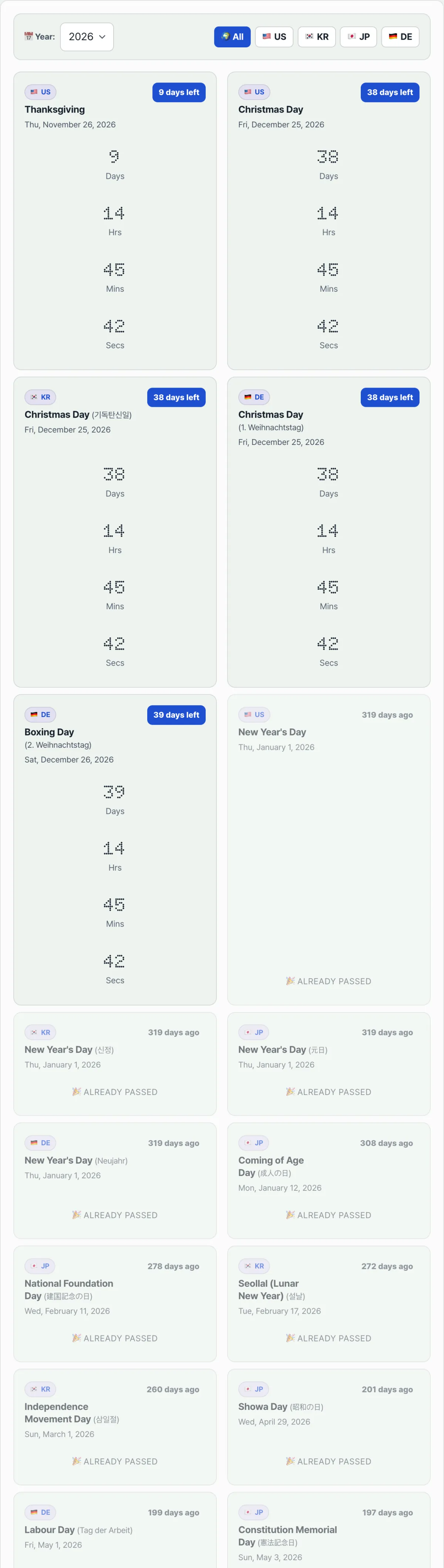
- As soon as you choose, the dashboard shows the nearest legal holidays for that country, along with a live countdown board that ticks down to the second.
- Each card shows the holiday's official local name (with the local language alongside), the date (including the day of the week), and whether the holiday has already passed. You can compare holiday schedules across countries on one screen and plan remote collaboration around them.
Summary
Checking the holidays of your overseas partners ahead of time can help you avoid communication delays and scheduling conflicts. The Global Holiday Countdown Timer lets you see holiday information and alternate day-off rules for each country on one screen. For actual business or investment decisions, rely on the official announcements at the time, since your situation may differ.
Free · Real-time D-Day timer for 4 countries · Alternate day-off info and a yearly holiday calendar summary by country
Frequently Asked Questions
Does South Korea's alternate holiday rule apply to every public holiday?
No. Some holidays that aren't national commemoration days, such as New Year's Day (January 1) and Memorial Day (June 6), are currently excluded from alternate holidays.
- Scope of the alternate holiday rule: Under South Korea's Regulations on Public Holidays of Government Offices, the Lunar New Year and Chuseok holidays, Children's Day, Independence Movement Day (March 1), Liberation Day, National Foundation Day, Hangul Day, Buddha's Birthday, and Christmas get an alternate holiday if they overlap with a weekend. The alternate day is the next non-holiday day, usually a Monday.
- Exclusions: New Year's Day on January 1 and Memorial Day, which honors the nation's fallen, are not among the four national commemoration days (March 1, Liberation Day, National Foundation Day, and Hangul Day). They are classed as simple commemorative holidays. If they fall on a weekend, no alternate holiday is created and the day is simply lost, so check carefully when managing HR schedules.
Are US stock market (NYSE/NASDAQ) closures the same dates as federal holidays?
They are mostly similar, but some days differ. Good Friday, the Friday before Easter, is not a federal holiday, yet the stock market closes.
- Good Friday closure: Good Friday is not a US federal legal holiday. Even so, the New York Stock Exchange and the bond market follow historical custom and close all day every year.
- Observed-day matching: When a federal holiday falls on a Saturday, markets close the day before, on Friday. When it falls on a Sunday, they close the next day, on Monday. If you plan US stock trading around these dates, check the SIFMA schedule as well as the federal holiday calendar.
This guide was reviewed against South Korea's Ministry of Personnel Management rules on public holidays at government offices and the US Office of Personnel Management (OPM) federal holiday guidelines.
This article was adapted from our Korean original. Read the Korean original