
How to Calculate Real MPG With the Full-to-Full Method
Contents
1. Precision Real-World Fuel Economy: The Full-to-Full Formula
The most mathematically precise way to measure your actual fuel economy is based on the Full-to-Full formula, which fixes the fuel tank's total volume as a constant between fill-ups.
- Real-world fuel economy equation:
Measured fuel economy (km/L) = (final odometer reading − initial odometer reading) (km) ÷ fuel added to fill the tank again (L)
Step-by-Step Measurement Protocol
- Step 1 (Fill up): Pull into a gas station and fill the tank until the nozzle clicks off, then record the odometer reading or reset Trip Meter A to 0.0 km.
- Step 2 (Drive): Go about your normal driving routine and cover at least 300–500 km (or more).
- Step 3 (Refuel): Stop at a gas station again, fill the tank until the nozzle clicks off just like in Step 1, then note the actual fuel added (L) and the distance driven (km) from the pump.
- Step 4 (Plug into the formula):
Measured fuel economy = 420 km (distance driven) ÷ 35 L (fuel added) = 12.0 km/L
2. Main Factors That Make Real-World Fuel Economy Differ from the Official Rating
These are the main physical variables that push your car's real-world fuel economy below what the trip computer or the official rating says.
- Low tire pressure: When pressure drops below the recommended level, friction with the road surface (rolling resistance) increases, so the engine has to work harder and fuel economy suffers. The exact drop varies by model and tire size; the pressure listed in the manufacturer's manual is your reference value.
- Lots of hard acceleration and braking: Pressing the accelerator deep makes the engine control unit (ECU) richen the air-fuel mixture and inject more fuel, and unnecessary hard braking dumps momentum you've already paid for as heat.
- Weight carried in the vehicle: Driving with camping gear or clutter in the trunk adds weight, which tends to lower fuel efficiency.
How to Use the Gas Mileage Calculator
If you're tired of punching division into your phone calculator every time you look at a fuel receipt, try a dedicated gas mileage calculator.
Free · No sign-up · Enter your distance driven and actual fuel used to get km/L, MPG, and L/100km instantly
Using the tool is straightforward and free of clutter.
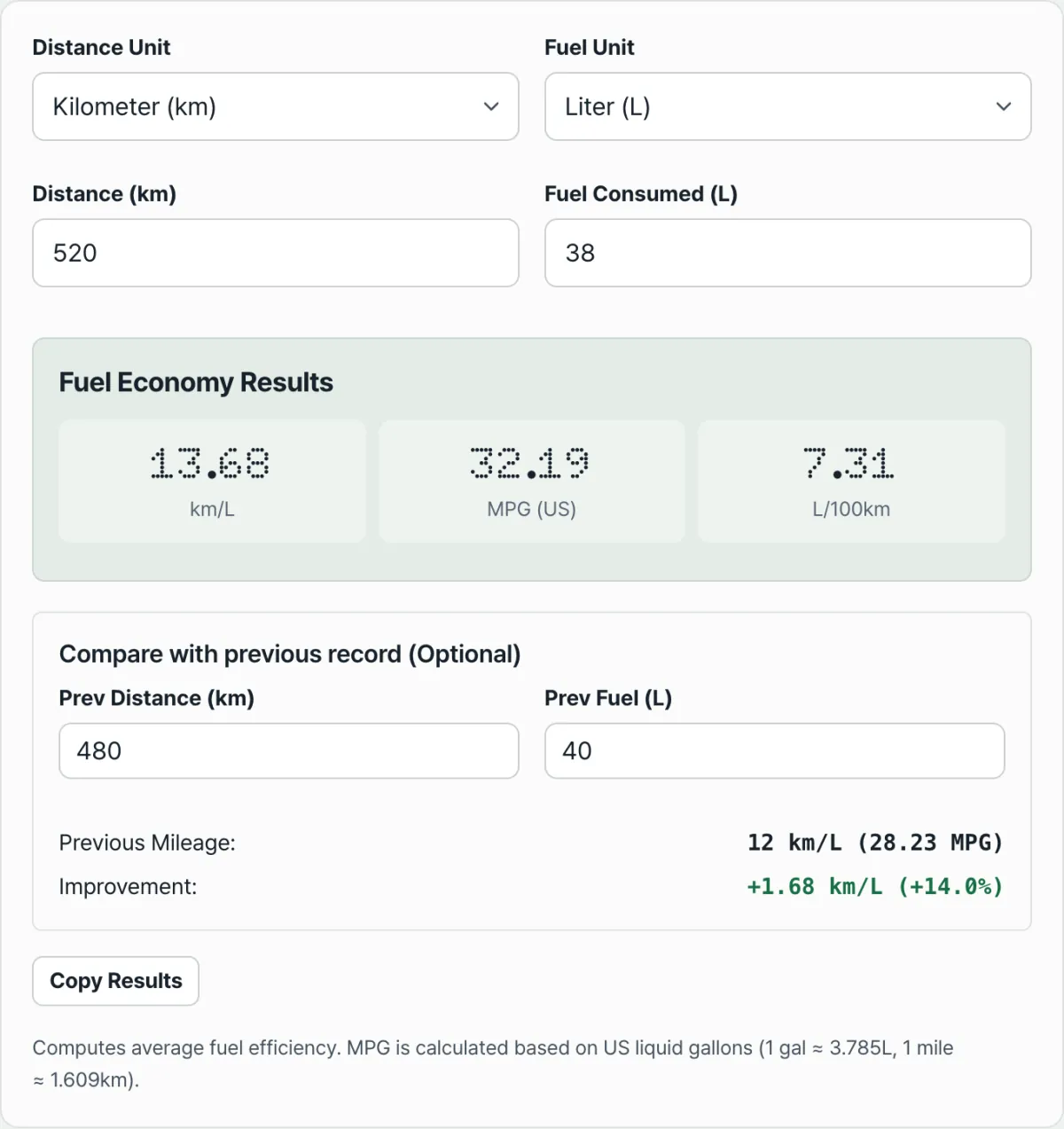
- Pick your units: Choose the distance unit (km/mile) and fuel unit (L/gal) that match your car's instrument panel.
- Enter your trip values: Put in the distance and actual fuel amount you got from the full-to-full method.
- As soon as you type, the tool shows your real fuel economy converted into all three units at once: km/L, MPG (US gallon), and L/100km.
- If you have an earlier measurement on hand, enter it in the comparison field to instantly see the difference (in km/L and %) from this tank, and use the copy button to save the result to a notes app or wherever you like.
Wrap-Up
Calculating and recording your car's real fuel economy on a regular basis helps you spot changes in gas prices, but also aging and early warning signs of engine trouble. Enter your distance and actual fuel amount into the Gas Mileage Calculator, and you can work out these real-world numbers and compare them with past records every time with ease.
Free · No sign-up · Enter your distance driven and actual fuel used to get km/L, MPG, and L/100km instantly
Frequently Asked Questions
Which hurts fuel economy more: running the AC in summer or the heater in winter?
Running the air conditioning in summer has a far bigger impact on fuel economy.
- Air conditioning (uses engine power directly): A car's AC runs a compressor that is mechanically driven by a belt off the engine crankshaft. The moment you turn it on, the engine gives up extra power to spin the compressor, so fuel economy drops right away.
- Heater (recovers waste heat): A winter heater, by contrast, blows hot waste heat from the coolant that has circulated around the cylinders into the cabin blower fan. Apart from the small electrical draw of the blower motor, it doesn't tap the engine's main power, so it carries almost no fuel economy penalty compared with the AC.
Why is the fuel economy I calculate at the pump always lower than what the trip computer says?
It comes down to fuel vapor that evaporates and is lost on the way into the tank, plus accumulated measurement error in the injectors' fuel delivery.
- Error in injector signal calculations: The trip computer's fuel economy is derived indirectly from the pulse-width signals the ECU sends when the injectors spray fuel, so it doesn't account for small errors from wear and viscosity resistance in the actual fuel flow path.
- Fuel volume and evaporation loss: A full-to-full calculation includes the small intake error from fuel evaporating into the air as it goes through the pump nozzle, along with variation in how far the tank can expand when filled to the top. That's why pump-based fuel economy usually comes out slightly more conservative and lower than what the car's own readout shows.
This article was adapted from our Korean original. Read the Korean original