
Ghost Leg Game: Origin and Why 1-to-1 Matching Always Works
Contents
1. The Hidden Topology and Group Theory Formula in Ghost Leg
It is easy to dismiss ghost leg as pure chance, but it can be explained by the geometric principles of symmetric group theory, a branch of abstract algebra.
Permutations and transpositions: If you number the vertical columns 1 through n, a single horizontal line is the smallest unit of operation that swaps the outcomes of two adjacent columns. In algebra, this is called a transposition. One horizontal line connecting two neighboring columns is one transposition.
The one-to-one mapping invariant: No matter how many horizontal lines the ladder has, the full path ultimately reduces to a finite number of transpositions composed in order. No matter how many transpositions you compose, the result always keeps the property of a bijection (a one-to-one correspondence).
This proves that the probability of two different participants reaching the same penalty slot at the same time is algebraically 0%, and that every participant ends at exactly one result with no one left out and no clustering.
2. Amidakuji in History: Why Is It Called the "Amida Buddha" Ladder?
The version we draw today has a parallel grid structure, but about 500 years ago, in the early Muromachi period, the original form was completely different.
- A radial, fan-shaped structure: The first game board had a concentric layout in which several lines spread outward from one central point in a fan shape, like the halo radiating from behind the head of an Amida Buddha statue.
- Rules of the game: Treats or penalty money were hidden at the center. Players placed their fingers on the ends of the outer lines and worked their way inward to split the pie fairly.
- Origin of the name Amidakuji: Because the shape resembled the light of Amida Buddha, who presides over the Pure Land, it was named Amidakuji (阿弥陀籤, Amida lots) in Japanese. Over time, it evolved into today's rectangular grid ladder, which is easier to store and draw.
How to Use the Ghost Leg Betting Game
If you want to settle a bet without the hassle of finding paper and a pen, drawing vertical lines, closing your eyes, and adding crooked horizontal lines, try the Ghost Leg Betting Game (2D Canvas).
Free · real-time 2D Canvas path tracking animation, plus copy-and-share text for group chats
The tool is designed to be clear and lively to use.
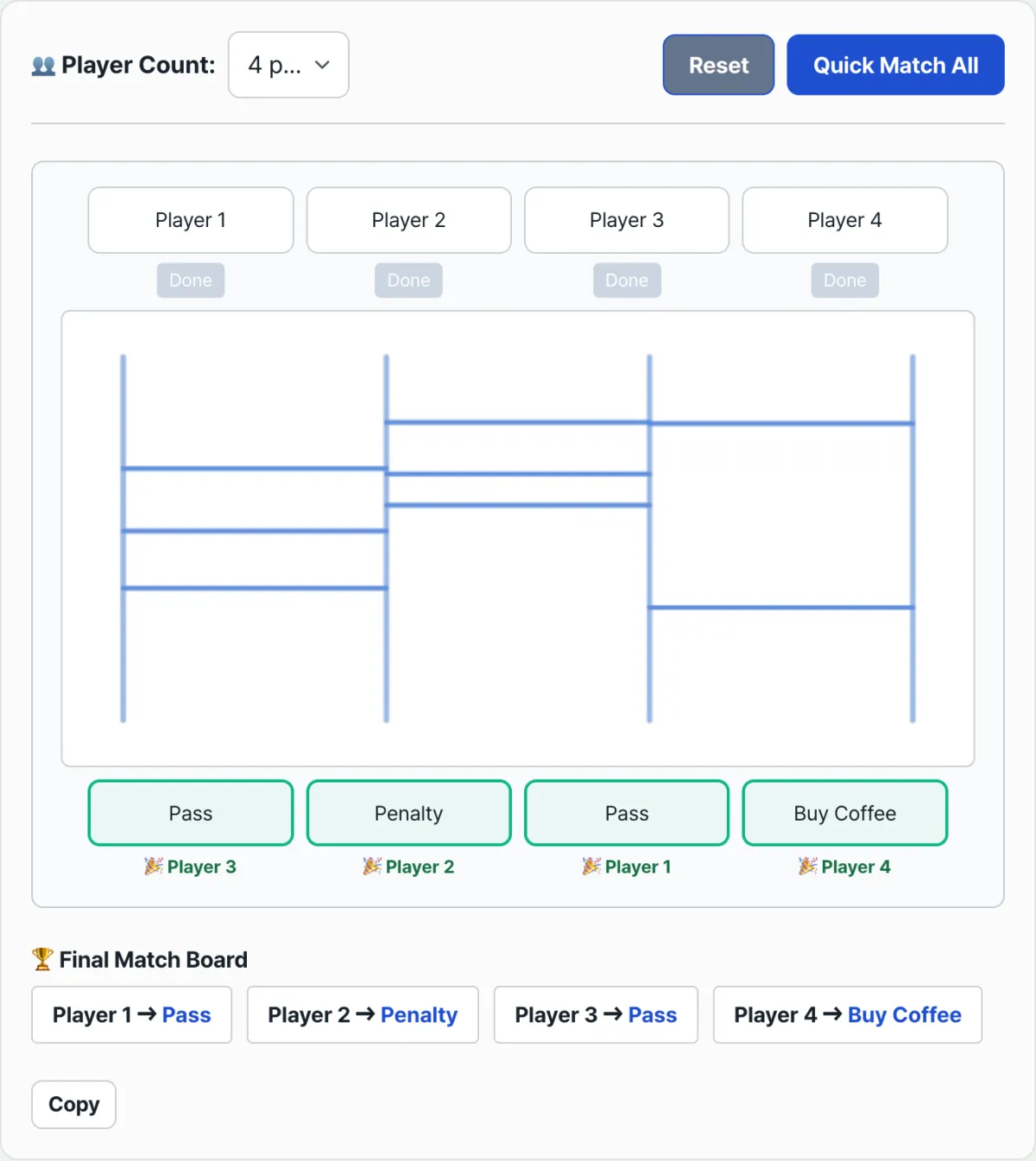
- Set the number of players: Use the dropdown to choose how many people are joining (2 to 8).
- Map names to penalties: Enter the members' names in the top input fields (for example, Alex and Jamie), and enter your own bet or penalty in each lower slot (for example, Pass, Buy coffee, Buy a meal).
- See the results: Press Go to watch a specific member's path travel down in a thick-line animation, or click Quick Match All to finish every match at once.
- As soon as the calculation finishes, the Canvas board renders attractive tracing lines and a summary match report at the bottom. You can copy the results to your clipboard in real time and send them to a group chat on KakaoTalk or another messenger to wrap up the bet cleanly.
Summary
Ghost leg may look like a simple game, but its origins reflect the Buddhist idea of fairness, and its internal mechanism follows the laws of permutation group theory in algebra.
With the Ghost Leg Betting Game (2D Canvas), you can see fair matching results right away when your group needs to choose a penalty or assign a chore.
Free · real-time 2D Canvas path tracking animation, plus copy-and-share text for group chats
Frequently Asked Questions
In ghost leg, does picking your vertical line first at the start change the mathematical odds of a particular outcome?
If the participants cannot know where the horizontal lines are in advance, the mathematical probability is exactly 1/n for everyone, no matter where they start.
- Symmetry of probability: When horizontal lines are generated at random, the probability distribution for a path that starts on any vertical line and ends at a particular destination is uniform and does not depend on the starting position.
- Safeguards against manipulation: However, if there are very few horizontal lines (for example, only 1 or 2) and they are visible, the geometry can reveal a higher chance of converging on a particular result near the starting point. To ensure fairness, it is better to generate plenty of horizontal lines at random and pack them closely together.
In ghost leg, if horizontal lines overlap or cross at one point, does that break the mathematical rule?
Yes. If horizontal lines cross in an X shape or overlap completely along the same line, the algebraic formula for one-to-one matching collapses and results can cluster.
- Why duplicates occur: For a transposition to work correctly, each horizontal line must connect only two adjacent vertical lines, independently, one after another.
- Collision penalty: If three or more vertical lines meet or cross at one point, a single starting path can make the wrong choice at a fork, or several participants' paths can merge into one. For this reason, in the computer-rendered Canvas version, a forced validation algorithm is applied. It uses different height offset values so that horizontal ladder steps between vertical lines form individually only at different heights (Y-axis positions).
This article is based on general permutation theory in discrete mathematics and group theory, along with widely known historical accounts of Amidakuji.
This article was adapted from our Korean original. Read the Korean original