
Due Date Calculator: Naegele's Rule and the 280-Day Formula
Contents
1. The Medical Standard for Due Dates: Naegele's Rule Formula
Obstetricians around the world use one formula to set an early due date: Naegele's rule, established by the 19th-century German obstetrician Franz Naegele. It works on the assumption that your menstrual cycle is a regular 28 days.
The Naegele's rule formula:
- Due date = first day of your last period + 280 days (40 weeks)
- If your cycle isn't 28 days, you add or subtract the difference (your cycle − 28 days) from the due date
Worked example (last period started May 10, average cycle 28 days):
- Add 280 days to May 10
- Final due date: February 14 of the following year
Worked example (last period started January 3, average cycle 28 days):
- Add 280 days to January 3
- Final due date: October 10 of the same year
You'll sometimes see Naegele's rule explained with the mental shortcut "subtract 3 from the month and add 7 to the day." But that's an approximation that treats every month as 30 days, so it can land a few days off from simply adding the real 280 days (3 days off in the first example above). This calculator doesn't use the approximation — it adds the full 280 days.
2. The Odd Secret Behind Pregnancy Weeks and Date Math
Lots of expectant parents wonder, "We only had sex two weeks ago — why does the clinic say I'm 4 weeks pregnant?"
- The starting point of week 0: By medical convention, the first day of your last period before pregnancy counts as 0 weeks, 0 days.
- The timeline of fertilization and implantation: On a 28-day cycle, ovulation and fertilization happen about 2 weeks after your last period (around 2 weeks, 0 days). Implantation in the uterus happens around 3 weeks, 0 days, and a home pregnancy test can usually confirm it once your missed period date passes — roughly 4 weeks, 0 days.
- Total pregnancy length: From fertilization it's 266 days, but from your last period the natural schedule is set for 280 days (40 weeks, 0 days) of growth before your baby is born.
Tips for Using the Due Date Calculator
Counting 280 days on your fingers means flipping through calendar months with their uneven 30- and 31-day stretches — and risking week-count errors. Instead, use our free tool, Ovulation, Fertile Window & Cycle-Adjusted Due Date.
Free · no sign-up · due date and ovulation/fertile window adjusted for your cycle length
Here's how to use it:
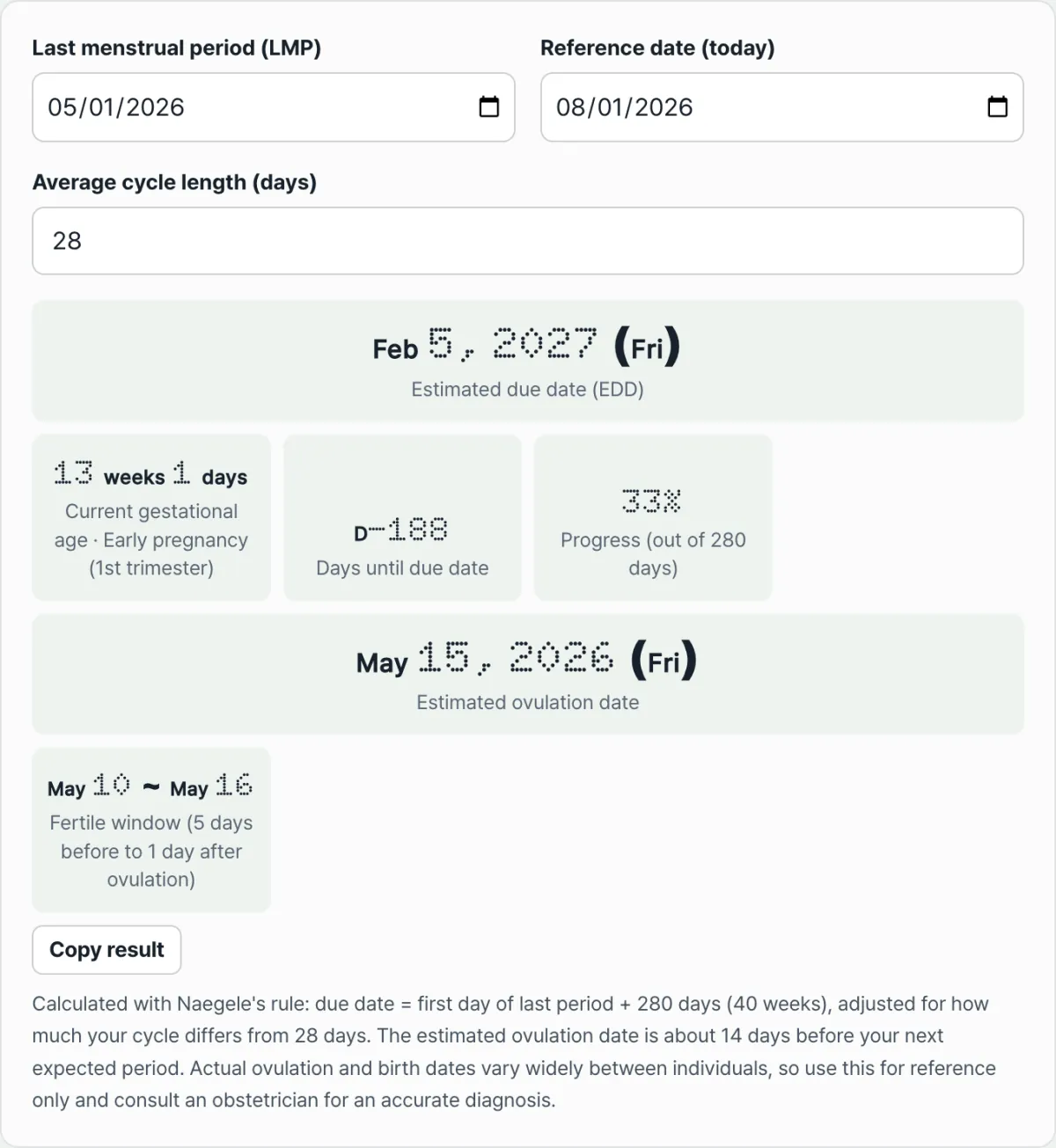
- Enter your last period start date: pick the date your last period began in the calendar module.
- Enter your cycle length: type your average cycle length (default 28 days; anything from 20 to 45 days works). The calculator automatically adjusts the due date by however many days your cycle runs longer or shorter than 28.
- The due date appears in the results area right away, along with the day of the week.
- At the same time, you'll see your current pregnancy weeks (X weeks, Y days), the D-Day count until your due date, pregnancy progress (as a % of 280 days), your predicted ovulation date, and your fertile window (5 days before to 1 day after ovulation) — all on one screen.
The Bottom Line
Your due date isn't the day your baby will definitely be born. It's the marker for when 40 weeks (280 days) from the first day of your last period is complete. Use the due date calculator to get a sense of your current pregnancy weeks and the days remaining, and confirm the exact diagnosis and ultrasound CRL adjustments with your OB-GYN.
Free · no sign-up · due date and ovulation/fertile window adjusted for your cycle length
Frequently Asked Questions
How likely is it that my baby will actually be born on my due date?
Exactly on the due date is rare. Most babies arrive within a few days to two weeks of it.
- Most babies are born healthy between 37 weeks, 0 days and 41 weeks, 6 days (the normal full-term range).
- Birth before 37 weeks is classified as preterm, which carries risks for the baby. Past 42 weeks it becomes a post-term delivery, with concerns about reduced placental function — so you may need to talk with your doctor about inducing labor. In other words, your due date is just the midpoint, the point where 40 weeks is reached.
My cycles are long: 35 days. Does that change the due date formula?
If your cycles are a regular 35 days, you ovulate about 7 days later than you would on a standard 28-day cycle.
- So your real due date is exactly 7 days later than the date Naegele's rule gives you.
- Enter 35 days into this calculator and the 7-day adjustment is applied automatically — you get the corrected due date with no extra math.
This calculator is a reference tool that estimates your due date from your last period start date and average cycle length alone. For an accurate diagnosis, confirm with your OB-GYN.
This article was adapted from our Korean original. Read the Korean original