
32 psi to bar: Tire Pressure Unit Conversion (psi, bar, kPa)
Contents
A tire pressure of 32 psi is about 2.2 bar, or 220 kPa. Whether your gauge reads in psi or the door sticker lists kPa, you're reading the same value in a different unit. One table and one converter will get you to the right number in any unit.
Summary 1 bar ≈ 14.5 psi, and 32 psi = 2.2 bar = 220 kPa. The target value is always the cold tire pressure recommended on the driver's door sticker or in the vehicle manual. Many new cars sold in Korea list kPa with psi in parentheses, so just match the unit printed on your sticker.
Why are there so many pressure units?
You see psi, bar, kPa, and kgf/cm² for the same pressure because each unit comes from a different system.
In the International System of Units (SI), the unit of pressure is the pascal (Pa). The BIPM's SI Brochure defines it as 1 Pa = N/m². Tire pressures are large numbers in pascals, so they're usually written in kilopascals (kPa), which are 1,000 pascals.
The bar is not an SI unit. The current SI Brochure (9th edition) only gives the bar's symbol and value (1 bar = 100 kPa = 10⁵ Pa). It doesn't include the bar in its table of non-SI units accepted for use with the SI, and NIST also discourages its use. Still, it's widely used by convention in European documents and gauges.
psi (pounds per square inch) and kgf/cm² (an older unit) both sit outside the SI. You'll mostly see psi on American gauges and in American documents, and kgf/cm² on the scales of older shop gauges.
On door stickers and in manuals for new cars sold in Korea, pressure is often listed in kPa with psi in parentheses. The kPa value comes first because it follows the SI, and the psi value is there because it's common on gauges at repair shops and gas stations.
One more note: the mmHg (millimeters of mercury) field you see in the converter is a unit used for blood pressure. It isn't used for tire pressure, so you can ignore that field.
A conversion table at a glance
This table covers the values you'll see most often. For finer decimals, check the converter below.
| psi | bar | kPa | kgf/cm² |
|---|---|---|---|
| 32 | 2.21 | 221 | 2.25 |
| 33 | 2.28 | 228 | 2.32 |
| 35 | 2.41 | 241 | 2.46 |
| 36 | 2.48 | 248 | 2.53 |
| 40 | 2.76 | 276 | 2.81 |
If you memorize a few basic relationships, you can do the math in your head.
- 1 bar ≈ 14.5 psi (more precisely, 14.5038 psi)
- 1 bar = 100 kPa
- 1 psi ≈ 6.895 kPa ≈ 0.069 bar
- 1 kgf/cm² ≈ 0.98 bar. It's nearly the same as bar, so the two are often confused on older gauges.
If you read "2.2" on a gauge marked in kgf/cm², that's effectively the same as 2.2 bar (about 2.16 bar). It isn't exactly equal, but it's within the margin of error for tire work.
How to convert by hand
If you convert everything to pascals first, you can calculate any unit. Here are the values for converting each unit to pascals (based on NIST SP 811):
- 1 psi = 6894.757 Pa
- 1 bar = 100000 Pa (exact)
- 1 kPa = 1000 Pa
- 1 kgf/cm² = 98066.5 Pa (exact)
For example, to convert 32 psi to bar, calculate 32 × 6894.757 = 220632 Pa, then ÷ 100000 = 2.2 bar. For kPa, 220632 ÷ 1000 ≈ 220 kPa.
If the math is a hassle, use a converter that takes psi, bar, or kPa in one field and shows the rest at once.
Enter a value in psi, bar, kPa (Pa), or atm and see all the other units at once with the Pressure Unit Converter
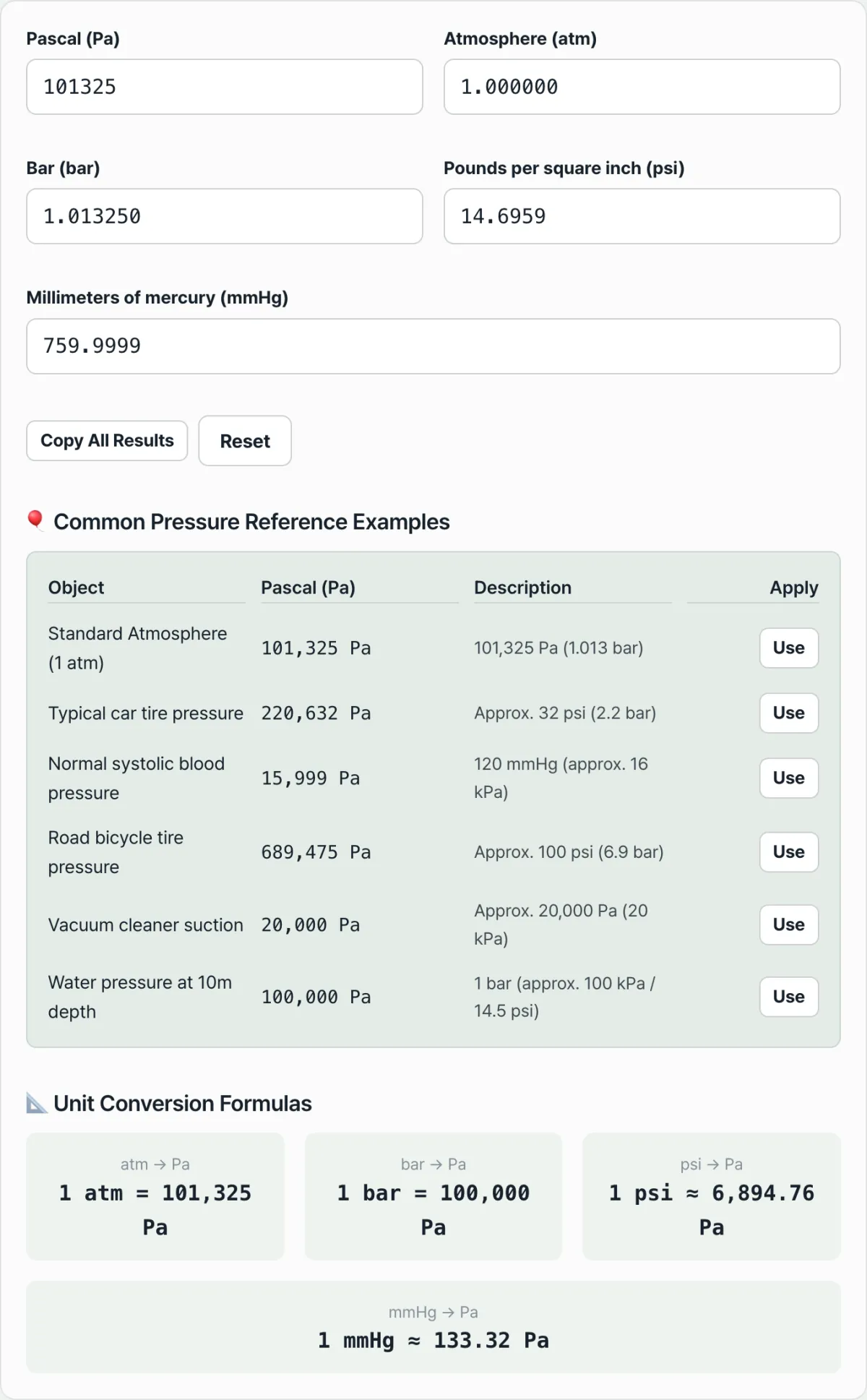
Here's a tip for using the Pressure Unit Converter. It has five input fields: Pa, atm, bar, psi, and mmHg. There's no field just for kPa, so to enter 240 kPa from a door sticker, put 2.4 in the bar field or 240000 in the Pa field (kPa × 1000 = Pa). The tool doesn't convert kgf/cm² directly, so use the table above or the "1 kgf/cm² ≈ 0.98 bar" relationship.
One more thing. The value a tire gauge shows is gauge pressure, which treats atmospheric pressure as zero. If you enter the gauge's "32 psi" in the tool's psi field, read the resulting 2.2 bar and 220 kPa as gauge pressure too. You don't need to add atmospheric pressure to correct for absolute pressure.
What's the right tire pressure to use?
Converting the number is one thing. Deciding how much air to put in is another. The target is always the cold tire pressure that the vehicle's manufacturer specifies.
The US federal standard (FMVSS 110) requires the manufacturer's recommended cold tire pressure to be shown on a permanently attached placard on the driver's side. It also sets the wording of the sticker in a dual-unit format, such as 248 kPa (36 psi). That's why you see two units on the sticker.
Korea's vehicle performance and standards regulation requires a tire pressure monitoring system (TPMS) on passenger cars (gross vehicle weight of 3.5 t or less) and specifies the markings on the tire sidewall. However, values like 180, 220, and 360 kPa in that regulation are test condition values, not recommended pressures.
So don't trust general advice like "the standard is 32 psi." The right answer is the cold pressure on your door sticker or in your manual, set in the same unit the sticker uses. If the sticker is in kPa but the gauge at the gas station is in psi, convert the sticker value to psi and fill to that number.
In short, the units are just different ways to express the same pressure. Use the sticker value as your target, and if your gauge uses a different unit, convert to that unit with the converter below and set the pressure to match.
Enter a value in psi, bar, kPa (Pa), or atm and see all the other units at once with the Pressure Unit Converter
Frequently asked questions
Exactly how many bar and kPa is 32 psi?
32 psi = 2.2063 bar = 220.63 kPa. Rounded, you can read it as about 2.2 bar or 220 kPa. In kgf/cm², it's about 2.25.
My door sticker is in kPa, but the air machine at the gas station reads in psi. How do I match them?
Convert the sticker's kPa value to psi, then set the gauge to that number. For example, if the sticker says 240 kPa, that's about 35 psi, so fill until the gauge reads 35 psi. If you enter 2.4 in the converter's bar field, the psi value appears right away.
Is kgf/cm² on an old gauge the same as bar?
It's close, but not exactly the same. 1 kgf/cm² = 0.98066 bar, a difference of about 2%. That isn't a big gap for tire work, but if you need to be precise, calculate with the pascal values above.
Do I need to add atmospheric pressure to the gauge reading?
No. A tire gauge reads gauge pressure, which treats atmospheric pressure as zero. Read the values in other units from the converter as gauge pressure too. You don't need to add atmospheric pressure to correct for absolute pressure.
This article was adapted from our Korean original. Read the Korean original