
Proportion Calculator: Solve for X with Cross-Multiplication
Contents
Working out one unknown in a proportion A:B = C:D isn't hard on its own. The trouble is that the pair of numbers you multiply changes depending on whether the unknown sits in the A, B, C, or D spot, so it's easy to get confused every time you do it by hand. This post walks through why that pairing changes — and how — using actual worked substitutions.
Summary ① The key property of a proportion is that the product of the outer terms (A and D, on the outside) equals the product of the inner terms (B and C, in the middle): A×D = B×C. ② If the unknown is an outer term (A or D), you divide the product of the inner terms. If it's an inner term (B or C), you divide the product of the outer terms. ③ Doing it by hand means re-deciding that pairing every single time, which is why people often mix up the two numbers they multiply with the one number they divide by.
Where proportions actually trip you up
Say you just solved a problem like "3 : 4 = 9 : X." Here the unknown X is in the D spot, so you multiply the two inner numbers (4 and 9) and divide by the outer number that's left (3), and you get the answer.
But if the very next problem is "3 : X = 9 : 12," with the unknown now in the B spot, applying the exact same order of operations gives you the wrong answer. The pair of numbers you need to multiply changes with the position of the unknown.
This happens anywhere proportions show up. You're given only the condition that two ratios are equal, and where the unknown term sits changes from problem to problem.
How to solve it by hand
Since A:B = C:D means the two ratios are equal, it's the same as A/B = C/D in fraction form. To clear the denominators, multiply both sides by B and D at the same time, and you're left with a single equation: A×D = B×C.
In that equation, A and D are the two numbers on the far outside when you line up the proportion, so they're called the outer terms. B and C are the two in the middle, so they're the inner terms. In other words, the product of the outer terms (A×D) always equals the product of the inner terms (B×C).
No matter whether the unknown is A, B, C, or D, that one equation is your starting point. The difference is in how you isolate the unknown: the two numbers you multiply and the one number you divide by depend on where it sits. Here are the rules.
| Unknown's position | Solved equation | Two numbers to multiply | Number to divide by |
|---|---|---|---|
| A (outer term) | A = (B×C)/D | Inner product B×C | Remaining outer term D |
| D (outer term) | D = (B×C)/A | Inner product B×C | Remaining outer term A |
| B (inner term) | B = (A×D)/C | Outer product A×D | Remaining inner term C |
| C (inner term) | C = (A×D)/B | Outer product A×D | Remaining inner term B |
Put the table into words and it comes out like this. If the unknown is an outer term (A or D), find the product of the inner terms and divide by the remaining outer term. If the unknown is an inner term (B or C), find the product of the outer terms and divide by the remaining inner term. You always multiply the whole side the unknown doesn't belong to (either the outer pair or the inner pair), and you divide by the one number left on the same side as the unknown.
When the unknown is an outer term: 8 : 5 = 24 : X
Let's check it with real numbers, starting with "8 : 5 = 24 : X," where the unknown is the outer term D.
Step 1, the general rule: since D is an outer term, D = (B×C)/A. Step 2, plug in the values: D = (5×24)/8. Step 3, calculate: D = 120/8 = 15.
To check: 8:5 and 24:15 both have a ratio of 1.6.
When the unknown is an inner term: 3 : X = 9 : 12
This time the unknown is the inner term B, in "3 : X = 9 : 12."
Step 1, the general rule: since B is an inner term, B = (A×D)/C. Step 2, plug in the values: B = (3×12)/9. Step 3, calculate: B = 36/9 = 4.
To check: 3:4 and 9:12 both have a ratio of 0.75. Both examples started from the same equation, A×D = B×C, but you can see the multiplication and division targets flip exactly depending on where the unknown sits.
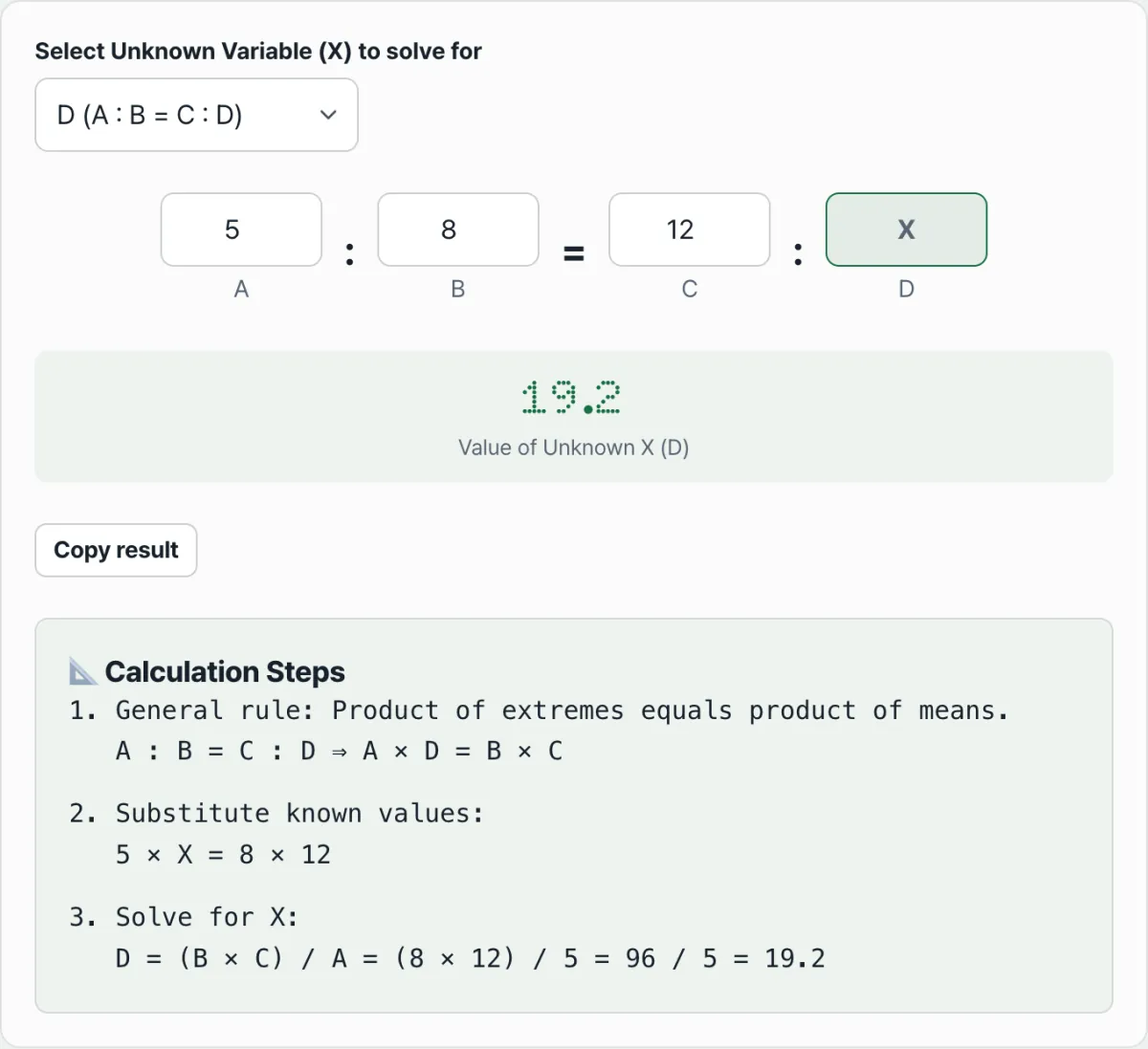
Check it with our free tool.
Pick which of A, B, C, or D is the unknown, and the tool calculates the result from the other values, along with a three-step solution.
Common points of confusion
Confusing the outer and inner terms themselves: The outer terms are the two numbers at the ends when you write out the proportion (A and D), and the inner terms are the two in the middle (B and C). It's about where they sit relative to the colon (:), not about which values are bigger.
Memorizing one multiplication formula and applying it no matter where the unknown moves: If all you remember is "multiply and divide" without remembering which pair to multiply, you'll get confused again every time the unknown shifts to the A or B spot. Approach it in the order shown in the table above — first decide whether the unknown is an outer or inner term — and you'll make fewer mistakes.
When the divisor is 0: The equation for the unknown always divides by one of the three remaining numbers. If that divisor is 0, the answer isn't mathematically defined, so the calculation can't be done, and the calculator reports an error in that case.
When the division doesn't come out even: Depending on the combination of the three numbers, the result can be a repeating decimal. What's shown on screen is rounded to a certain number of decimal places, so if you need an exact value, check the rounding as well.
Recap
- The one rule for proportions is outer product (A×D) = inner product (B×C).
- If the unknown is an outer term (A or D), divide the inner product by the remaining outer term.
- If the unknown is an inner term (B or C), divide the outer product by the remaining inner term.
- You multiply the whole side the unknown doesn't belong to, and divide by the one number left on the same side as the unknown.
- A divisor of 0, or a division that doesn't come out even, needs separate attention.
Pick which of A, B, C, or D is the unknown, and the tool calculates the result from the other values, along with a three-step solution.
FAQ
How do I tell the outer terms from the inner terms?
When you write the proportion A:B = C:D in order, the two numbers at the very front and very back (A and D) are the outer terms, and the two in the middle (B and C) are the inner terms. It has nothing to do with which values are larger or smaller — position in the sequence is all that matters.
What happens if the result has a long string of decimals?
If the combination doesn't divide evenly, you can get a repeating decimal. The calculator rounds the value to 8 decimal places.
What happens if the divisor is 0?
Dividing by 0 is mathematically undefined. The calculator automatically detects when the value used as the divisor is 0, shows an error message, and doesn't force a result.
Do I have to put the unknown in the D spot?
No. In the dropdown at the top of the calculator, you can choose which of A, B, C, or D is the unknown; the default is D. The spot you select as the unknown can't be typed into, and the calculated value appears there automatically.
This article was adapted from our Korean original. Read the Korean original