
Rental Property ROI: Cap Rate vs. Cash-on-Cash Return
Contents
If you search for rental property return, different calculators give you different numbers. The math isn't wrong. "Rental return" can mean at least two different metrics. One is the capitalization rate (cap rate), which uses the full purchase price as its base. The other is cash-on-cash return (CoC), which uses only the equity you actually put in after subtracting the loan and the tenant deposit.
This article walks through where each number comes from and why they move differently.
Summary ① Cap rate is net operating income (NOI) divided by the full purchase price. It doesn't change with or without a loan. ② Cash-on-cash return (CoC) is net cash flow after interest divided by the equity you actually invest. It changes with the loan share and the interest rate. ③ Neither metric includes closing costs such as acquisition tax and brokerage fees, so the equity you actually put in can be larger than the calculated figure.
Return on Price vs. Return on Your Own Money: Why the Numbers Don't Match
When you shop for rental properties, you end up trying several return calculators. It's common to see one show 3% and another show 5% for the same property and the same rent. If you enter the same price and rent and get different results, it's hard to know which one is right.
Chances are neither is wrong. The denominator is different. One uses the full purchase price. The other uses only the equity you actually invest, after subtracting the loan and the deposit. The more a property is financed with debt, the smaller your equity is compared with the price. So the same cash flow can produce a larger ratio against your equity.
To compare the two numbers, first check what each metric uses as its numerator and denominator. Before you decide which one is the "real" return, lay the two calculations side by side.
How to Calculate by Hand Without a Calculator
You can work out both metrics by hand. The order is fixed.
Steps 1–3: Up to Cap Rate
Step 1: Find annual gross rental income. That's monthly rent × 12 months.
Step 2: Find net operating income (NOI). Subtract only annual maintenance costs from annual gross rental income. Don't subtract loan interest at this step.
Step 3: Find the cap rate. It's NOI ÷ purchase price × 100. The loan amount and interest rate don't appear anywhere in this calculation.
Steps 4–7: Up to Cash-on-Cash Return (CoC)
Step 4: Find annual loan interest. That's loan amount × (interest rate ÷ 100).
Step 5: Find pre-tax net cash flow. Subtract the annual interest from Step 4 from NOI. This is the first point where the loan terms enter the calculation.
Step 6: Find the equity you actually invest. Subtract the loan amount and the deposit from the purchase price. You have to return the deposit to the tenant eventually. But at the time of purchase, it lets you put in that much less of your own money, so it comes out of your equity the same way the loan does.
Step 7: Find cash-on-cash return (CoC). It's the net cash flow from Step 5 ÷ the equity from Step 6 × 100.
Example Calculation
Say a property has a purchase price of ₩300 million, a deposit of ₩30 million, a loan of ₩150 million (at 3%), monthly rent of ₩1 million, and annual maintenance costs of ₩1.2 million. The numbers work out like this:
- Annual gross rental income: ₩1 million × 12 = ₩12 million
- NOI: ₩12 million − ₩1.2 million = ₩10.8 million
- Cap rate: ₩10.8 million ÷ ₩300 million × 100 = 3.6%
- Annual loan interest: ₩150 million × 3% = ₩4.5 million
- Pre-tax net cash flow: ₩10.8 million − ₩4.5 million = ₩6.3 million
- Equity: ₩300 million − ₩150 million − ₩30 million = ₩120 million
- CoC: ₩6.3 million ÷ ₩120 million × 100 = 5.25%
It's the same property, but the cap rate is 3.6% and the CoC is 5.25%. Both calculations use the same NOI. They differ because the denominator is different and only one of them accounts for interest.
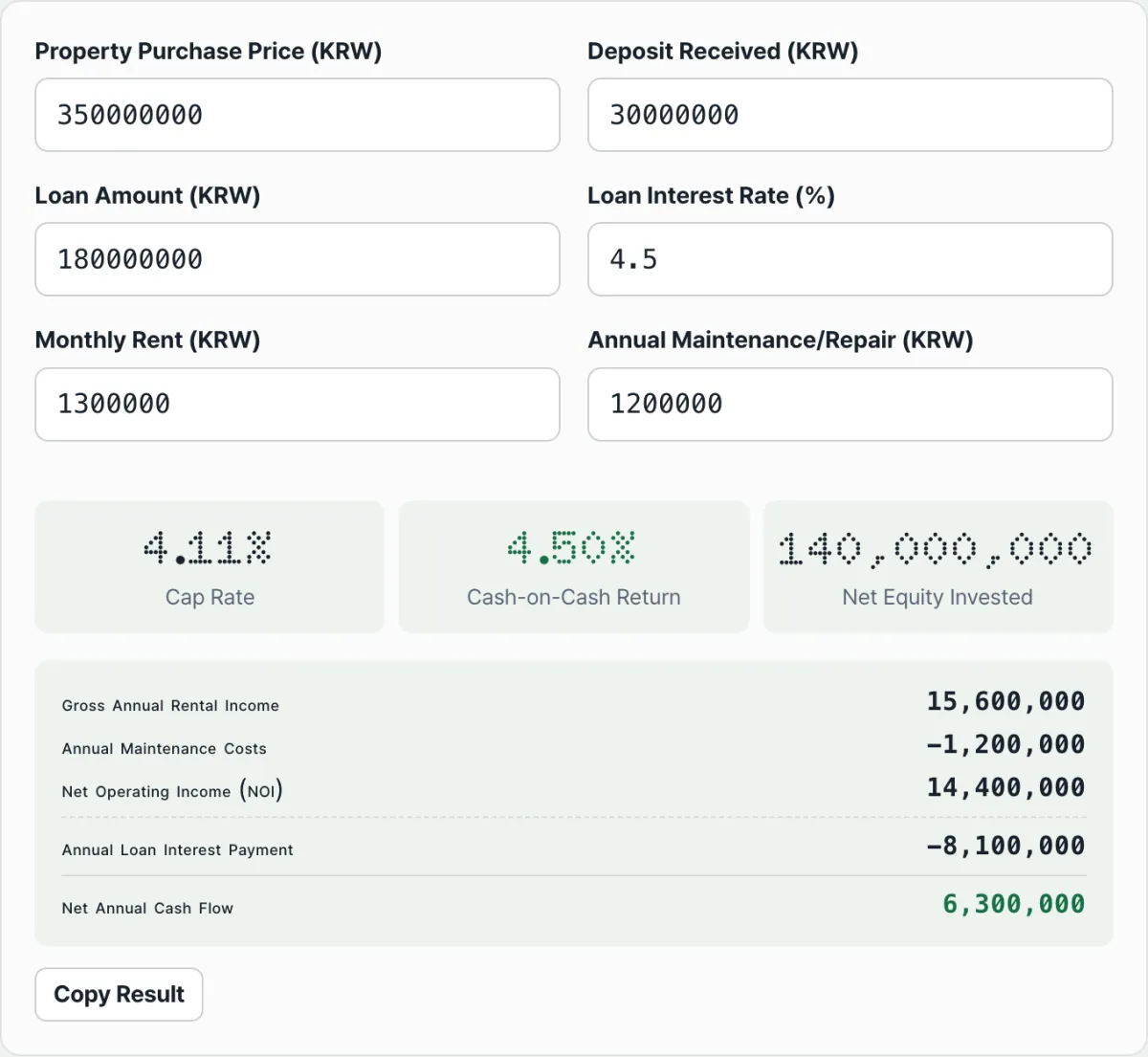
Repeating these seven steps by hand every time the property changes is tedious. Check it with our tool.
Enter the purchase price, security deposit, loan amount, interest rate, monthly rent, and maintenance costs to get the cap rate and cash-on-cash return instantly. Your numbers are processed only in your browser and are never sent to a server.
Common Points People Miss
The math is simple, but a few things often trip people up when they read the results.
Loan interest comes out at the net cash flow step, not in NOI. NOI measures what "the property itself" earns against the full purchase price. It's calculated the same way no matter how much the buyer borrows. Interest only shows up afterward, when you look at actual cash flow against your equity.
Closing costs such as acquisition tax and brokerage fees aren't included. This calculator takes only six inputs: purchase price, deposit, loan amount, interest rate, monthly rent, and maintenance costs. In a real purchase, acquisition tax and brokerage fees add to your costs. If you add them to your equity, your actual CoC moves lower than the calculated figure.
| Item | Included? |
|---|---|
| Loan interest | Included in CoC (net cash flow), not included in cap rate (NOI) |
| Deposit | Subtracted in the equity calculation, the same way as the loan |
| Acquisition tax and brokerage fees | Not included in either metric |
If you increase the loan share, cap rate stays the same but CoC moves. The numerator (NOI) and denominator (purchase price) of the cap rate never use the loan amount. So whether you borrow more or less, the cap rate stays put. With CoC, the denominator (equity) shrinks by the amount of the loan, and the numerator (net cash flow) shrinks by the amount of the interest. Depending on how those two compare, CoC can go up or down.
In the earlier example, say you raise the loan from ₩150 million to ₩200 million (same 3% rate). Equity drops to ₩70 million, interest rises to ₩6 million, and pre-tax net cash flow becomes ₩4.8 million. CoC rises to ₩4.8 million ÷ ₩70 million × 100 = about 6.9%. The cap rate is still 3.6%.
If the interest rate is higher, the result changes. Take the same property and set the rate at 8%. Annual interest becomes ₩12 million (₩150 million × 8%), which is more than NOI (₩10.8 million). Pre-tax net cash flow is −₩1.2 million, and CoC is −₩1.2 million ÷ ₩120 million × 100 = about −1.0%, which is negative. The cap rate is still 3.6%, regardless of the loan terms.
So whether CoC goes up or down depends on the arithmetic relationship between the loan's interest rate and what the property itself earns. Cap rate doesn't use the loan in its calculation, so it doesn't move.
Summary
- Cap rate is NOI (annual gross rental income − maintenance costs) divided by the full purchase price. It shows what the property itself earns, with or without a loan.
- CoC (cash-on-cash return) is pre-tax net cash flow, which is NOI minus loan interest, divided by the equity you actually invest (purchase price − loan amount − deposit).
- If you increase the loan, cap rate stays the same. CoC goes up or down depending on the relationship between the loan's interest rate and what the property earns.
- Closing costs such as acquisition tax and brokerage fees aren't included in the calculation, so your actual equity and actual CoC can differ from the calculated figures.
- The two metrics answer different questions. Neither one replaces the other.
Enter the purchase price, security deposit, loan amount, interest rate, monthly rent, and maintenance costs to get the cap rate and cash-on-cash return instantly. Your numbers are processed only in your browser and are never sent to a server.
Frequently Asked Questions
Should I look at cap rate or cash-on-cash return?
The two numbers answer different questions. Cap rate shows how much the property itself earns relative to its purchase price. Cash-on-cash return (CoC) shows how much cash you keep relative to the money you actually put in.
Which one to prioritize depends on how much debt you plan to use and what you want to compare against. This article only covers what each number measures.
Why is the security deposit subtracted from your equity, like a loan?
A security deposit is money you will have to return to the tenant later. But at the time of purchase, it covers part of the payment you owe the seller. That's why equity is calculated by subtracting both the loan amount and the deposit from the purchase price (purchase price − loan amount − deposit).
How much does CoC change if I include acquisition tax and agent fees?
The Rental Property ROI Calculator doesn't take acquisition tax or agent fees as inputs, so it can't calculate the exact difference. Structurally, though, these extra costs make the equity you actually invest larger than the calculated figure. That means your real CoC will be lower than the value the calculator shows.
Does the calculation change if rent is late or the unit sits vacant?
The calculator uses annual gross rental income, assuming the monthly rent you enter comes in for all 12 months. It doesn't account for actual income during periods of vacancy or late payment. Your real cash flow may differ from the calculated figure.
This article was adapted from our Korean original. Read the Korean original