
Retirement Savings Calculator: Total, Shortfall, Monthly Savings
Contents
The Retirement Savings Calculator takes seven inputs — current age, retirement age, life expectancy, desired monthly living expenses, current assets, inflation rate, and investment return — and instantly tells you how much you need by the time you retire.
It also shows how much you need to save each month to get there. This article walks through exactly what order those numbers come out in and which formulas produce them.
It does not judge whether a particular retirement age or savings amount is appropriate.
Summary ① The total retirement savings you need is calculated by working backward from life expectancy down to retirement age, discounting each year's living expenses by the investment return and adding them up. ② The inflation rate is used to compound today's living expenses forward to the amount you'll need in the year you retire, and it keeps applying to rising living expenses every year after retirement too. ③ A single investment return rate applies to both asset growth before retirement and management of the remaining balance after retirement, and the required monthly savings is calculated with the sinking fund formula.
Why simple multiplication gets it wrong
Many people estimate retirement savings with simple multiplication: "monthly living expenses × 12 months × remaining life expectancy." If you assume 3,000,000 won a month for 20 years, you get 720 million won.
That calculation leaves out two things. Living expenses at retirement will be higher than today by the rate of inflation, and your saved assets and remaining money keep earning the investment return after retirement.
So there's a big gap between the simple multiplication result and the total the calculator shows. That gap isn't a calculator error — it's the result of factoring in two variables: inflation and investment return.
How to calculate it yourself without the tool
The retirement calculation breaks into five steps. You can follow along with nothing but a spreadsheet program.
Steps 1–2: Convert living expenses to a future value
Step 1 — Convert to living expenses at retirement. Apply the inflation rate, compounded over the number of years left until retirement, to today's monthly living expenses.
Monthly living expenses at retirement = today's monthly living expenses × (1 + inflation rate)^(retirement age − current age)
Step 2 — Figure out living expenses for each year after retirement. Assume living expenses keep rising by the inflation rate after retirement too. Living expenses in year n of retirement equal the first-year amount from Step 1 compounded by the inflation rate for n−1 more years.
Step 3: Work backward from life expectancy to get the total
Start at the year you reach life expectancy and step back one year at a time toward retirement age. At each step, discount the amount accumulated so far by the investment return once, then add that year's living expenses.
When you reach retirement age, that value is "the total you need to have on hand at the moment you retire." The reason for calculating from the back is that only this way is each year's withdrawal discounted by exactly the number of years remaining until that point.
Steps 4–5: Future value of assets and monthly savings
Step 4 — Grow your current assets to their value at retirement.
Future value of assets at retirement = current assets × (1 + investment return)^(retirement age − current age)
This uses the same investment return as Step 3. One single number drives both how fast your assets grow before retirement and how fast the remaining money grows after retirement.
Step 5 — Find the shortfall and the monthly savings needed.
Shortfall = total needed − future value of assets (0 if the result is below 0) Required monthly savings = shortfall × monthly rate ÷ [(1 + monthly rate)^total months − 1], where monthly rate = annual investment return ÷ 1200
This is the sinking fund formula, which assumes you save the same amount every month and that those savings also grow at the investment return. That's why it comes out smaller than simply dividing "shortfall ÷ number of months left."
Checking the flow with an example
Take a 35-year-old who wants to retire at 65 with a life expectancy of 85, monthly living expenses of 3,000,000 won (in today's money), current assets of 100 million won, an inflation rate of 2.5% a year, and an investment return of 5.0% a year. Plug those straight into the five steps and here's what comes out.
| Item | Value |
|---|---|
| Years left until retirement | 30 years |
| Monthly living expenses in the first year of retirement (inflation-adjusted) | about 6,290,000 won |
| Total retirement savings needed | about 1,212,860,000 won |
| Future value of assets at retirement | about 432,190,000 won |
| Shortfall | about 780,670,000 won |
| Required monthly savings | about 938,000 won |
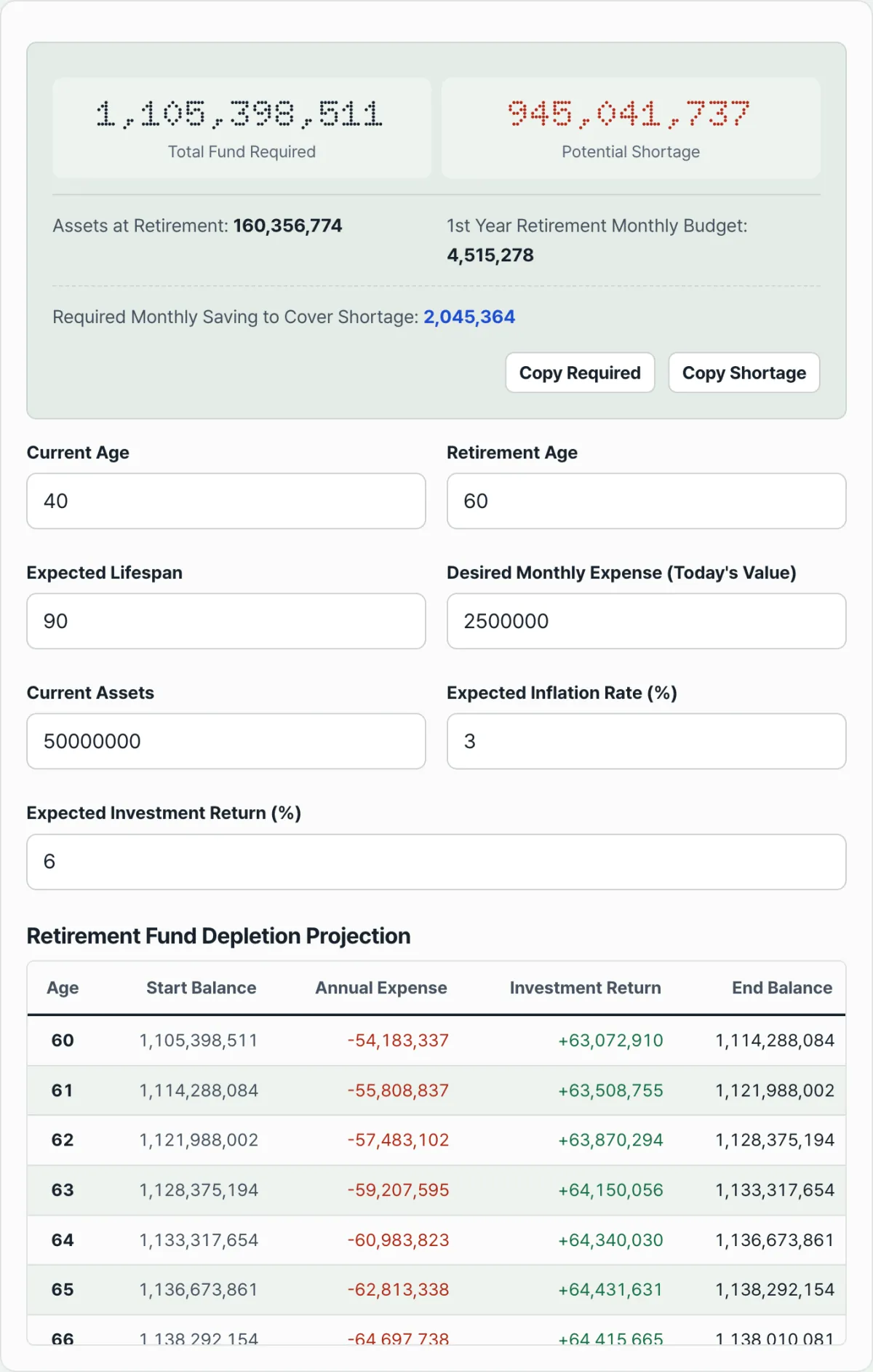
These six numbers all change based on the five inputs: age, living expenses, assets, inflation rate, and investment return. Instead of grinding through 20 to 30 years by hand, there's a tool that runs those five steps and shows you the results instantly.
Check it with our tool.
Enter your age, living expenses, assets, inflation rate, and investment return, and your required total, shortfall, and monthly savings are calculated right away. Nothing you enter is sent to the server.
Points on the results screen that often confuse people
The math itself is accurate, but people often get confused by comparing numbers on the screen that are on different bases.
| Confusing point | How it's actually calculated |
|---|---|
| The first-year monthly living expenses in retirement are far bigger than the monthly living expenses you entered | The input is a present value in today's money; the displayed figure is a future value with the inflation rate compounded forward to the retirement year |
| The total retirement savings needed looks like it means "you need this much right now" | This amount is the total needed as of retirement (in the future). It's not the amount you need today — it's the amount you need to have in hand in the year you retire |
| You'd think lowering the investment return would only make the shortfall bigger | The investment return is used in two places at once: the future value of assets before retirement and the management of the remaining balance after retirement (the total needed calculation). Lower it and both the future value of assets and the total needed change together |
| You'd think required monthly savings is "shortfall ÷ months left" | It uses the sinking fund formula, which assumes your savings themselves grow at the investment return, so the result is smaller than simple division |
Below the results screen, a retirement savings depletion simulation table is also shown. The "Investment Return" line in that table isn't the full balance at the start of the year — it's the investment return applied only to what's left after that year's living expenses are subtracted.
So if you do mental math from the starting balance and the investment return figure alone, you may come out slightly off from the numbers in the table. Keep the order in mind — living expenses come out first, and only the remaining money earns a return — and the table reads exactly as it should.
Recap
- The total retirement savings needed is calculated by working backward from life expectancy to retirement age, discounting each year's withdrawal by the investment return and adding them up.
- Living expenses at retirement and living expenses for each year after retirement are both future values with the inflation rate compounded in, so they can't be compared directly with today's living expenses.
- One investment return rate applies equally to both asset growth before retirement and management of the remaining balance after retirement.
- Required monthly savings isn't the shortfall divided by the number of months — it's calculated with the sinking fund formula, which assumes your savings grow too.
- Change any one of age, living expenses, assets, inflation rate, or investment return and every result changes with it. Once you understand the flow, you can read why the numbers on the screen came out the way they did.
Enter your age, living expenses, assets, inflation rate, and investment return, and your required total, shortfall, and monthly savings are calculated right away. Nothing you enter is sent to the server.
Frequently asked questions
Do I enter monthly living expenses in today's money or in retirement-year money?
Enter them in today's money (present value). The calculator applies the inflation rate you entered, compounded over the years left until retirement, and converts it to retirement-year living expenses automatically.
What happens if I put the same number for the investment return and the inflation rate?
The calculation runs as usual and no error occurs. But if the two values are equal, the rate at which your assets grow and the rate at which living expenses rise become nominally the same, so the difference you see in the results depends on the gap between the two values.
How much do the results change if I enter a longer life expectancy?
A longer life expectancy means more withdrawal years after retirement, so Step 3 adds up more years of living expenses. The total retirement savings needed, the shortfall, and the required monthly savings all grow along with it.
Is my age, asset, and living expense information saved anywhere?
No. Everything is calculated inside your browser only, and your inputs are never sent to or stored on a server.
This article was adapted from our Korean original. Read the Korean original