
Running Pace Calculator: Convert Pace to Speed and Times
Contents
If you finished a 10K in 58 minutes, what was your pace per kilometer? And if you run a half marathon at 5-minute pace, how many hours and minutes will that take? Both come down to the same formula.
Pace, finish time, and speed aren't three unrelated numbers. They're values you get by converting one into another, with distance as the shared axis. This post covers the formula, plus how the tool's "predicted times by distance" table is actually calculated.
Summary ① Pace isn't a decimal (5.5) — it's written as min:sec/km. "5:30" means 5 minutes 30 seconds per kilometer. ② Pace, finish time, and speed all convert into each other through distance (km) — finish time (sec) = pace (sec/km) × distance (km). ③ The "predicted times by distance" table takes your current pace and multiplies it straight across every distance, so it doesn't account for hills or a slowdown late in the race.
When you have a finish time but no pace
Running apps and race results don't always give you pace alongside everything else. Plenty of people run without a GPS watch, and plenty of results sheets list nothing but the total finish time.
Say you run a 10K and all you have afterward is a finish time of "58:24." From that number alone you can't tell how many minutes per kilometer you averaged, or what that is in km/h. You have to divide distance (10 km) by time (58 minutes 24 seconds) to get the pace.
The reverse happens too. You've settled on a goal pace of 5:30, but you have no feel for how long that race actually takes — "how many hours is a half marathon at 5:30 pace?" Both cases use the same formula; only the direction of the calculation changes.
How to work out pace, finish time, and speed by hand
Pace is written as min:sec/km
Pace is the time it takes to run 1 kilometer, written as minutes:seconds. It's not a single decimal number rolled into one figure.
If pace shows up as a decimal like "5.5" on a screen or a results sheet, that means 5 minutes 30 seconds, not 5 minutes 5 seconds. Thirty seconds is 0.5 of a minute (30 ÷ 60). Multiply the decimal part by 60 to get seconds — not by 100.
| Decimal (min) | Min:sec notation |
|---|---|
| 5.00 min | 5 min 00 sec |
| 5.25 min | 5 min 15 sec |
| 5.50 min | 5 min 30 sec |
| 5.75 min | 5 min 45 sec |
The smaller the number, the faster the pace. 5:00/km is faster than 6:00/km, because it means you covered each kilometer in less time.
Finish time → pace → speed (the forward direction)
If you're doing this by hand, start by converting every time into seconds.
- Convert the finish time to seconds. h:mm:ss → (hours × 3600) + (minutes × 60) + seconds
- Find the pace in seconds per km. pace (sec/km) = total finish time (sec) ÷ distance (km)
- Convert the pace to min:sec. seconds ÷ 60 = minutes, and the remainder is seconds
- Find the speed in km/h. speed (km/h) = 3600 ÷ pace (sec)
Here's what it looks like for a 10K finished in 58 minutes.
- Finish time (sec): 58 × 60 = 3,480 sec
- Pace (sec/km): 3,480 ÷ 10 = 348 sec/km
- Pace (min:sec): 348 ÷ 60 = 5 min, remainder 48 sec → 5 min 48 sec/km
- Speed: 3,600 ÷ 348 ≈ 10.34 km/h
Goal pace → finish time (the reverse direction)
Going the other way — you know your goal pace and the distance and want the projected finish time — only the direction changes.
- Convert the pace to seconds. (minutes × 60) + seconds
- Find the finish time in seconds. finish time (sec) = pace (sec/km) × distance (km)
- Convert seconds to h:mm:ss.
Say you plan to run a half marathon (21.0975 km) at 5 minutes 0 seconds per kilometer.
- Pace (sec): 5 × 60 = 300 sec/km
- Finish time (sec): 300 × 21.0975 = 6,329.25 sec
- Convert to h:mm:ss: 6,329.25 sec ÷ 3,600 ≈ 1 hour, leaving 2,729.25 sec ÷ 60 ≈ 45 minutes, leaving 29.25 sec → about 1 hour 45 minutes 29 seconds
You can do this without a calculator as long as you work through those four steps in order. But once you're handling decimals and converting seconds to h:mm:ss by hand over and over, it's easy to drop a digit.
Check it with our tool.
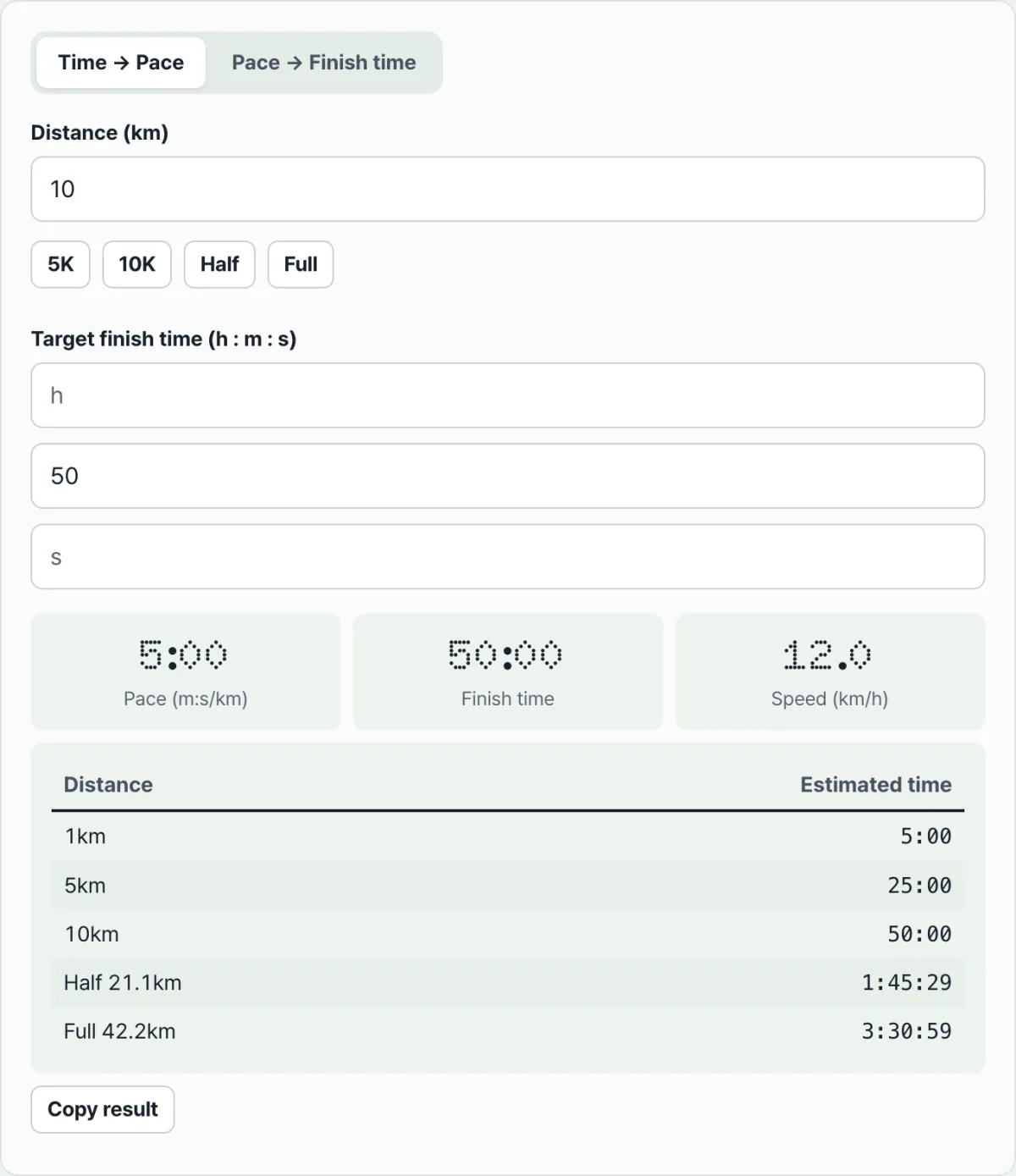
Enter your distance and finish time (or a target pace) and it instantly calculates pace, speed, and projected times at 1K, 5K, 10K, half, and full.
Where the numbers in the "predicted times by distance" table come from
At the bottom of the tool, a table shows projected times for 1K, 5K, 10K, half (21.0975 km), and full (42.195 km). Knowing how that table is built keeps you from misreading the results.
The math is simple. It takes the pace you just calculated (sec/km) and multiplies it straight across each distance (km).
For example, if your pace comes out to 5 minutes 48 seconds per kilometer, the 10K column shows 5 min 48 sec × 10 = 58 minutes, and the full marathon column shows 5 min 48 sec × 42.195 ≈ 4 hours 4 minutes 44 seconds.
This approach assumes the pace you just ran holds from start to finish. A real race has plenty of variables that break that assumption.
- Every segment has its own uphills and downhills.
- The longer the race, the more common it is to fade in the later stages.
- Weather, surface, and when you hit the water stations all change from segment to segment.
So the "projected full marathon time" in the table is a reference value — your current pace stretched arithmetically across the distance. It's not a prediction that you'll actually finish in that time. Few people run the same pace in a full as they do in a 10K.
Common mix-ups
| What trips people up | What it actually means |
|---|---|
| Pace written as "5.5" | As a decimal it means 5 minutes 30 seconds (0.5 × 60 = 30 sec), not 5 minutes 5 seconds |
| "5.5" on a treadmill speed display | That's usually 5.5 km/h. Converted to pace, 3,600 ÷ 5.5 ÷ 60 ≈ 10 min 55 sec/km — nothing like the pace your GPS watch shows |
| Saying "my pace is high" | A bigger number means a slower pace. The faster the pace, the smaller the min:sec number |
| Predicted times by distance table | An arithmetic conversion that multiplies your current pace across each distance. Your actual finish time can differ |
A treadmill usually shows speed in km/h, while a GPS watch or running app usually shows pace (min:sec/km). The two are reciprocals, so if you glance at the numbers and assume they mean the same thing, your math will come out wrong.
Recap
- Pace is written as min:sec/km. When you see it as a decimal, convert in base 60 (0.5 min = 30 sec).
- pace (sec/km) = finish time (sec) ÷ distance (km), and finish time (sec) = pace (sec/km) × distance (km).
- speed (km/h) = 3,600 ÷ pace (sec).
- A half marathon is 21.0975 km; a full marathon is 42.195 km.
- The "predicted times by distance" table is a simple conversion that applies your current pace to every distance. It doesn't account for hills or a late-race slowdown.
Enter your distance and finish time (or a target pace) and it instantly calculates pace, speed, and projected times at 1K, 5K, 10K, half, and full.
Frequently asked questions
Is a smaller pace number faster?
Yes. Pace is the time it takes to run 1 kilometer, so 5:00/km is faster than 6:00/km — you cover each kilometer in less time. Speed works the opposite way: a bigger number is faster.
What are the exact distances for the half and the full?
A half marathon is 21.0975 km, and a full marathon is 42.195 km. If you round to 21 km or 42 km, your projected times will be off.
Can I just use the predicted times table as my goal?
The table multiplies your current pace arithmetically across each distance. It doesn't account for real race variables like hills, late-race slowdowns, or weather, so it's best treated as a reference conversion.
How do I convert between speed and pace?
If you know the pace in seconds per km, speed (km/h) = 3,600 ÷ pace (sec). Going the other way, pace (sec/km) = 3,600 ÷ speed (km/h). The two are reciprocals.
This article was adapted from our Korean original. Read the Korean original