
Tier List Grades Explained: Why S–F Rankings Differ by Site
Contents
Whether it's game character rankings, diet plans, or your favorite idol group, you've probably seen the same subject land in S tier on one tier list and B tier on another.
The grades differ not because one side is wrong, but because the S-through-F labels aren't a fixed absolute standard. They're a relative ranking picked by whoever made the list. This post covers what the grades actually mean and how to build an accurate tier chart on your own terms.
Summary ① S–F grades aren't an absolute standard. They're relative ranking labels set by the person who made the list. ② The same subject gets a different grade when the criteria differ (win rate, value for money, personal taste, and so on). ③ When you look at someone else's chart, check "what it was sorted by" before you check the grades.
Why grades differ from site to site and person to person
A tier list isn't a certified rating issued by an official body after review. It's the output of one person or community setting specific criteria and ranking things relative to each other within those criteria.
For example, one person might build a game character tier list around "1v1 match win rate," while another builds it around "how easy the character is for beginners to handle." When the criteria differ, the same character can land in a completely different tier.
This structure applies just as much to tier charts about food, idols, or movies as it does to games. The less a chart states its criteria, the more taste and evidence get mixed together, so you can't tell from the grades alone what it was graded on.
What S, A, B, C, D, and F actually mean
The grades commonly used on school report cards put A at the top, with B, C, D, and F (failing) below it. A tier list uses a six-level scale that adds S ahead of A to mark a spot one step above the top.
In other words, S isn't an absolute grade tied to a set score range. It's a label for a relative position: "specifically above A." Some tier lists add SS and SSS above S, and others skip S entirely and start at A.
Rather than the grade names themselves, it's more accurate to look at which position a tier holds out of how many total levels.
How to check a tier list someone else made
Before you take a tier list someone posted at face value, check these three things in order and you won't misread the grades.
| What to check | Why |
|---|---|
| Does it state its criteria? | The same subject can flip grades depending on the criteria, such as win rate, value for money, or personal taste |
| Is it recent? | Game patches or shifting trends can change the criteria themselves |
| Did you compare several tier lists? | Don't look at just one. Compare them and look at what ranks high across the board for higher confidence |
In the end, there's no such thing as "the correct tier list." Rather than interpreting grades against someone else's criteria, a chart you rank yourself using criteria you set is closer to the right answer.
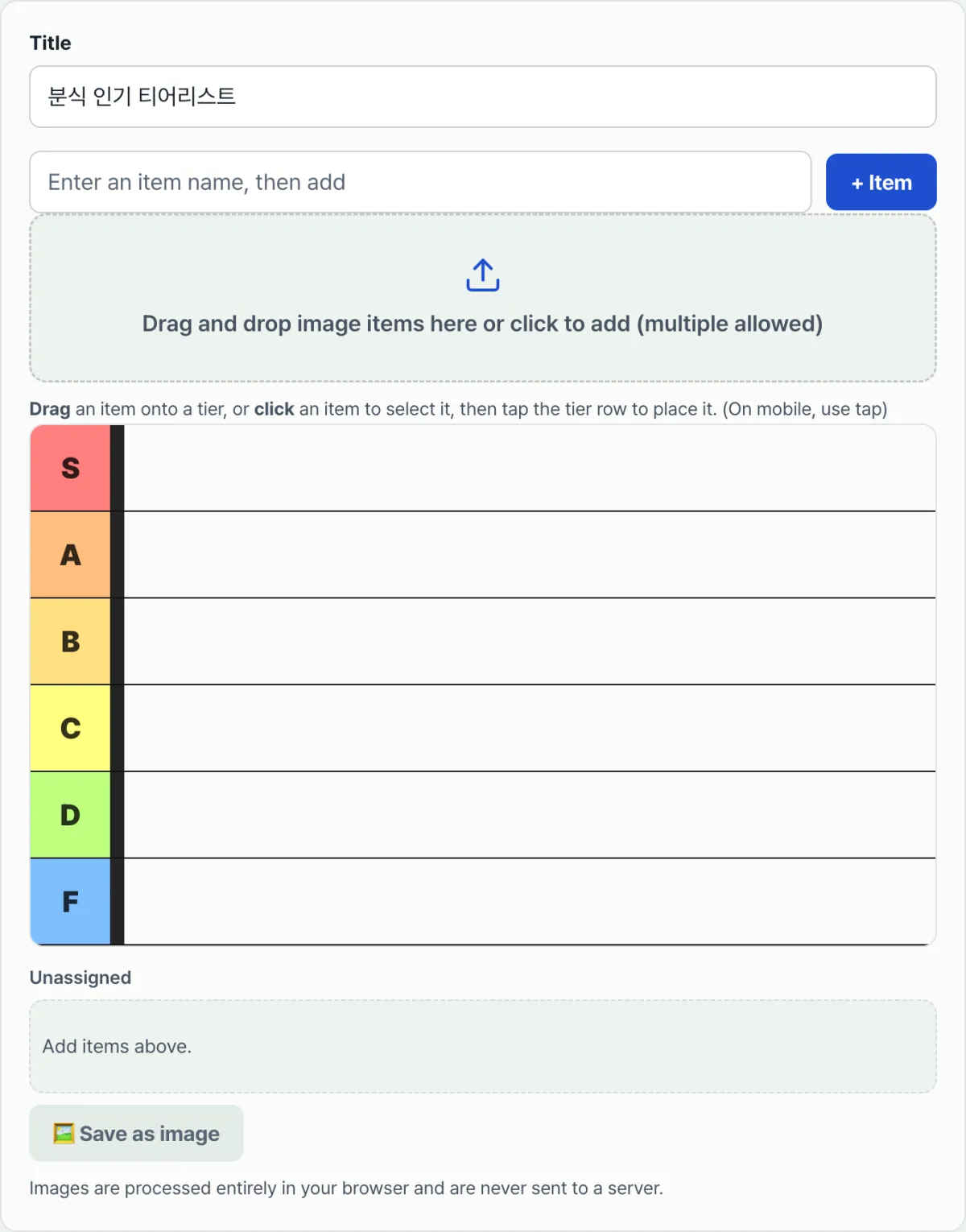
Check it with our tool. If you build one by hand, you have to draw six level rows in Paint or a spreadsheet app, match the image size for each item, place the text boxes manually, then take another screenshot — a lot of manual work.
Free · No sign-up · Images are processed only in your browser
Common sticking points
| Situation | What to check |
|---|---|
| Dragging doesn't work on mobile | Tap an item once to select it, then tap the tier row you want to move it to and it jumps to that tier |
| Are images saved on a server? | No. Adding image items and generating the tier chart are processed entirely in your browser |
| I want more than six levels | The default grades are fixed at six levels: S, A, B, C, D, and F. Items you haven't placed yet are collected in an "Unranked" row |
| What file do I get for the finished chart? | Tap "Save as image" and it downloads straight to a PNG file |
The takeaway
The reason grades differ from site to site isn't a scoring error — it's a difference in criteria. S–F are relative ranking labels, not absolute scores, and when you look at someone else's chart, checking the criteria first is more accurate than checking the grades. In the end, the most accurate tier chart is the one you build yourself on criteria you set.
Free · No sign-up · Images are processed only in your browser
Frequently asked questions
Who decides the S tier on a tier list?
There's no official body or standard. A tier list is a ranking chart that a person or community grades relatively, based on criteria they chose themselves (win rate, preference, value for money, and so on), so the same subject can get a different grade depending on who made the list.
Why is S tier above A tier?
On the usual A–F grading scale, A is the top. A tier list uses a six-level scale that adds S ahead of A to mark a spot one step higher than that. S isn't a set score range — it marks a relative position: "above A."
If I upload image items to a tier chart, are the files saved on a server?
No. Adding image items and generating the tier chart image are both handled inside your browser. No file is sent to or stored on a server.
Can I move items into tiers on my phone?
Yes. Where dragging is hard, tap an item once to select it, then tap the tier row you want, and it moves to that tier right away.
This article was adapted from our Korean original. Read the Korean original