
Blood Pressure Categories Chart: Normal Systolic and Diastolic
Contents
Under the Korean Society of Hypertension's "2026 Hypertension Management Guideline (6th edition)," normal blood pressure is a systolic reading below 120 mmHg and a diastolic reading below 80 mmHg. Hypertension is an office blood pressure of 140/90 mmHg or higher. In between are elevated blood pressure (120–129 / below 80) and prehypertension (130–139 or 80–89).
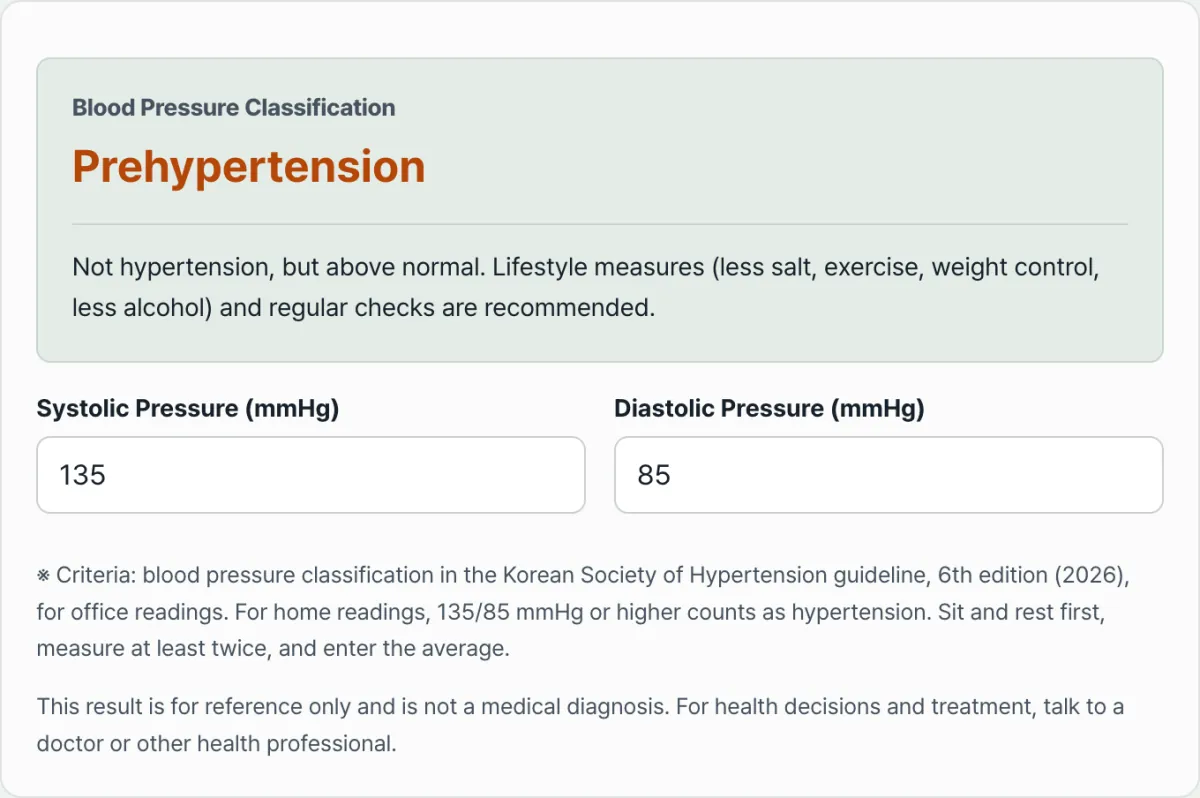
If a health checkup or a pharmacy blood pressure monitor shows 135/88 mmHg, that falls in the prehypertension range. This article reproduces the classification table from the 6th edition guideline, published in May 2026. It also covers what's new: isolated diastolic hypertension, the 180/110 mmHg threshold, the home blood pressure cutoff (135/85), and why one reading is not enough for a diagnosis.
Summary ① Categories (office blood pressure): Normal is below 120/80. Elevated is 120–129 / below 80. Prehypertension is 130–139 or 80–89. Stage 1 is 140–159 or 90–99. Stage 2 is 160 or higher, or 100 or higher. ② Isolated hypertension: If only the systolic number is 140 or higher (diastolic below 90), it is isolated systolic hypertension. If only the diastolic number is 90 or higher (systolic below 140), it is isolated diastolic hypertension (new in the 2026 6th edition). ③ Home blood pressure: A reading of 135/85 mmHg or higher counts as hypertension. ④ 180/110 or higher: This is in the acute severe hypertension range, and you need medical care right away. Results are for reference only and are not a diagnosis.
How are blood pressure categories defined?
Your category is the higher one of your systolic and diastolic readings. Below is Table 1 (office blood pressure) from the Korean Society of Hypertension's 2026 6th edition guideline.
| Category | Systolic (mmHg) | Diastolic (mmHg) |
|---|---|---|
| Normal blood pressure | Below 120 and | Below 80 |
| Elevated blood pressure | 120–129 and | Below 80 |
| Prehypertension | 130–139 or | 80–89 |
| Stage 1 hypertension | 140–159 or | 90–99 |
| Stage 2 hypertension | 160 or higher or | 100 or higher |
| Isolated systolic hypertension | 140 or higher and | Below 90 |
| Isolated diastolic hypertension | Below 140 and | 90 or higher |
Examples
- 135/88 → Systolic is in the prehypertension range, and so is diastolic → Prehypertension
- 125/85 → Systolic is in the elevated range, but diastolic is 80–89 → Prehypertension
- 150/80 → Only systolic is 140 or higher → Isolated systolic hypertension
- 132/94 → Only diastolic is 90 or higher → Isolated diastolic hypertension
Free · Enter your systolic and diastolic readings to see the category under the Korean Society of Hypertension 2026 (6th edition) guideline
What changed from the 2022 guideline?
The diagnostic threshold for hypertension (140/90) is the same. The classification table now includes isolated diastolic hypertension. The 6th edition also drops the term "hypertensive urgency." Instead, it calls a reading of 180/110 mmHg or higher without organ damage acute severe hypertension. If organ damage is also present, it is a hypertensive emergency.
An earlier version of this checker used the U.S. "hypertensive crisis" threshold of 180/120. We changed it to 180/110 to match the Korean guideline.
Does one high reading mean I have hypertension?
No. The guideline does not diagnose hypertension from a single reading. If a reading is high, you confirm it by measuring again at the office on another day, or by using home blood pressure or 24-hour ambulatory blood pressure monitoring. Each time you measure, take at least two readings and use the average.
The diagnostic threshold depends on how you measure.
| Measurement method | Hypertension threshold |
|---|---|
| Office blood pressure | 140/90 or higher |
| Home blood pressure | 135/85 or higher |
| 24-hour ambulatory blood pressure (daily average) | 130/80 or higher |
- Some people are high only at the office and normal at home (white coat hypertension). Others are high only at home (masked hypertension). A home blood pressure log helps sort this out.
- The guideline recommends checking blood pressure every 2 years for adults 20 and older. If you are 40 or older, have obesity, have prehypertension, or have a family history, check every year.
How should I measure my blood pressure at home?
Sit back in a chair and rest, then measure with your arm at heart level.
- Avoid caffeine, smoking, and exercise for 30 minutes before you measure.
- Put the cuff on a bare arm. Don't talk or move while you measure.
- Take at least two readings and record the average. Measure at consistent times, such as morning (after waking up) and evening (before bed).
What should I do if my reading is 180/110 or higher?
Rest for a few minutes and measure again. If it is still this high, get medical care right away. If you also have chest pain, shortness of breath, a severe headache, weakness on one side, slurred speech, or vision changes, call 119 (in the U.S., call 911). This could be a hypertensive emergency with organ damage.
Summary
- Normal blood pressure is below 120/80. Hypertension is 140/90 or higher by office measurement (Korean Society of Hypertension, 2026 6th edition).
- The 2026 6th edition adds isolated diastolic hypertension. A reading of 180/110 or higher is in the acute severe hypertension range.
- For home blood pressure, 135/85 or higher is the hypertension threshold.
- The checker's result is for reference only. If high readings keep showing up, see a doctor.
Free · Enter your systolic and diastolic readings to see the category under the Korean Society of Hypertension 2026 (6th edition) guideline
Frequently Asked Questions
Is a blood pressure of 135/85 high blood pressure?
As an office reading, it is prehypertension. But if your home readings keep coming in at 135/85 or higher, that meets the home blood pressure threshold for hypertension. See a doctor.
My systolic number is high but my diastolic is normal.
A systolic of 140 or higher with a diastolic below 90 is isolated systolic hypertension. It becomes more common with age and is managed as a type of hypertension.
What is isolated diastolic hypertension?
It means your systolic is below 140 but your diastolic is 90 or higher. The 2026 6th edition guideline newly added it as a category.
My blood pressure is different in each arm.
The first time, measure both arms and compare. After that, it's common to use the arm that reads higher. If the difference stays large, tell your doctor at your visit.
Is the blood pressure I enter saved?
No. The classification happens only in your browser. Nothing is sent to a server or saved.
Sources
- Korean Society of Hypertension, "2026 Hypertension Management Guideline (6th edition)" (published 2026-05-22) https://www.koreanhypertension.org/reference/guide (accessed 2026-11-17)
This article was adapted from our Korean original. Read the Korean original