
BMI Calculator and Chart: Formula and Weight Categories
Contents
- The BMI (Body Mass Index) Formula and the Math Behind It
- Korea (KSSO) vs. the West (Global WHO): Obesity Cutoffs Compared
- How It Works: Standard Weight and Formulas That Cover the Limits of the Quetelet Index
- BMI vs. Body Fat Percentage vs. Waist Circumference: A Combined Health Assessment Matrix
- 5 Common Mistakes When Managing Your Weight
- A 5-Step Workflow for Scientific Weight Management
- 7 Healthy Habits for Weight Management
- What Should You Do Next Based on Your BMI?
- Cheat Sheet: Key Medical Terms for Obesity and Body Composition
- Frequently Asked Questions
- Sources
When you start a diet or check your results from a workplace health screening, the first body measurement you run into is usually body mass index (BMI).
You can classify your weight status in one second using only your height and weight, which is why health organizations around the world use BMI as a standard screening measure. But few people know exactly why the cutoffs for obesity differ between Asian and Western populations (in Korea, obesity starts at a BMI of 25; in Western countries, it starts at 30), or why BMI can be seriously off for muscular athletes and for people with a "skinny fat" build.
The short answer: for Korean adults, a BMI of 18.5 to 22.9 is normal, 23 to 24.9 is pre-obese (overweight), and 25 or higher is obese (Korean Society for the Study of Obesity, 2022 guidelines). Below, you'll find the formula, how the Korean and WHO cutoffs differ, how to work backward to a standard weight, and why you should look at body fat percentage and waist circumference too.
Medical Disclaimer The BMI values and obesity categories provided by this calculator and content are statistical classifications based on the Korean Society for the Study of Obesity (KSSO) and WHO Asia-Pacific criteria. BMI can't tell skeletal muscle mass from body fat distribution, so for athletes, older or frail adults, and pregnant women, it may not match your actual metabolic health. For an accurate health assessment and a diet plan, get a body composition analysis (such as InBody) and talk with a family medicine or internal medicine doctor.
Key Takeaways ① BMI formula: BMI = weight (kg)/height (m)2 (divide your weight by your height in meters, squared). ② Korean obesity cutoff (25 or higher): Compared with Westerners, Koreans are at higher risk of visceral fat buildup and diabetes. So the Korean standard is stricter: a BMI of 23 to 24.9 is pre-obese (overweight), and 25 or higher is Class 1 obesity. ③ Working backward to a standard weight: You can calculate an ideal standard weight with the formula height (m)2 × 22 (21 for women). ④ Enter your height and weight in the BMI Calculator, and you'll see your obesity category and the gap from your standard weight in one second.
The BMI (Body Mass Index) Formula and the Math Behind It
BMI is a body mass index devised in the 19th century by the Belgian statistician Adolphe Quetelet:
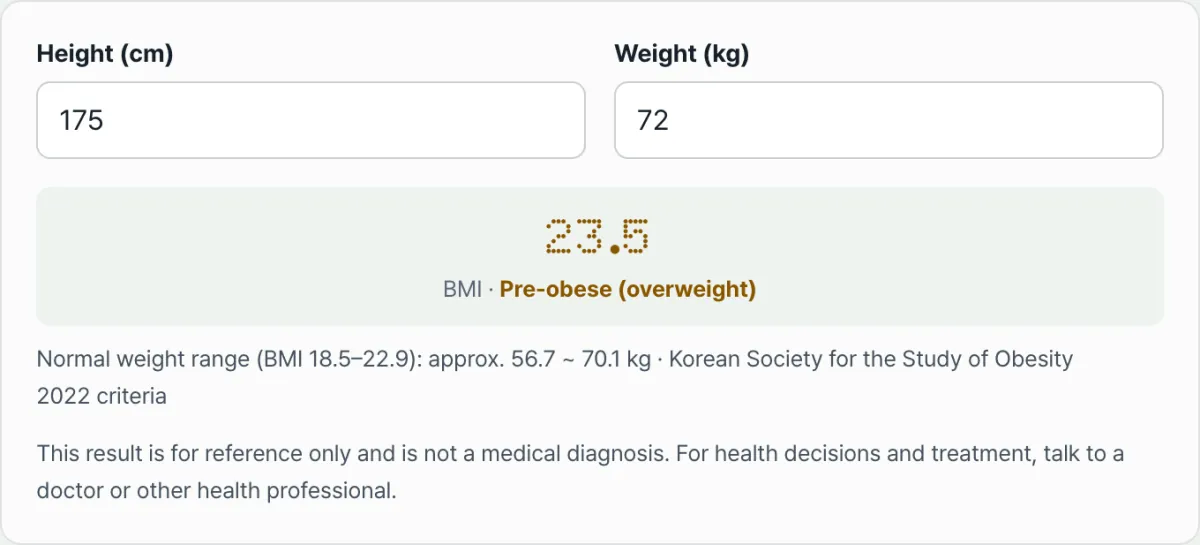
- Example (adult who is 175 cm tall and weighs 72 kg):
- Convert height to meters (m): 175cm = 1.75m
- Square the height: 1.75 × 1.75 = 3.0625
- Divide weight by the squared value: 72 ÷ 3.0625 ≈ 23.51 ➔ Pre-obese (overweight)
Korea (KSSO) vs. the West (Global WHO): Obesity Cutoffs Compared
Asians have a different skeletal structure from Westerners. At the same BMI, they tend to store more abdominal visceral fat, which puts them at a much higher risk of metabolic syndrome, including high blood pressure and diabetes. For this reason, the Asia-Pacific region uses stricter cutoffs.
| BMI Range | KSSO (Korean standard) | Global WHO (Western standard) | Health risk and recommended action |
|---|---|---|---|
| Under 18.5 | Underweight | Underweight | Watch for weakened immunity; make sure you get enough nutrition |
| 18.5 – 22.9 | Normal weight | Normal weight | The healthiest range; keep it up |
| 23.0 – 24.9 | Pre-obese (overweight) | Normal weight | Start managing your diet and doing cardio |
| 25.0 – 29.9 | Class 1 obesity | Overweight | Manage lifestyle habits; see a doctor if needed |
| 30.0 – 34.9 | Class 2 obesity | Class 1 obesity | See a doctor to check for metabolic disease |
| 35.0 or higher | Class 3 obesity (severe obesity) | Class 2 or higher obesity | See a doctor about obesity treatment |
Free · Enter your height and weight to get your BMI and weight category in one second
How It Works: Standard Weight and Formulas That Cover the Limits of the Quetelet Index
Here's a look at the reverse calculation of BMI and the measures that fill in its gaps.
1. Working Backward to Standard (Ideal Body) Weight
Male standard weight (kg) = (height m)2 × 22 Female standard weight (kg) = (height m)2 × 21
- For a woman who is 170 cm tall: 1.7 × 1.7 × 21 = 60.69 kg
- For a man who is 180 cm tall: 1.8 × 1.8 × 22 = 71.28 kg
2. Two Big Blind Spots of BMI
- Ignores skeletal muscle mass: It can't tell how much of your weight is fat (body fat percentage) and how much is muscle (lean mass).
- Ignores where fat is stored: It can't measure visceral fat (abdominal obesity, waist circumference) separately. (Abdominal obesity is a waist of 90 cm or more for men and 85 cm or more for women.)
BMI vs. Body Fat Percentage vs. Waist Circumference: A Combined Health Assessment Matrix
| Measure | How it's measured | Normal range | Strength | Major weakness |
|---|---|---|---|---|
| BMI (body mass index) | Divide weight by height with the formula | 18.5 – 22.9 | Takes one second; global standard | Doesn't separate muscle from fat |
| Body fat percentage (BIA) | InBody bioelectrical impedance analysis | Men 10–20%, women 18–28% | Shows your actual body composition | Varies with hydration and meals |
| Waist circumference (Waist) | Measure around the abdomen with a tape measure | Men <90 cm, women <85 cm | Directly tied to metabolic risk from visceral fat | Can include subcutaneous fat |
| Waist-to-height ratio (WHtR) | waist circumference ÷ height | Under 0.5 | Best predictor of cardiovascular disease | Tape measure error |
5 Common Mistakes When Managing Your Weight
- Fasting based on your BMI alone: You lose weight, but you also lose muscle and water. Your basal metabolic rate crashes, and the weight comes back.
- Relaxing because you trust the Western cutoff (BMI 30): The KSSO standard counts a BMI of 23 or higher as pre-obese and 25 or higher as obese (lower than the Western cutoff of 30).
- Feeling safe with a "skinny fat" build: Even if the number on the scale is normal, thin arms and legs with a protruding lower belly put you in the visceral fat risk group.
- Losing weight too fast: Losing more than 5% of your body weight in a month (for example, more than 3.5 kg at 70 kg) raises your risk of gallstones and hair loss.
- Weighing yourself at inconsistent times: The most accurate reading is right after you wake up and use the bathroom. A reading after dinner includes 1 to 2 kg of water retention.
A 5-Step Workflow for Scientific Weight Management
- Step 1 (Check your current BMI with the BMI Calculator): Enter your height (cm) and weight (kg) to see your current weight category.
- Step 2 (Calculate your standard weight and weight-loss target): Work backward to the standard weight for your height (height2 × 22) and set a realistic target weight.
- Step 3 (Measure your waist and body fat percentage): Use a tape measure around your waist at navel level and check that it's under 90 cm for men or 85 cm for women.
- Step 4 (Set a daily calorie deficit of 500 kcal): Take your basal metabolic rate (BMR) and total daily energy expenditure (TDEE) into account, and plan meals with a 500 kcal daily deficit.
- Step 5 (Track your weight weekly): Weigh yourself on an empty stomach, on the same day each week in the morning, and keep a steady loss of 1.5 to 2 kg per month.
7 Healthy Habits for Weight Management
- Stay within the normal range: According to the Korean Society for the Study of Obesity, a normal BMI is 18.5 to 22.9. Look at the trend over several months, not a single number.
- Eat 1.2 to 1.5 g of protein per kg of body weight: When you diet, eating enough protein helps you burn body fat without losing muscle.
- Cut out liquid fructose completely: The liquid fructose in soda, syrups, and juice can cause insulin resistance and head straight for visceral fat.
- Change the order you eat in: Eating vegetables first, then protein, then carbohydrates may help your blood sugar rise more slowly after a meal.
- Don't skip lower-body strength training: About 70% of your muscle is in your lower body, so squats and lunges raise your basal metabolic rate the fastest.
- Sleep 7 to 8 hours a night: Not getting enough sleep lowers leptin, the hormone that suppresses appetite, and sharply raises ghrelin, the hormone that stimulates it.
- Bookmark this calculator: As you work on your weight, check how your BMI changes along with your weight.
What Should You Do Next Based on Your BMI?
- BMI < 18.5 ➔ [Underweight] Add protein and healthy carbohydrates, and gain weight in a healthy way through strength training
- BMI 18.5 to 22.9 ➔ [Normal weight] Keep your current eating habits, and build fitness with strength training and cardio 3 times a week
- BMI 23.0 to 24.9 ➔ [Pre-obesity] Limit late-night snacks and alcohol, walk briskly for 30 minutes a day, and cut carbohydrates by 20%
- BMI 25.0 to 29.9 ➔ [Stage 1 obesity] Control portion sizes, exercise at least 150 minutes a week, and talk to a doctor if needed
- BMI 30.0 or higher ➔ [Stage 2 to 3 obesity] See a family medicine or internal medicine doctor
Cheat Sheet: Key Medical Terms for Obesity and Body Composition
- BMI (Body Mass Index): An index that estimates overall body fatness from the ratio of height to weight.
- BMR (Basal Metabolic Rate): The minimum energy your body uses just to stay alive, even at rest.
- Visceral Fat: Dangerous fat that builds up around the organs in the abdominal cavity and releases inflammatory substances and fatty acids.
- Sarcopenia: A condition in which skeletal muscle mass and strength drop sharply because of aging or extreme dieting.
Frequently Asked Questions
Why do my weight and BMI change by 1 to 2 kg every day?
Most daily weight changes aren't changes in fat. They come from body water, swelling caused by sodium intake, and the weight of food in your digestive tract. Don't get caught up in daily swings. Comparing your weekly average, weighed first thing in the morning on an empty stomach, is more accurate.
I'm thin, but my lower belly sticks out. Is that still obesity?
Yes. It's called "skinny fat" or "visceral-fat abdominal obesity." You may look thin, but your visceral fat level can be high. That puts your risk of high blood lipids and diabetes on par with people who have general obesity. Strength training and limiting sugar are essential.
Is the body data I enter in the calculator collected?
No, it isn't collected at all. Every calculation in the BMI Calculator runs locally in your web browser, so your personal body information is never stored on a server.
Sources
- Korean Society for the Study of Obesity, "Diagnosis of Obesity: 2022 Update" (Journal of Obesity & Metabolic Syndrome 2023;32(2):121-129) — https://doi.org/10.7570/jomes23031 (accessed 2026-11-17)
- Korean Society for the Study of Obesity, public website, "Obesity Diagnosis" — https://general.kosso.or.kr/html/?pmode=obesityDiagnosis (accessed 2026-11-17)
This article was adapted from our Korean original. Read the Korean original