
Calcium Carbonate Molar Mass: How 100.09 g/mol Is Calculated
Contents
- Why the molecular weight of calcium carbonate gets confusing
- How to do it by hand without a calculator
- Where people slip up: letter case and percentages
- The core mechanism: how the chemistry math works
- Comparison table of common calcium compounds
- Five common calculation mistakes and how badly they go wrong
- A Practical 5-Step Workflow for Calculating Molecular Weight
- 7 Chemistry Calculation Tips
- Final Decision Tree: How Should You Calculate This Compound?
- Key Chemistry Terms Glossary and Cheat Sheet
- Frequently Asked Questions
The molecular weight of calcium carbonate (CaCO3) is 100.086 — the atomic weights of one calcium (Ca), one carbon (C), and three oxygen (O) atoms added together — or about 100.09 g/mol when rounded.
You often need the molecular weight of CaCO3 for a chemistry workbook or an ingredient list, and that's where things go wrong: you look up each atomic weight in a table and add them by hand, then miscount the atoms or lose track of a decimal place.
This post covers how that calculation reaches the number 100.09 in the first place, and how to check any other formula the same way in seconds just by swapping it in.
Summary ① The molecular weight of calcium carbonate (CaCO3) is the atomic weights of 1 Ca + 1 C + 3 O added together, or about 100.09 g/mol. ② A chemical formula has to be read in chunks, one element symbol at a time, each starting with a capital letter. Change the case — Co (cobalt) versus CO (carbon + oxygen) — and you get a completely different value. ③ Mass percent (%) is not the ratio of atom counts. It's the share of the total molecular weight that the element's mass accounts for.
Why the molecular weight of calcium carbonate gets confusing
Chemistry classes and exams ask for the molecular weight of CaCO3 all the time. You open an atomic weight table, look up calcium (Ca), carbon (C), and oxygen (O) one at a time, then add them by hand — and that's exactly where mistakes creep in.
The most common one is missing that there are three oxygen (O) atoms and calculating it as one. A subscript number in a formula tells you how many atoms of that element are present, and the "3" in CaCO3 applies only to oxygen.
The other is that references differ in how many decimal places they give for atomic weights, so it's hard to know which number to use. Count the atoms correctly and plug in the atomic weights correctly, and this is plain arithmetic with no room for error — even by hand.
How to do it by hand without a calculator
The molecular weight of calcium carbonate takes four steps.
Check the atom counts and the atomic weights
Step 1 — Break the formula into elements. CaCO3 consists of 1 Ca (calcium), 1 C (carbon), and 3 O (oxygen). A number right after an element symbol is that element's count, and if there's no number, it's 1.
Step 2 — Look up the standard atomic weight of each element. The widely used standard atomic weights are roughly Ca 40.078, C 12.011, and O 15.999. You can find them in an atomic weight table or on the periodic table.
Step 3 — Multiply (count × atomic weight) for each element.
- Ca: 1 × 40.078 = 40.078
- C: 1 × 12.011 = 12.011
- O: 3 × 15.999 = 47.997
Add the values to finish the molecular weight
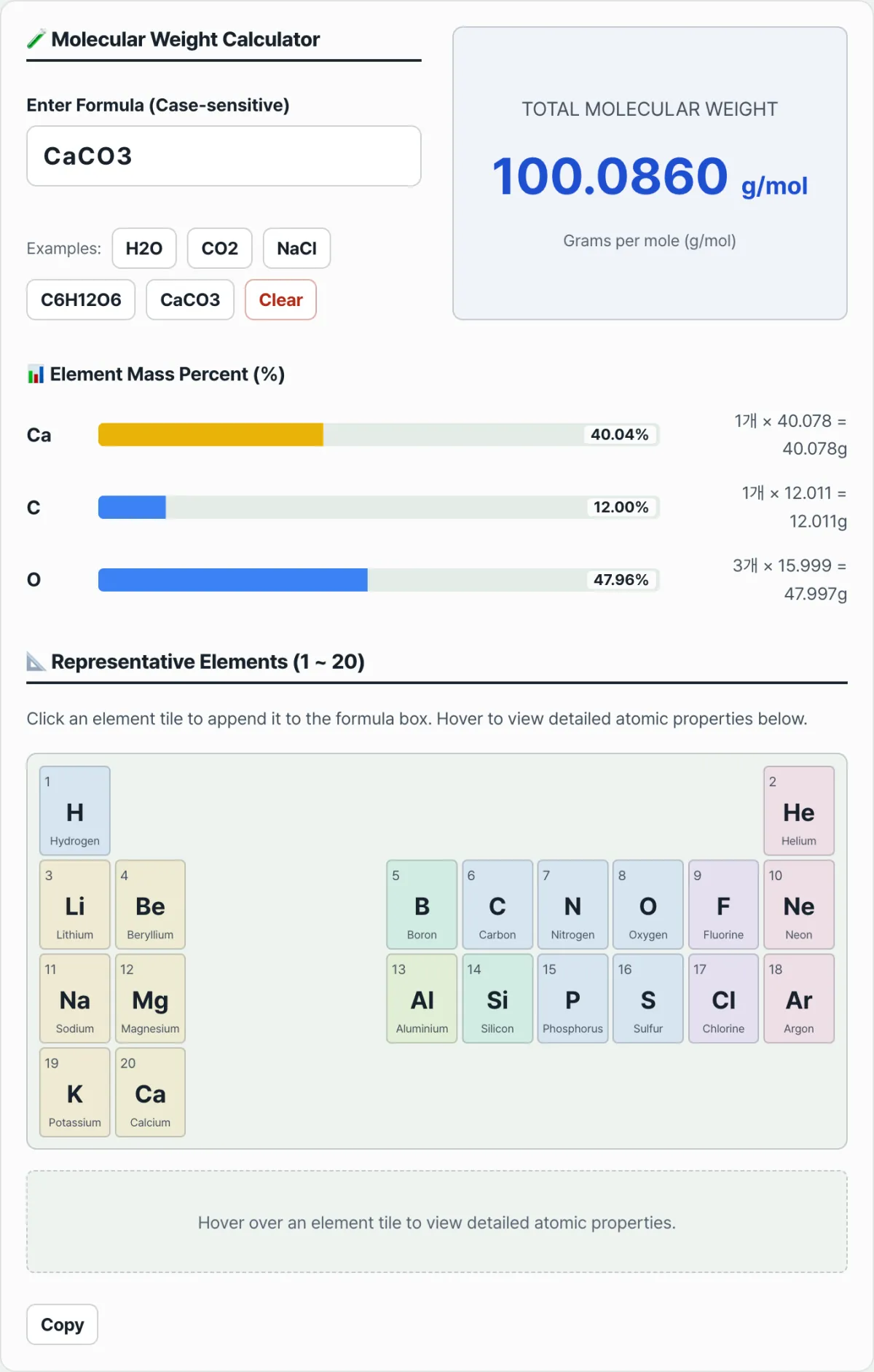
Step 4 — Add all three values. 40.078 + 12.011 + 47.997 = 100.086, which rounds to about 100.09 g/mol — the molecular weight of calcium carbonate.
You can get the mass percent of each element from the same numbers. Divide each element's total mass by the total molecular weight (100.086) and multiply by 100. For oxygen, for example, 47.997 ÷ 100.086 × 100 ≈ 47.96%, which is nearly half of calcium carbonate's mass.
The same approach lets you calculate any formula by hand: recount the atoms and plug in accurate atomic weights. The catch is that as you add more elements, or as the atomic weights get longer, decimal slips become easy in hand calculations.
Check it with our free tool.
Enter a chemical formula in the Periodic Table & Molecular Weight Calculator and it matches each symbol against the atomic weight table, then shows the total molecular weight and each element's mass percentage right away. Free, no login needed.
Where people slip up: letter case and percentages
A chemical formula is read one element symbol at a time, each starting with a capital letter. Swap a capital for a lowercase letter and it reads as a completely different element.
For example, "Co" reads as the single element cobalt, but "CO" reads as carbon (C) and oxygen (O) joined together. Change that one capital O and the result is entirely different.
| Notation | Interpretation | Result |
|
The core mechanism: how the chemistry math works
Getting an accurate molecular weight requires the international standard reference values and a mathematical grasp of the calculation mechanism.
The molecular weight of calcium carbonate follows the standard atomic weights of the IUPAC Commission on Isotopic Abundances and Atomic Weights (CIAAW 2021).
- Calcium (Ca) = 40.078(4)
- Carbon (C) = 12.011
- Oxygen (O) = 15.999(4)
Molecular mass (Mr) vs. molar mass (M) Strictly speaking, molecular mass is a dimensionless (unitless) relative value based on 1/12 the mass of the carbon-12 isotope. Molar mass is the mass per unit amount of substance (1 mole) and uses the unit g/mol. In practice, though, the two numbers are identical, so they get used interchangeably.
The relationship to Avogadro's number (NA = 6.022 × 10²³ mol−1) The microscopic mass of a molecule measured in atomic mass units (amu) converts exactly into the macroscopic mass in grams (molar mass) that we can actually weigh in daily life only once you gather Avogadro's number of them.
Mass fraction formula The weight ratio of a given element in a compound is calculated with the following formula. wi = ni × Ar,i/Mr × 100% (where ni is the number of atoms of the element, Ar,i is that element's atomic weight, and Mr is the total molecular weight)
CaCO3, the absolute reference for chemical analysis Add up the molecular weight of CaCO3 and you get 40.08 + 12.01 + 48.00 = 100.09 g/mol, landing neatly on the number 100. The math is that clean, it has few impurities, and it's easy to weigh — which is why calcium carbonate is widely used as a primary standard in gravimetric analysis and acid-base titration experiments.
Comparison table of common calcium compounds
Beyond calcium carbonate, here's how other calcium compounds used in industry and daily life compare on molecular weight and mass percent. The actual calcium content varies a lot from one compound to another, so choose the one that fits your purpose.
| Compound | Formula | Molecular weight (g/mol) | Calcium mass percent (%) | Main uses |
|---|---|---|---|---|
| Calcium carbonate | CaCO3 | 100.09 | 40.04% | Antacids, chalk, limestone |
| Calcium chloride | CaCl2 | 110.98 | 36.11% | Winter de-icer, desiccant |
| Calcium hydroxide (slaked lime) | Ca(OH)2 | 74.09 | 54.09% | Soil acidity amendment |
| Calcium sulfate | CaSO4 | 136.14 | 29.44% | Building plaster, tofu coagulant |
| Calcium oxide (quicklime) | CaO | 56.08 | 71.47% | Heat packs, cement raw material |
| Calcium phosphate | Ca3(PO4)2 | 310.18 | 38.76% | Bone health supplements, artificial bone |
Five common calculation mistakes and how badly they go wrong
When you're studying chemistry or preparing an experiment, one small misreading can lead to results you can't undo.
- Ignoring subscripts on polyatomic ions: With a polyatomic ion like NO3, SO4, or CO3, people either multiply the trailing number across the whole group or drop it entirely. In CaCO3, the "3" applies only to O.
- Letter-case errors (Co vs CO): Writing silicon (Si) as SI (sulfur + iodine) or cobalt (Co) as carbon monoxide (CO) — not distinguishing case can throw the molecular weight off by hundreds of times.
- Using whole-number atomic weights for precise experiments: Middle and high school exams use C=12 and O=16 for convenience, but in real analytical chemistry, dropping the decimals (12.011) shifts your significant figures and makes experimental error grow exponentially.
- Confusing mole ratio with mass percent: In CaCO3, oxygen's atom ratio is 3/5 (60%), but its mass percent is about 48%. Mix up count and weight when combining reagents and your concentration will be completely off.
- Ignoring water of crystallization in hydrates: When weighing a hydrate with bound water molecules, such as copper sulfate (CuSO4, e.g. CuSO4·5H2O), leaving out the weight of 5H2O (about 90 g/mol) leads to concentration errors.
A Practical 5-Step Workflow for Calculating Molecular Weight
No matter how complex the compound you're given, these 5 steps will never let you down.
- Step 1 (Parse the formula and separate the elements): Split the formula at each capital letter. (Example: Ca / C / O)
- Step 2 (Check the subscripts and set the multipliers): Look at the number after each element. If there's no number, it's 1. (Ca=1, C=1, O=3)
- Step 3 (Look up the standard IUPAC atomic weights): Find the exact decimal atomic weight of each element in a reliable periodic table.
- Step 4 (Calculate the mass of each element and add them up): Multiply each atomic weight by its count, then add all the results to get the total molecular weight (molar mass).
- Step 5 (Verify with mass percentages): Calculate the share each element contributes, then check backward to confirm the percentages add up to 100%.
7 Chemistry Calculation Tips
These are the core habits researchers and chemistry majors follow in the lab without even thinking about it.
- Always capitalize the first letter of an element symbol: Make it a habit to write the first letter of an element symbol in uppercase and the second in lowercase, no matter what. This prevents parsing errors.
- Memorize the four big atomic weights: CHON makes up more than 90% of the human body (carbon 12.011, hydrogen 1.008, oxygen 15.999, nitrogen 14.007). Memorizing these speeds up your calculations.
- Check whether a salt is a hydrate: Before you take a reagent off the shelf, always check the label to see whether the compound is anhydrous or a hydrate, and recalculate the molecular weight accordingly.
- The 100% check rule: If the mass percentages you calculated for each element don't land between 99.9% and 100.1%, there's a clear error somewhere in your intermediate math.
- Keep molarity (M) and molality (m) strictly separate: Decide whether you're dissolving your compound in a solvent measured by volume (molarity) or by mass (molality) based on how sensitive the measurement needs to be to temperature changes.
- Match your significant figures to your balance's precision: On an ordinary balance that measures to 0.1 g, rounding the molecular weight to 100.1 instead of 100.086 actually narrows your margin of error.
- Use a dedicated verification tool: No matter how confident you are, cross-check with the molecular weight calculator on this site to eliminate human error at the source.
Final Decision Tree: How Should You Calculate This Compound?
Here's a guide to deciding within one second which type of formula weight notation to follow based on the properties of the substance you have.
- Is it a single element? (e.g., Fe, C) ➔ Use Atomic Weight (use the periodic table number as is for the substance)
- Is it a standalone molecule held together by covalent bonds? (e.g., H2O, CO2) ➔ Use Molecular Weight (add up the atomic weights)
- Is it an ionic compound of a metal and a nonmetal? (e.g., CaCO3, NaCl) ➔ Use Formula Weight (it doesn't exist as a molecule, so add up based on the empirical formula)
- Does it contain water of crystallization? (e.g., MgSO4·7H2O) ➔ Use Hydrate Formula Weight (add the weight of water, 18.015, times the number of water molecules)
Key Chemistry Terms Glossary and Cheat Sheet
Here are clear definitions of the key terms that trip people up during lab work and paper writing.
- Molecular Weight: The relative mass of a single molecule that exists independently.
- Molar Mass (g/mol): The actual macroscopic mass of one mole of a substance (6.022×10²³ units) taken together.
- Atomic Weight: The relative mass ratio of other elements when the mass of the carbon-12 isotope is set to 12.
- Mass Fraction: The percentage of a compound's total weight contributed by a particular element.
- Avogadro Constant: The number of particles that defines the grouping unit we call one mole (about 6.022 × 10²³).
- Hydrate: A compound in which water molecules are stably bound within the crystal structure.
Frequently Asked Questions
Clear answers to the more advanced questions people ask most often right before running an actual experiment.
Q1. Do natural limestone, marble, and chalk all have the same molecular weight for their calcium carbonate?
A1. If the CaCO3 is chemically pure, the molecular weight is the same: 100.09 g/mol. But real marble and limestone contain various impurities such as magnesium and iron, so if you assume the whole sample is 100% calcium carbonate and calculate from that, you can end up with errors.
Q2. How do you calculate the molecular weight for a formula with parentheses, like calcium hydroxide, Ca(OH)2?
A2. Just multiply every element inside the parentheses by the subscript outside the parentheses. Ca(OH)2 splits into 1 Ca, 2 O, and 2 H, so (40.08) + (15.999 × 2) + (1.008 × 2) = 74.09 g/mol.
Q3. When a compound is in hydrate form, how do the calculation and the experiment change?
A3. If the reagent bottle says something like 'CaCO3·xH2O', you need to add about 18.015 g/mol to the total formula weight for each water molecule in the hydrate. Ignore that, and you'll end up with a failed experiment where the actual concentration is noticeably more dilute than you expected.
This article was adapted from our Korean original. Read the Korean original