
CES-D Depression Test Scoring: Reverse-Scored Items Explained
Contents
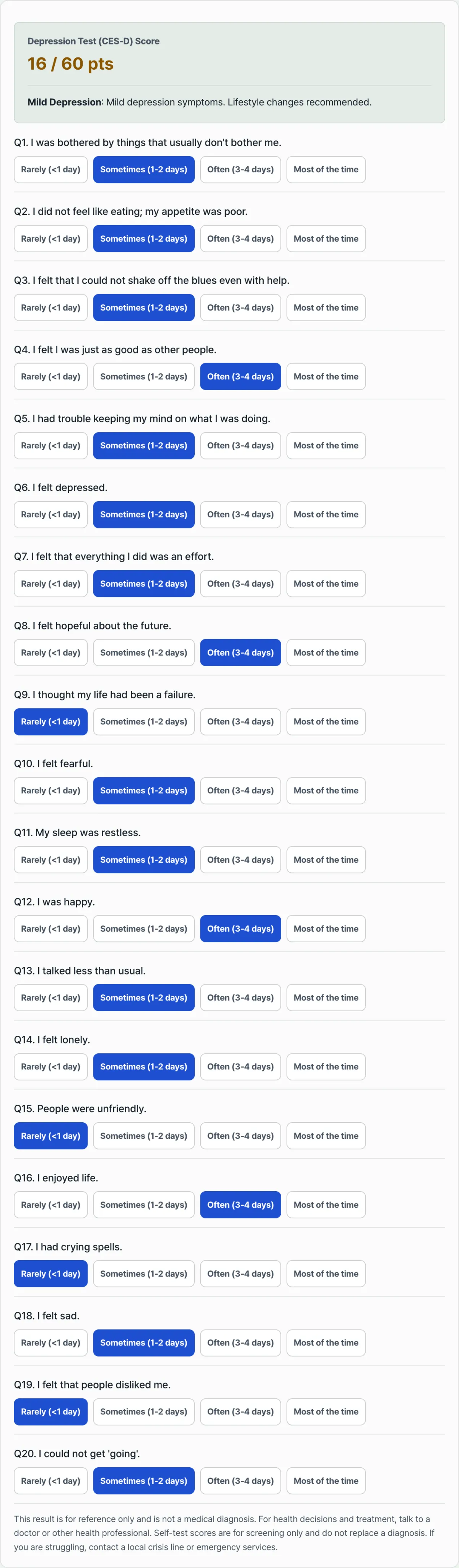
The CES-D depression self-test has you answer 20 questions on a 0–3 scale. Items 4, 8, 12, and 16 are positive statements, so they are reverse scored (3 − your answer). The total score runs from 0 to 60. Our tool shows 15 or below as normal, 16–20 as mild, 21–24 as moderate, and 25 or above as severe depressive symptoms. The result is a screening score for reference only. It is not a diagnosis.
Feeling down for a short time is different from depression that needs treatment. This article explains how the 20 CES-D items are scored and what each score range means. The CES-D is a depression scale developed at the Center for Epidemiologic Studies of the National Institute of Mental Health in the United States.
Important: Medical disclaimer for mental health and psychological screening tests The CES-D self-test results and explanations here are a "supplementary screening tool." They do not replace a formal clinical interview. This is a simple questionnaire calculation. It does not include an in-depth interview with a clinical psychologist, physiological tests, or details of your personal circumstances. Please don't use this score alone to decide whether you have depression. If your total is 16 or higher, consider talking with a psychiatrist or a local mental health center. If you are having thoughts of dying or urges to harm yourself, call right now, no matter what your score is. In South Korea, the 24-hour suicide prevention hotline is 109, and the mental health crisis line is 1577-0199.
Summary ① CES-D scale: A depression screening scale with 20 questions asking how many days in the past week you had certain feelings and behaviors. ② Reverse scoring: To keep the questionnaire consistent and reduce response bias, positive items (for example, "I was happy" or "I enjoyed life") are scored in the opposite direction from the other items, using the formula
3 - selected value. ③ Score ranges: The tool labels 16 or higher as mild, 21 or higher as moderate, and 25 or higher as severe depressive symptoms. A score of 16 is a commonly used screening cutoff for the CES-D. The 21 and 25 cutoffs are based on criteria proposed in Korean studies. ④ Once you answer all 20 questions, you get your total score, your level, and a short guidance message.
1. The Math Behind CES-D Depression Scoring
For each question, the CES-D gives 0 points (rarely or none of the time, less than 1 day), 1 point (some or a little of the time, 1–2 days), 2 points (occasionally or a moderate amount of the time, 3–4 days), or 3 points (most or all of the time, 5 or more days), based on how many days in the past week you felt that way. The four positive items must be scored in reverse for the total to be correct.
CES-D Total Score Formula
Total score = (sum of the scores for items that are not reverse scored) + (sum of "3 − item score" for the reverse-scored items) (The reverse-scored items are questions 4, 8, 12, and 16, which describe positive states.)
How Reverse Scoring Works
- Standard negative items: "I felt sad" → the more often it happened, the higher the score, up to 3 points (adds to the depression total)
- Positive reverse-scored items: "I was happy" → if that was true most of the time, your answer is 3 points, but it becomes 3 − 3 = 0 points when added to the total.
2. How to Read Your Score Range
Based on your total (0–60), the tool shows one of the four levels below. Different studies use slightly different cutoffs, so treat these ranges as a screening reference.
- 0–15 points: Normal
- Your emotional state is within a typical range. Everyday stress management is enough.
- 16–20 points: Mild Depressive Symptoms
- You may be carrying low mood and emotional fatigue. Regular aerobic exercise, enough sleep, and getting outside to spend time with friends are all strongly recommended.
- 21–24 points: Moderate Depressive Symptoms
- A meaningful level of depressive symptoms is showing up. Rather than working through it alone, talk openly with a family member or friend you trust.
- 25–60 points: Severe Depressive Symptoms (Professional help recommended)
- You reported a high number of depressive symptoms. Rather than letting it go, see a psychiatrist for a proper evaluation and to discuss treatment options.
How to Use the Depression Self-Test
If you don't want to work through a text table, track each question number with your finger, and do the reverse-scoring subtraction in your head, a dedicated self-test calculator is easier.
Free · No sign-up · Answer all 20 CES-D questions and get your total score and level, with reverse scoring calculated automatically
The tool is simple to use.
- Answer the questions: For each of the 20 questions, choose how often it applied during the past week: "Rarely or none of the time," "Some of the time," "Occasionally," or "Most of the time." While you answer, the tool only shows how many questions you've completed.
- See your result: Once you answer all 20 questions, you get your total score (out of 60), one of Normal, Mild, Moderate, or Severe, and a short guidance message. The tool calculates reverse scoring for you automatically.
- Below your result, the tool also shows the South Korean suicide prevention hotline, 109 (24 hours), and the mental health crisis line, 1577-0199.
Bottom Line
Depression is not a sign of weak willpower. It is a treatable condition shaped by a mix of biological, psychological, and environmental factors. Your CES-D score is a screening reference to help you check in on how you're doing right now. If your score is high, or if you've felt bad for two weeks or longer, please talk to a professional.
Free · No sign-up · Answer all 20 CES-D questions and get your total score and level, with reverse scoring calculated automatically
Frequently Asked Questions
Does depression treatment really change the brain physically?
Some neuroscience studies report a link between depression and changes in brain structure. But this is still an active area of research, and it can't be said to apply the same way to every patient.
- Some studies report that long-untreated depression is associated with a tendency toward a smaller hippocampus, the brain region involved in memory and emotion.
- There are reports of symptoms improving when antidepressants (such as SSRIs) are combined with counseling or cognitive behavioral therapy, along with increased secretion of brain-derived neurotrophic factor (BDNF). However, the speed and extent of recovery vary widely from person to person, and a full return to a previous state is not guaranteed.
Can a psychiatric treatment record hurt me when applying for jobs or insurance?
In general, the law restricts medical records from being given to third parties without your consent. So, in principle, it is difficult to treat you unfavorably based on a history of psychiatric care alone.
- Some occupations (for example, jobs that require certain safety- or security-related qualifications or licenses) may be exceptions where you must separately disclose your health status under the relevant laws.
- When you apply for private indemnity health insurance, a history of psychiatric treatment may have to be disclosed. The specific standards and any waiting period or restriction on coverage differ by insurer and by product.
- If you want the exact legal standards, it's safest to ask a legal professional or a relevant agency, such as the Financial Supervisory Service in South Korea. Worrying about stigma shouldn't make you put off treatment when you need it.
This article was adapted from our Korean original. Read the Korean original