
Distance, Speed, and Time Formula: Convert m/s to km/h (×3.6)
Contents
1. The 'Distance, Speed, Time' Triangle Formula Explained
The classic speed formula from physics comes down to basic algebra with fractions and multiplication.
Distance formula: d = s × t Interpretation: If you drive a car at
80 km/hfor2 hours 30 minutes (2.5 hours), the distance traveled is 80 × 2.5 = 200 km.Speed formula: s = d ÷ t Interpretation: If you covered a distance of
150 kmin2 hours, your average speed works out to 150 ÷ 2 = 75 km/h.Time formula: t = d ÷ s Interpretation: If you drove the
100 kmto your in-laws' place at a highway speed of60 km/h, the time it takes is 100 ÷ 60 ≈ 1.67 hours = 1 hour 40 minutes.
2. Deriving the 3.6 Conversion Constant Between m/s and km/h
When you look at typhoon wind speeds (say, a 25 meter-per-second gale) or a treadmill pace, it's easy to get thrown off because the number doesn't map intuitively to the km/h you know from driving.
The two units are tied together by the ratios of the time unit (1 hour = 3,600 seconds) and the length unit (1 km = 1,000 m).
1 m/s = (1 m) ÷ (1 s) = (0.001 km) ÷ (1/3,600 hours) = 0.001 × 3,600 km/h = 3.6 km/h
m/s → km/h conversion formula: km/h = m/s × 3.6
km/h → m/s conversion formula: m/s = km/h ÷ 3.6
Worked example (a typhoon wind of 20 m/s):
- Converting to km/h: 20 × 3.6 = 72 km/h What this means: A wind of 20 meters per second equals a speed of 72 km/h after unit conversion. That said, the wind strength (pressure) you actually feel depends not only on speed but also on air density, the surface area exposed, the drag coefficient, and so on — so the same speed doesn't mean the physical force is exactly the same.
How to Get the Most Out of the Distance, Speed, and Time Calculator
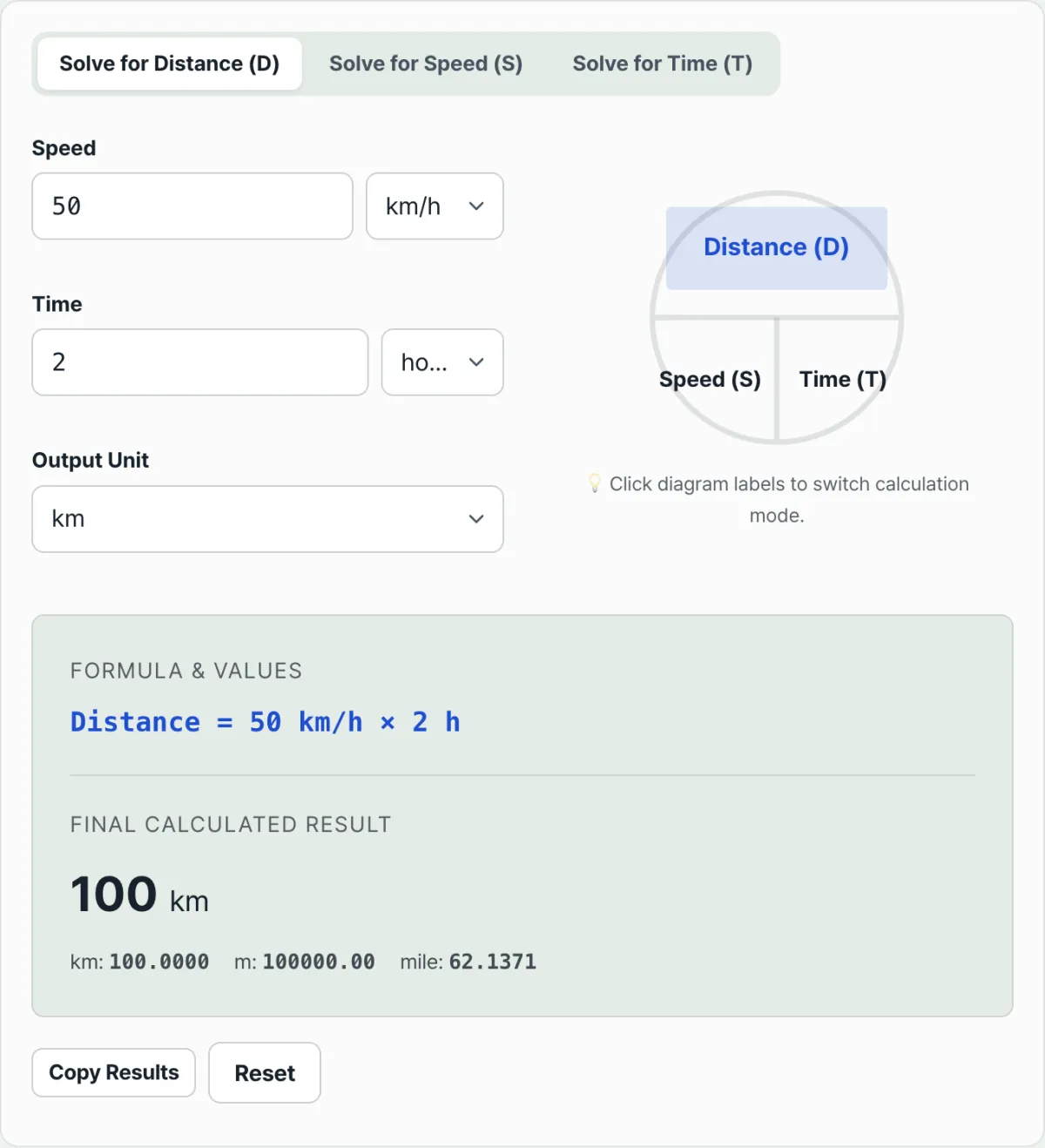
If you're tired of plugging decimal hours (say, how many minutes 1.43 hours is) into a hours/minutes/seconds conversion formula by hand, or you keep getting tripped up by unit conversions, try the dedicated distance, speed, and time module.
Free · no sign-up · enter any two of distance, speed, or time and the third is calculated instantly
The tool is laid out in a very clear order.
- Enter your variables: Of the three input fields for distance, speed, and time, fill in the two values you know (you can choose any unit you like: km, m, km/h, m/s, hours, minutes, and so on).
- The remaining empty field is filled in automatically in real time with the calculated result, rounded to decimal precision.
- At the same time, the result panel below shows the formula used along with the final value, and the results are converted into several units at once — distance in km/m/mile, speed in km/h/m/s/mph, time in hours/minutes/seconds — so you can read the answer right away without converting units yourself.
Wrapping Up
Understanding how distance, speed, and time work in proportion is a basic skill for any smart businessperson trying to control transportation costs or plan a trip without gaps. Before you set out, open the calculator to check precise driving time and unit conversions, and build a safe timetable that conservatively accounts for traffic variables on the road.
Free · no sign-up · enter any two of distance, speed, or time and the third is calculated instantly
Frequently Asked Questions
What speed in km/h do I need to run a sub-3 marathon?
Finishing a full marathon (42.195 km) in under 3 hours (sub-3) takes a serious pace.
- Average speed calculation: s = 42.195 km ÷ 3 hours ≈ 14.07 km/h
- Pace conversion: You need to hold roughly 4 minutes 16 seconds per kilometer steadily for 3 hours to hit that time. In the calculator's "Solve for speed (S)" mode, enter 42.195 km and a target time of 2 hours 59 minutes, and you'll see the average speed you need in km/h, m/s, and mph right away.
How do average-speed (point-to-point) speed cameras work?
Average-speed cameras don't use a simple radar-gun laser reading. They apply the average speed principle from the distance, speed, and time formula to catch speeding vehicles.
- How enforcement works: A camera at the start of the monitored stretch records the time your vehicle passes, and a camera several kilometers away (for example, 10 km) records the time again at the end.
- Dividing the exact distance (d) between the two points by the time difference (t) gives the vehicle's average speed (s).
- If the posted limit is 100 km/h but the calculated average comes out to 110 km/h, you get a ticket — no matter how much you slowed down in the middle of the stretch.
This post is based on the basic physics formulas for distance, speed, and time and on the principles behind km/h–m/s unit conversion.
This article was adapted from our Korean original. Read the Korean original