
Fantasy Name Generator: Why Elves and Orcs Sound Different
Contents
When you name a game character or a web novel character, some names instantly give the impression of "that sounds like an elf" or "that sounds like an orc," while others feel awkward and disconnected from the setting. That difference doesn't come from gut feeling. It comes from the sound (phoneme) combinations that get repeated for each race. This post covers why names sound different by race in fantasy fiction, and the rules you can use to build names yourself without any tool.
Summary ① Elf names traditionally use soft sounds where liquids (l, r) flow into vowels, while orc names use harsh sounds with stacked plosives (g, k). ② Suffixes common in human and dwarf names, like '-ton, -ford, -smith, -son', have real origins in actual English place names and surnames. ③ Once you know these sound rules, you can combine race-appropriate names yourself without a generator.
Why some names don't sound "elven"
If you're naming an orc warrior for a TRPG scenario or a game design doc and a name like 'Aeliana' pops into your head, something feels off right away. The sound itself sits closer to elves than orcs.
That discomfort isn't a matter of taste. It comes from sound-placement conventions that fantasy fiction has repeated for a long time. Since Tolkien's language work, most games and novels have followed a set phoneme combination for each race, and readers and players have learned that convention.
If you don't know the rules and just attach random syllables, you end up with names where the sound clashes with the setting — "an elf with an orc name," or "a dwarf with a human name."
How name sounds split by race
The two things that separate the name sounds of the four races are the type of consonants and the way syllables close. Here's the breakdown in a table.
| Race | Sound traits | Sounds used often |
|---|---|---|
| Elf | Soft sounds where liquids (l, r) and vowels stretch out long | ael-, syl-, -ariel, -wind, -star |
| Orc | Short, harsh sounds with stacked plosives (g, k) and fricatives | grom-, thrak-, -gash, -claw, -crush |
| Dwarf | Hard sounds ending in closed consonants, with mineral and metal imagery | thor-, bal-, -stone, -iron, -shield |
| Human | Balanced sounds that read as ordinary, with no particular color | ed-, val-, -ton, -ford, -smith |
Human and dwarf suffixes often borrow directly from the way English-speaking regions actually formed place names and surnames. '-ton' comes from an Old English word for a village or enclosure, '-ford' from a river crossing, '-smith' from the occupation of blacksmith, and '-son' from a patronymic meaning "son of." These suffixes don't feel foreign because they're real surname-building patterns.
Elf and orc sounds, by contrast, weren't borrowed from any real language. They're invented phonology designed purely around the impression of sound. Liquids and long vowels are placed on purpose to feel soft and mysterious, while plosives and short closed syllables are placed to feel rough and threatening.
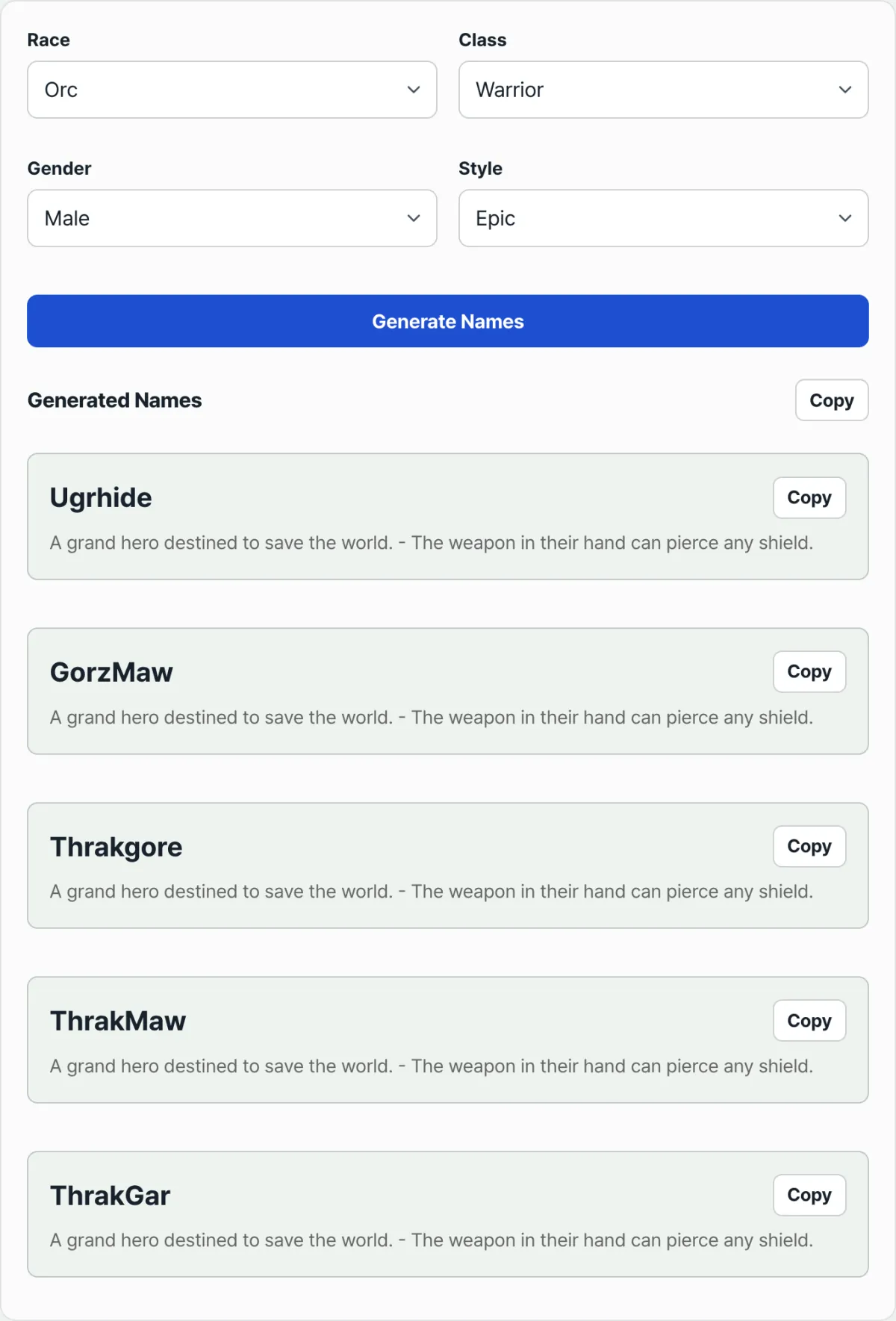
Check it with our free tool. You can use these rules to combine prefixes and suffixes by hand, but if you want to swap race, class, and mood and compare several candidates at once, a generator is faster.
Free · no signup · instant names by race, class, and mood
The spots where naming usually gets stuck
| Question | Fact |
|---|---|
| Does changing the race completely change how the name sounds? | Yes. Each race has its own separate prefix and suffix word lists, so picking a different race swaps the entire sound family. |
| Does changing the class or mood change the name too? | No. The name sound depends only on the race. Class and mood only affect the description text (tagline) attached next to the name. |
| Is it weird if the same name keeps coming up? | No. Each name picks one prefix and one suffix independently from 10 options each, so repeated attempts can produce the same combination again. |
| Does specifying gender change the sound? | Gender is a character setting field. It doesn't take part in choosing the prefixes and suffixes that build the name itself. |
Wrapping up
Whether a fantasy name sounds like its race is decided by consonant types and syllable structure, not by feel. Elves use liquids and vowels, orcs use plosives and closed syllables, and dwarves and humans borrow suffixes from real English place names and surnames.
Knowing these rules helps you avoid naming mistakes that clash with a race, and it also helps you understand why a generator's output sounds the way it does.
Free · no signup · instant names by race, class, and mood
Frequently asked questions
Is there an official international standard for fantasy race names?
There's no official standard. Since Tolkien's work, many games and novels have followed similar sound conventions, so it's closer to a creative practice that hardened into an unspoken agreement among readers and players.
Are suffixes like '-ton' and '-smith' really from actual English words?
Yes. '-ton' comes from an Old English word meaning village, and '-smith' comes from the occupation of blacksmith. Both are real place-name and surname patterns. Fantasy name generators use these suffixes precisely because that etymology makes them feel familiar.
Is a repeated name a bug in the generator?
No. Each race has around 10 prefixes and 10 suffixes, and each name picks randomly from those every time, so seeing the same combination again after several tries is normal.
Does changing class or gender change the name too?
No. The name sound depends only on the race you pick. Class, mood, and gender change the character description text that appears next to the name.
This article was adapted from our Korean original. Read the Korean original