
Morse Code Decoding: Alphabet Chart and How to Translate
Contents
In the movies Parasite and Interstellar, characters send messages by tapping on walls or flashing lights. The signaling system they use is Morse code.
Morse code maps the English alphabet, digits, and major punctuation to one-to-one combinations of a short signal — the dot (.) — and a long signal — the dash (-). This article covers how each character's code is assigned and which rules separate letters from words when you convert text to Morse and back.
Summary ① Letters, digits, and punctuation map one-to-one to dot-and-dash combinations, and case does not matter. ② Letters are separated by one space, and words are separated by a slash (
/). ③ Once you know these rules, you can encode and decode by hand to check any result, no tool needed.
Why Morse code is still around
Morse code was created during the telegraph era in the 19th century, but it survives today in distress signals (SOS), amateur radio, and cipher puzzles. The reason is simple. It is one of the few codes that can carry text through devices that express only two states, on and off — sound, light, or vibration.
The problem is that most people have not memorized all 26 letters and 10 digits. So even to send one short sentence, you have to look up a table each time. And when you receive a string of dots and dashes, you have to match it character by character by hand.
Alphabet and number mapping dictionary
In Morse code, every character corresponds to one fixed combination of dots (.) and dashes (-). The more frequently a character is used, the shorter its code. Here are some common examples.
| Character | Morse code | Notes |
|---|---|---|
A | .- | One dot, one dash |
B | -... | One dash, three dots |
E | . | The most common letter in English, so the shortest: a single dot |
S | ... | Three dots |
O | --- | Three dashes |
T | - | One dash |
Digits are always fixed at five dot/dash positions.
| Digit | Morse code |
|---|---|
1 | .---- |
5 | ..... |
9 | ----. |
If you convert the well-known distress signal SOS one character at a time with this table, you get S (...) + O (---) + S (...), which is ... --- .... In actual radio practice, operators sometimes sent SOS run together as ...---... with no letter spacing, but if you encode text by the standard rules, the spaces between characters stay in place and you get the ... --- ... form.
Rules for separating letters and words when converting text ↔ Morse code
When you convert a sentence to Morse code, or decode one back, just follow these steps in order.
Encoding (text → Morse code)
- Morse does not distinguish uppercase from lowercase, so convert everything to uppercase first and compare it against the dictionary.
- Replace each character with its code from the table, and inside a single word put one space between characters.
- At each point where the word changes, add a slash (
/) to mark the word boundary. For example, "SOS HELLO" becomes... --- ... / .... . .-.. .-.. ---.
Decoding (Morse code → text)
- Split first on the slash (
/) to group the code into words. - Inside each word, split on spaces to get the dot/dash letter codes one at a time.
- Look each code up in reverse (code → character), restore the original letter, and join them together.
There is one point people often miss. Word boundaries are not recognized no matter how many spaces you put in. You must use a slash (/). If you only leave extra spaces with no slash, the spaces between words disappear and everything decodes as one block.
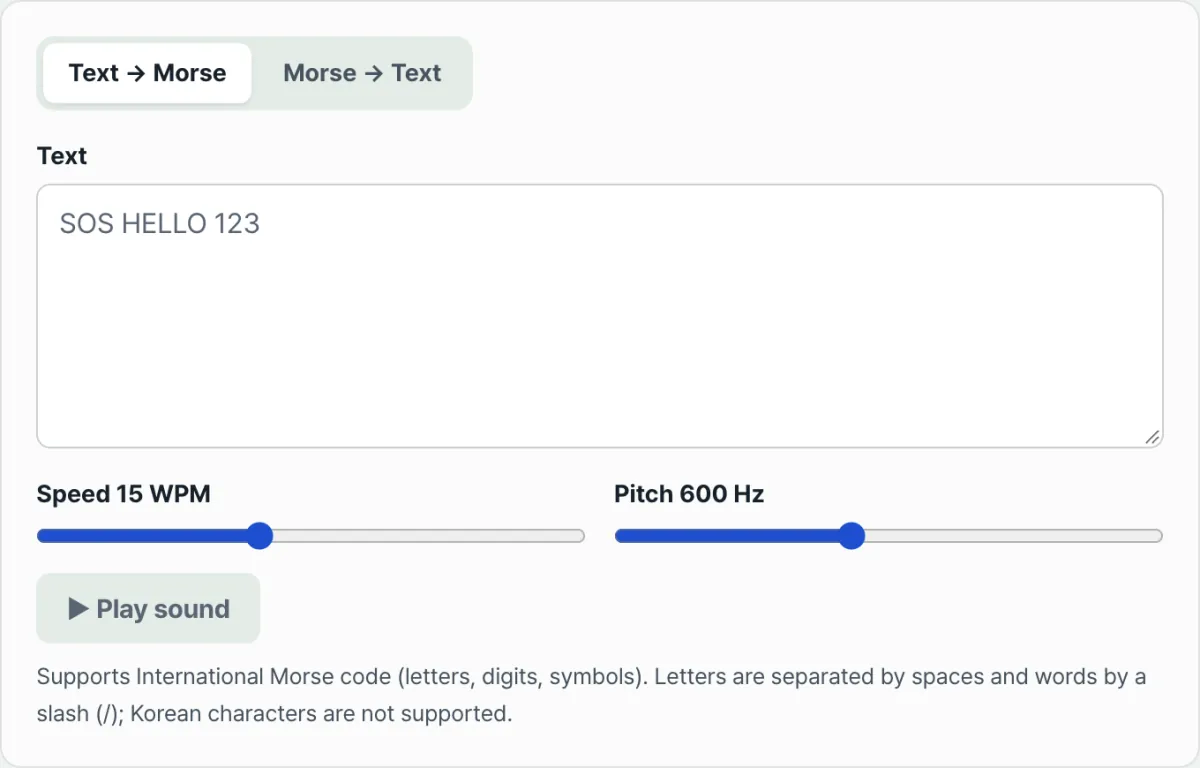
Check it with our tool. Instead of matching characters against a table by eye, type your text or Morse code into the Morse Code Translator and it converts in both directions instantly.
Type the text or Morse code (. and -, plus spaces) you want to translate and see the result in the other format update live as you go.
Common sticking points
| Situation | Result |
|---|---|
| Missing the space between characters | .- (A) and . (E) + - (T) can't be told apart, so it reads as a different character |
| Using spaces instead of a slash between words | The word boundary disappears and the words decode as one |
| Typing in lowercase | Case does not matter, so the result is the same, but you need to uppercase it before comparing against the dictionary |
| Typing Korean | Korean is not in the international Morse code table, so it will not convert (English letters, digits, and symbols only) |
Recap
- In Morse code, every character has a fixed dot-and-dash combination in a one-to-one substitution code, and case does not matter.
- Separate characters with one space and words with a slash (
/). Keep just these two separators correct and you can verify results by hand. - If you need to do this repeatedly, checking with a tool is faster than looking up the table every time.
Type the text or Morse code (. and -, plus spaces) you want to translate and see the result in the other format update live as you go.
Frequently asked questions
Can I convert Korean into Morse code?
This tool works with international Morse code (English letters, digits, and major symbols) and does not support Korean. You need to translate Korean text into English first, then convert it.
Can I separate words with just the spacebar?
No. Characters are separated by one space, but words must be marked with a slash (/) to be told apart correctly. If you only add multiple spaces, the word boundaries disappear and everything decodes as one.
Why do sources write SOS differently?
If you chain the per-character codes (S=..., O=---) directly, you get ... --- ..., but in actual radio traffic operators conventionally sent it run together as ...---... with no letter spacing. It is only a difference in notation — the codes themselves are the same.
This article was adapted from our Korean original. Read the Korean original