
Initials from English Names: Rules, Order, and Capitalization
Contents
Instead of spelling out a full English name, we call the notation that gathers only the first letter of each word initials. You see them often in business email signatures, logo monograms, and the supporting documents for passports and airline tickets. But the order of the family name and given name differs from one culture to the next, and conventions for periods and capitalization vary just as much, so building them by hand every time invites mistakes. This article lays out the rules for making initials and clears up the conventions people mix up most.
The Basic Rules for Forming Initials from an English Name
Making initials comes down to three steps.
- Split the name into words. Break the full name apart on the spaces. Example: "John Fitzgerald Kennedy" → John / Fitzgerald / Kennedy.
- Keep only the first letter of each word and capitalize it. J / F / K.
- Join them with separators. Add periods and you get "J.F.K."; leave them out and you get "JFK".
Whether to include a middle name depends on the situation. On formal documents like a signature line, you include the middle name and write "J.F.K."; in other cases you shorten it to just the first name and the family name.
Eastern vs. Western Order: Family Name and Given Name
Because the order of the family name and the given name differs by culture, you have to figure out which word is the family name before you make initials.
- Western order (Given → Family): The given name comes first and the family name last. For "Albert Einstein", making initials in the same word order gives "A.E."
- Eastern order (Family → Given): In Korea, China, Japan, and elsewhere, the family name comes first and the given name after. Making "Hong Gil Dong" into initials in the same word order gives "H.G.D."
Institutions can require different orders for entering an English name on official documents such as passports and airline tickets. Before you make initials, confirm which side of the original name is the family name and which is the given name — that's how you avoid scrambling the order.
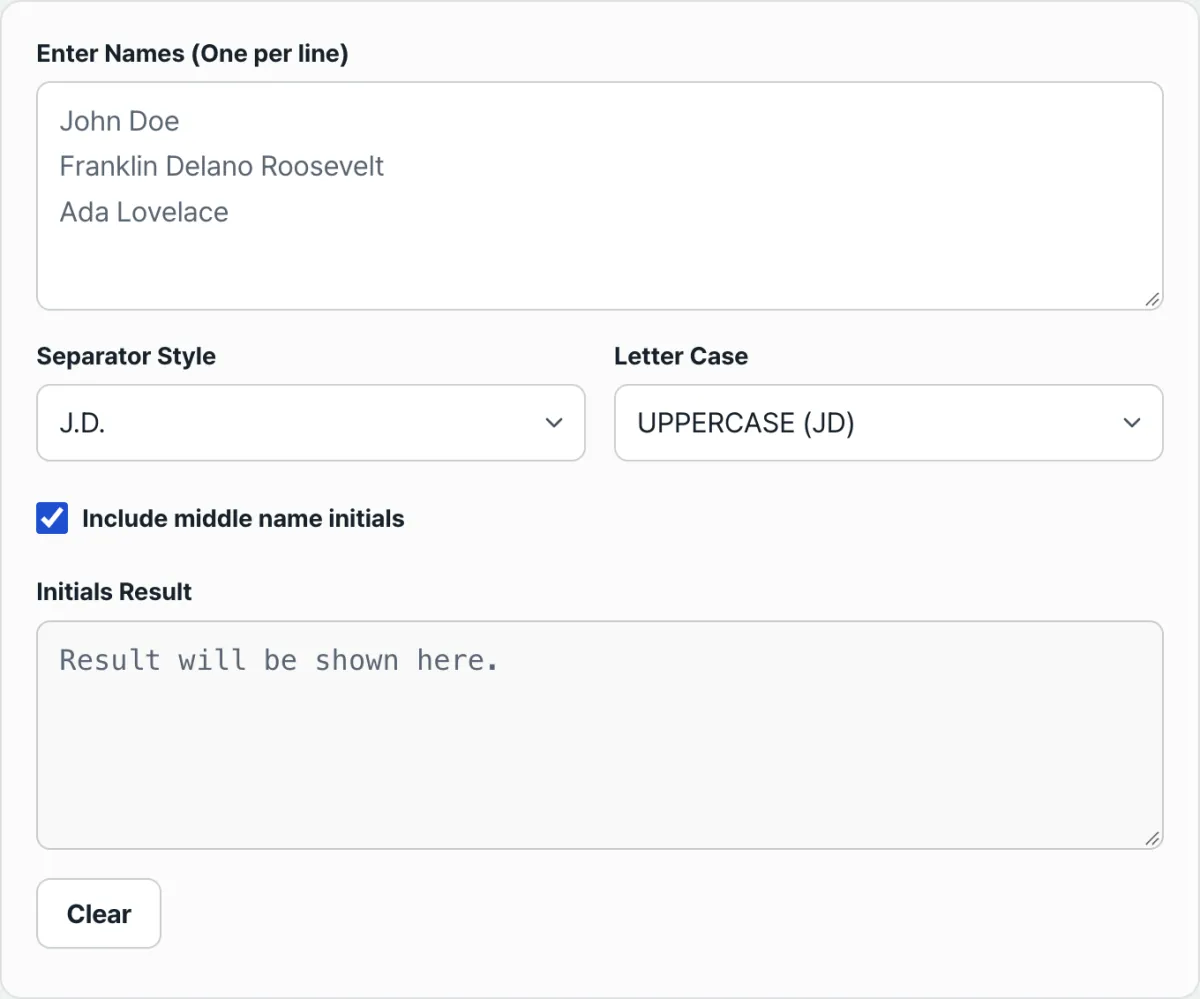
Check it with our free tool, Initials Generator. Instead of deleting letters, fixing capitals, and adding periods every time, enter names one per line and get initials for several people at once. You can change the separator, capitalization, and whether middle names are included in the settings and see the format you want right away.
Type in the Korean or English names you want to convert and instantly generate a set of English initials in several formats for business documents.
Common Sticking Points
| Situation | What to check |
|---|---|
| Airline tickets and passport paperwork | Don't shorten to initials — write the spelling exactly as it appears on the passport, in full |
| Handling middle names | On signature lines, it's common to write the first and last names in full and shorten only the middle name to an initial (e.g. "Franklin D. Roosevelt") |
| Family name vs. given name order | Decide which cultural order you're following first, then build the initials |
Summary
- Initials are made by splitting a name on spaces, then gathering the first letter of each word in uppercase.
- Separators such as periods and spaces, and capitalization, are used differently depending on the type of document.
- Family name and given name order differs by culture, so check the word order of the original name first.
- On documents that verify identity, such as airline tickets, write the passport spelling in full rather than initials.
Type in the Korean or English names you want to convert and instantly generate a set of English initials in several formats for business documents.
Frequently Asked Questions
Do I have to put periods in my initials?
It depends on the document. On signature lines and formal documents, the "J.F.K." form with periods is common, while for visual uses like logos and monograms, people often write "JFK" with no periods.
Should I include my middle name in my initials?
There's no fixed rule. Documents that identify you, like a signature, often include the middle name, while simple uses keep only the first letters of the first and last names. Include it or leave it out as you need.
This article was adapted from our Korean original. Read the Korean original