
Ovulation Calculator: Find Your Ovulation Date and Fertile Window
Contents
When you count your cycle by hand to estimate ovulation, a difference of a day or two can easily change the result. Here's how to calculate your next expected period, your ovulation date, and your fertile window.
Summary ① Your ovulation date is 14 days counted back from the start date of your next period. ② Your fertile window is 5 days before through 1 day after your ovulation date, 7 days total. ③ Just enter your last period start date and average cycle length to see a schedule for the next 6 cycles right away.
Why hand calculations end up a day off
Your menstrual cycle has two phases: the time before ovulation (the follicular phase) and the time after ovulation (the luteal phase). The follicular phase varies in length from cycle to cycle, but the luteal phase varies less from person to person and stays fairly consistent at about 14 days on average.
That's why ovulation is estimated by counting back 14 days from your next expected period, not from your last period start date. If you repeat this by hand for 6 cycles at a time, it's easy to lose track or be off by a day.
How to calculate your ovulation date and fertile window
Your next expected period is your current period start date plus your average cycle length. Subtract 14 days from that to get your ovulation date.
For example, if your period started on July 17 and your average cycle is 28 days, your next period is expected on August 14, and your ovulation date is 14 days earlier, on July 31.
Your fertile window isn't just ovulation day. Sperm that enters the uterus can survive for several days and stay able to fertilize an egg, while an egg survives for only about a day after ovulation. That's why the fertile window is considered to be 5 days before through 1 day after your ovulation date, 7 days total.
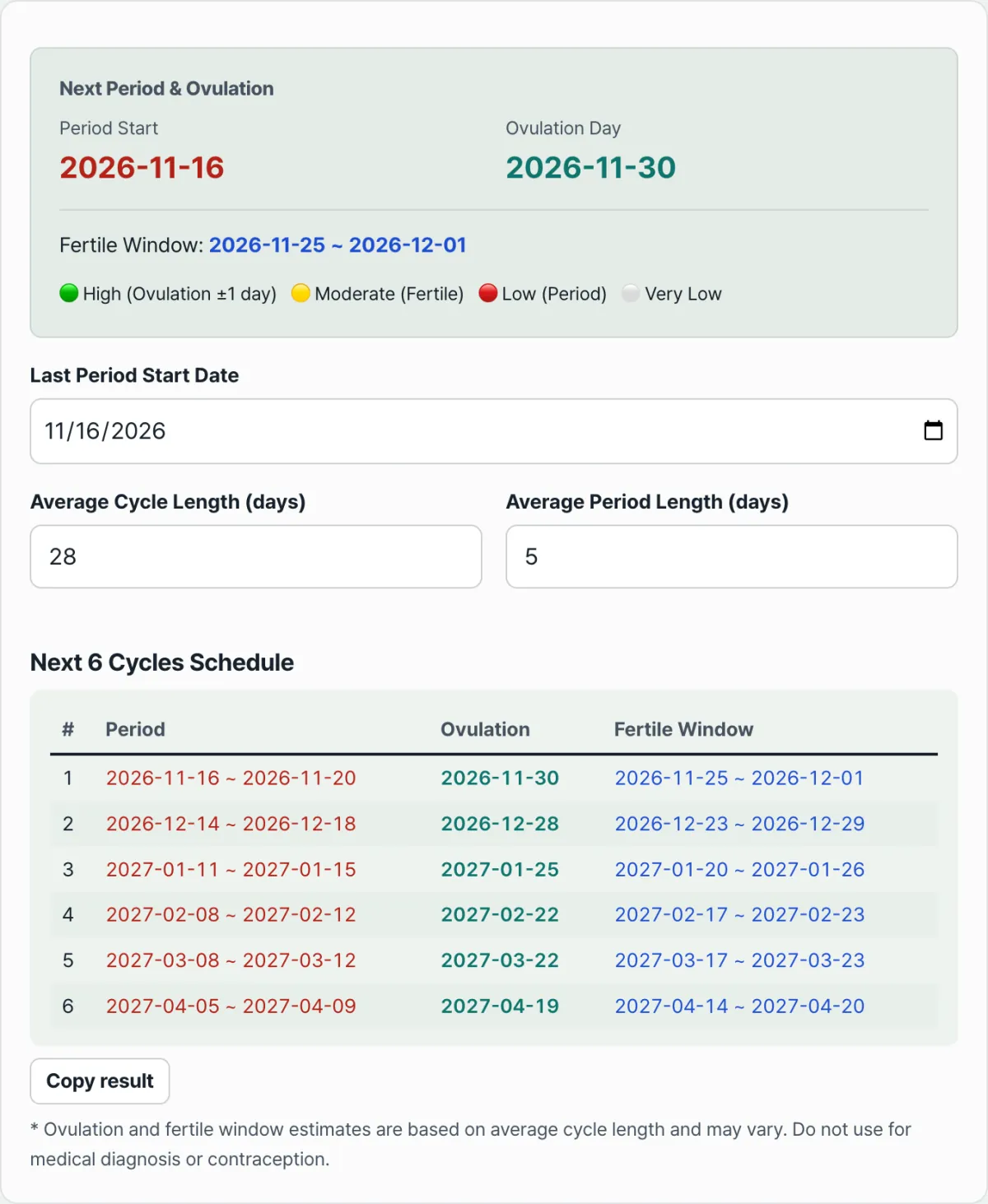
Check it with our free Ovulation Calculator. Just enter your last period start date, average cycle length, and period length, and you'll see the calculation for up to 6 upcoming cycles in one table.
Enter your last period start date and average cycle length, and it instantly shows your next period date, ovulation date, fertile window, and the next 6 cycles.
What to keep in mind when reading your results
| Situation | How it affects the calculation |
|---|---|
| Your cycle length varies from month to month | Even if you enter an average, the result can be several days off from your actual ovulation date |
| Your health or daily routine has changed recently | Ovulation may be later or earlier than expected |
| You plan to use it for birth control | Because it's an estimate based on average cycle length, the margin of error is too large for contraception |
Your ovulation date and fertile window are estimates based on an average menstrual cycle. Your actual ovulation timing can shift with your health or daily routine, so the calculated date may be off by several days. This difference varies from person to person. To get a clearer picture of the exact timing, you can also use basal body temperature tracking, ovulation test kits, or a visit to your OB/GYN.
Summary
- Ovulation date = next expected period − 14 days
- Fertile window = 5 days before to 1 day after ovulation (7 days total)
- The more irregular your cycle, the larger the difference between the calculated and actual ovulation date
- The result is an estimate based on average cycle length. Don't use it for birth control or medical decisions.
Enter your last period start date and average cycle length, and it instantly shows your next period date, ovulation date, fertile window, and the next 6 cycles.
Frequently asked questions
Can I still calculate if my cycle length is different every month?
You can calculate using an average cycle length, but the more irregular your cycle, the larger the difference from your actual ovulation date. If you record your period start dates for the last 3 to 6 months, you can get a more accurate average cycle length.
What if my ovulation date and fertile window don't match the calculated result?
The result is an estimate based on average cycle length. Taking your basal body temperature every morning can help you spot the temperature shift around ovulation and use that as a reference for estimating when you actually ovulated.
Can I use this result for birth control?
Because it's an estimate based on average cycle length, the margin of error is too large for it to work as birth control. If your goal is to prevent pregnancy, it's safer to use another form of birth control as well.
This article was adapted from our Korean original. Read the Korean original