
Ovulation Calculator: Count Back 14 Days From Your Next Period
Contents
The standard way to calculate your ovulation date is to subtract 14 days from your next expected period. If you track your cycle and know when your next period is due, that single subtraction gives you your estimated ovulation date and fertile window.
This article explains why the formula uses 14 days and why the fertile window extends further before ovulation than after it.
Summary ① Your estimated ovulation date = your next expected period minus 14 days. This is based on the fact that the time from ovulation to your next period (the luteal phase) is relatively consistent compared with the time before ovulation (the follicular phase). ② The fertile window runs from 5 days before your estimated ovulation date to 1 day after. This range reflects how long sperm and eggs remain capable of fertilization. ③ The calculation depends entirely on one input: your next expected period. If your cycle is irregular, the margin of error grows, and you cannot use it as a birth control measure.
Why you should calculate from your next expected period
When you track your cycle, you'll often come across the shortcut of estimating ovulation as "the first day of your last period + 14 days." That method only works if your cycle is exactly 28 days.
If your cycle is longer or shorter than 28 days and you use that formula as is, you'll get an error. For example, if your usual cycle is 32 days and you count 14 days after the first day of your last period as ovulation, you'll calculate a date four or more days earlier than your actual ovulation.
Why we count backward instead of forward
Your menstrual cycle is divided into the phase before ovulation (the follicular phase) and the phase after ovulation (the luteal phase). The length of the follicular phase varies from person to person and from cycle to cycle in the same person, while the luteal phase is relatively consistent and is often treated as around 14 days.
So counting backward 14 days from your next expected period produces a smaller error than counting forward from your last period. That's because your next expected period already reflects the actual length of this cycle.
This is why Ovulation Date Calculator asks for just one input: your next expected period.
How to calculate by hand without a tool
The calculator only does date subtraction, so you can do the same thing by hand.
- Set your next expected period. Look at your cycle length over the past few months. Add your usual cycle length to the first day of your last period to get your next expected period.
- Find your estimated ovulation date. Subtract 14 days from your next expected period. If your next expected period is August 10, your estimated ovulation date is July 27.
- Find the start of your fertile window. Subtract another 5 days from your estimated ovulation date. If your estimated ovulation date is July 27, your fertile window starts on July 22.
- Find the end of your fertile window. Add 1 day to your estimated ovulation date. In the example above, your fertile window ends on July 28.
Counting by hand means adding up dates several times, and it's easy to get confused at the end or beginning of a month. Check it with our free Ovulation Date Calculator.
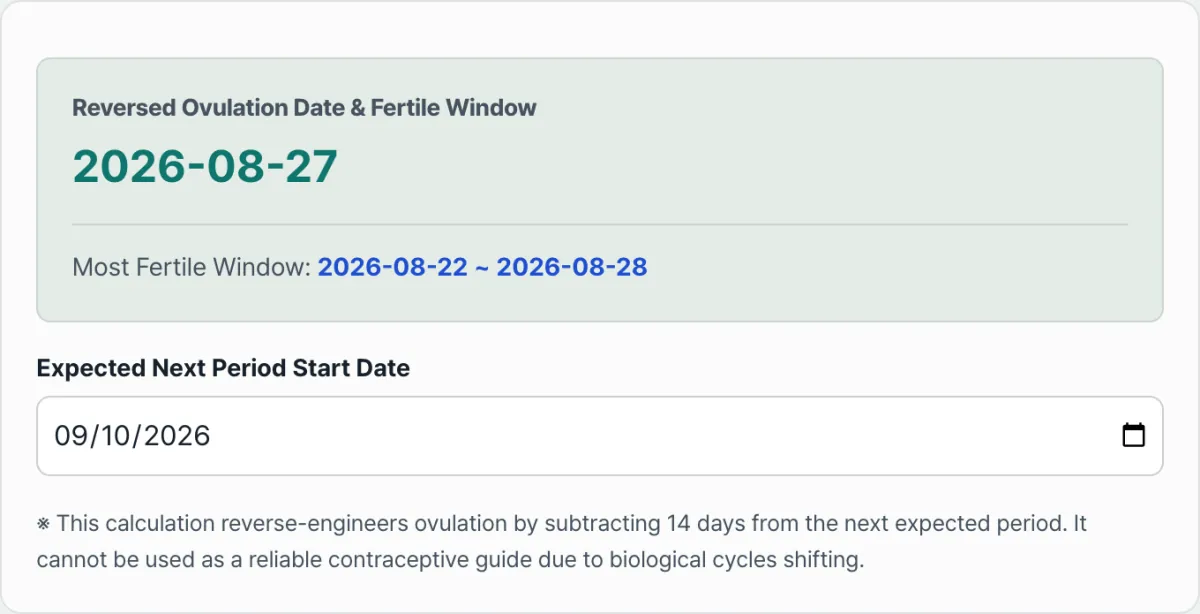
Enter your next expected period date and the tool instantly calculates your estimated ovulation date and fertile window. The date you enter never goes to a server — it's processed only in your browser.
Common misreadings of the results
Here are three common misunderstandings people have when they look at the results.
| Common misunderstanding | How the calculation actually works |
|---|---|
| Your estimated ovulation date is the exact day ovulation happens | The date shown is an estimate based on the average 14-day luteal phase. Actual ovulation can happen within a range of several days before or after it |
| The calculation is just as accurate if your cycle is irregular | The calculation is a fixed operation: subtract 14 days from the next expected period you enter. Any error in the input (your predicted next period) carries straight through to the result |
| You can use the fertile window result as a birth control measure | This is a statistical estimate based on the calendar. It does not account for stress, physical condition, or hormonal changes that can shift when you actually ovulate |
Your estimated ovulation date appears as a single date produced by a formula. But it's important to remember that the date itself is not a confirmed fact. It's the result of applying an average value of 14 days.
The more regular your cycle, the more accurate your prediction of your next period, and the smaller the error in the ovulation date and fertile window calculated backward from it. If your cycle is all over the place, the error starts at the input stage and carries through the entire calculation.
The same structure explains why this calculation cannot be a birth control measure. It's an advance estimate based on just two values: your next expected period and 14 days. It is not a measurement that confirms when ovulation is actually happening.
The bottom line
- Your estimated ovulation date is your next expected period minus 14 days. It's a backward calculation based on the luteal phase being relatively consistent compared with the follicular phase.
- The fertile window runs from 5 days before your estimated ovulation date to 1 day after. This range reflects how long sperm and eggs can remain capable of fertilization.
- The calculation depends on one input, your next expected period, so if your cycle is irregular, the margin of error grows.
- The result is a calendar-based estimate, not a way to measure when you actually ovulate, so you cannot use it as a birth control measure.
Enter your next expected period date and the tool instantly calculates your estimated ovulation date and fertile window. The date you enter never goes to a server — it's processed only in your browser.
Frequently asked questions
How do you calculate your ovulation date?
Subtract 14 days from your next expected period to get your estimated ovulation date. This backward calculation relies on the fact that the time from ovulation to your next period (the luteal phase) is relatively consistent compared with the time before ovulation.
Why is the fertile window from 5 days before ovulation to 1 day after?
Sperm can stay capable of fertilization for several days in the female reproductive tract, and an egg is generally known to be capable of fertilization for about one day after ovulation. The fertile window combines both time frames, running from 5 days before your estimated ovulation date to 1 day after.
Can I use this result for birth control?
No. Your estimated ovulation date is an average estimate based on your next expected period, and actual ovulation can shift with hormonal changes or physical condition.
This is only a calendar-based estimate, not a method for measuring actual ovulation, so it is not a reliable birth control measure.
Why does the tool already show a date and results when I first open it?
To show how the first screen is laid out, the tool fills in a default date 14 days from today. When you change it to your own next expected period, the estimated ovulation date and fertile window are recalculated right away based on that date.
This article was adapted from our Korean original. Read the Korean original