
Percent Error Formula: Calculate It in 3 Steps
Contents
To figure out what percentage an experimental value deviates from a theoretical value, you work through three steps in order: absolute error, relative error, and percent error. Each step has its own formula, and there are exceptions where the calculation can't be done at all — such as when the theoretical value is 0. This article walks through the calculation, the exceptions, and the criteria for reading the result as a grade.
Summary ① A three-step calculation that runs from absolute error |E−T| → relative error |E−T|/|T| → percent error (relative error ×100). ② Because the numerator takes an absolute value, percent error always comes out as a positive number of 0 or more, whether the experimental value is larger or smaller than the theoretical value. ③ If the theoretical value is 0, the denominator of relative error and percent error becomes 0, so they can't be defined. In that case, only absolute error is meaningful.
Where You Get Stuck Comparing Experimental and Theoretical Values
There's a requirement that comes up constantly when you write a science lab report. You're asked to compare the experimental value you measured against the theoretical value from a textbook or design standard, and express the difference as a percentage (%).
Take this example: you measure the acceleration due to gravity yourself and get 9.7m/s², while the accepted theoretical value is 9.8m/s². Three things usually trip people up here. Which value goes in the denominator, what to do when the difference between the two values comes out negative, and what happens to the calculation when the theoretical value is 0 or close to 0.
All three have answers built into the formulas. Let's go through them in order.
How to Calculate It by Hand, Without a Tool
Percent error is a three-step formula that runs through absolute error and relative error. Apply the steps in order and you can work it out by hand, no calculator needed.
Step 1: Find the absolute error
Absolute error is the experimental value (E) minus the theoretical value (T), with the absolute value taken.
Absolute error = |E − T|
With the example above, |9.7 − 9.8| = 0.1. The unit is the same as the original measurement (m/s² in this example).
Step 2: Find the relative error
Relative error is the absolute error divided by the absolute value of the theoretical value.
Relative error = |E − T| / |T|
Continuing the calculation, 0.1 / 9.8 ≈ 0.0102. It's a pure ratio with no unit.
Step 3: Find the percent error
Percent error is the relative error multiplied by 100 to convert it into a percentage.
Percent error = relative error × 100 (%)
0.0102 × 100 ≈ 1.02% is the final result. The three formulas aren't separate, independent calculations — each step's result feeds straight into the next as its input.
Why take the absolute value in the numerator?
The absolute value bars in the absolute error formula are there to keep only the size of the error, not its direction. Without them, the sign would keep flipping: positive when the experimental value is larger than the theoretical value, negative when it's smaller.
With the absolute value, you always get a value of 0 or more, no matter how E and T compare. That's also why relative error and percent error always show up as positive numbers of 0 or more. Whether your experimental value came out higher or lower than the theoretical value can't be told from this formula alone — all that's left is "how far off it is."
Why can't you calculate it when the theoretical value is 0?
Both the relative error and percent error formulas put the theoretical value T in the denominator. If T is 0, the denominator is 0 and the division itself doesn't work. That's division by zero.
In that case, absolute error |E − T| still calculates fine even when T is 0, because it simply becomes |E|. Relative error and percent error, though, are left undefined, so when the theoretical value is 0, only absolute error shows up as a meaningful result.
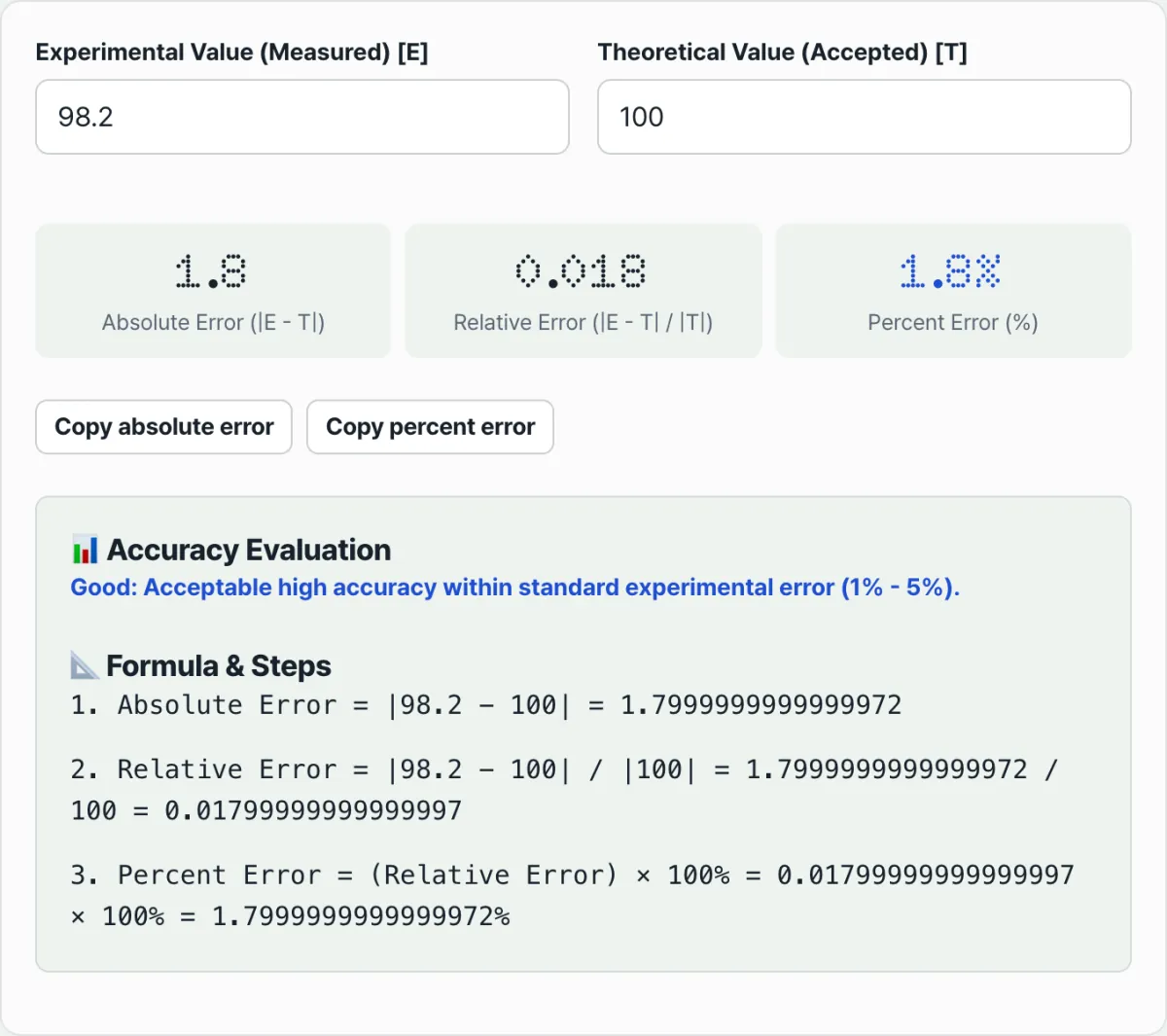
Check it with our Percent Error Calculator.
Enter your experimental and theoretical values, and the absolute error, relative error, percent error, and Excellent/Good/Fair/Caution grade update as you type.
Common Points of Confusion in Percent Error Calculations
Putting the three error concepts side by side in a table makes the differences clear.
| Item | Formula | Unit | Always 0 or more? |
|---|---|---|---|
| Absolute error | |E − T| | Same as the original measurement | Yes |
| Relative error | |E − T| / |T| | None (ratio) | Yes |
| Percent error | Relative error × 100 | % | Yes |
The most common mix-up is treating relative error and percent error as the same number. Relative error is a unitless ratio like 0.0102, and percent error is that ratio multiplied by 100 with a % sign — 1.02%. The numbers connect, but they're written at different stages.
The second mix-up is entering the experimental and theoretical values the wrong way around. For absolute error, |E − T| and |T − E| are the same, so swapping the order gives the same result. But relative error and percent error have the theoretical value (T) fixed in the denominator, so which one you designate as the theoretical value changes the result.
The third thing to look at is the grade label. The four bands — Excellent (under 1%), Good (1–5%), Fair (5–10%), and Caution (10% or more) — are just the computed percent error plugged into preset thresholds. Whether a given error rate is actually acceptable in a particular experiment or field depends on that field's standards, so this grade label doesn't make that judgment for you.
Summary
- Percent error is a three-step formula that runs absolute error (|E−T|) → relative error (|E−T|/|T|) → percent error (×100%).
- Because the numerator takes an absolute value, the result is always a positive number of 0 or more, regardless of how the experimental and theoretical values compare.
- If the theoretical value is 0, the denominator becomes 0, so relative error and percent error can't be defined. In that case, only absolute error is calculated.
- The Excellent, Good, Fair, and Caution grades are the computed percent error number run through four preset bands (thresholds at 1%, 5%, and 10%). The label itself is not an expert judgment about a particular experiment.
- Swapping the experimental and theoretical values can leave absolute error the same while changing relative and percent error, so identify clearly which value is the theoretical one first.
Enter your experimental and theoretical values, and the absolute error, relative error, percent error, and Excellent/Good/Fair/Caution grade update as you type.
Frequently Asked Questions
Can percent error come out negative?
No. The absolute error formula (|E − T|) includes absolute value bars, so the result always shows as a positive number of 0 or more, whether the experimental value is larger or smaller than the theoretical value. The direction of the error — whether it came out higher or lower — can't be determined from this formula alone.
What shows up when the theoretical value is 0?
Relative error and percent error put the theoretical value (T) in the denominator, so if T is 0, the division doesn't work and they can't be defined. In that case, only absolute error (|E − T|) is calculated and displayed, and relative error and percent error are replaced with a message telling you it's a division-by-zero situation.
What are the Excellent, Good, Fair, and Caution grades based on?
They're the computed percent error number placed into one of four bands. Under 1% is Excellent, 1% to under 5% is Good, 5% to under 10% is Fair, and 10% or more is Caution. These bands are a fixed classification applied to the number — not an expert standard for whether that error rate is actually appropriate for a particular experiment or field.
Which do I enter first, the experimental value or the theoretical value?
The value in the denominator is the theoretical value (T), so which value goes in which field affects the result. Absolute error is the same for |E − T| and |T − E|, so order doesn't matter there, but relative error and percent error depend on what's in the denominator. Enter the reference value — the true value, design value, or accepted figure — in the theoretical value (T) field, and the value you measured or got from the experiment in the experimental value (E) field.
This article was adapted from our Korean original. Read the Korean original