
Proposal Outline Order: Why It Changes by Project Type
Contents
When you write a proposal for the first time, the hardest part is figuring out what order the sections should go in. Starting from a blank page feels like you can structure it however you want, but the people reviewing it expect a set flow. Here's how that flow changes across IT builds, marketing agency work, business partnerships, and public bids — and when you should break away from the standard structure.
Summary ① A proposal outline isn't a matter of taste. It follows the order in which reviewers score you. ② Each type of project (IT, marketing, partnership, public) emphasizes different items, so the outline changes too. ③ If the client specifies an outline, that outline always takes priority over the standard structure.
Why you can't just make up your own outline
An RFP or an internal approval process usually comes with an evaluation sheet. That sheet is often a scoring rubric that assigns points by outline section. For example: "Technical and functional: 30 points, project management: 20 points, support structure: 10 points."
Reviewers often don't read the proposal cover to cover. They go down the scoring sheet in order, find each item, and score it. If an item isn't in the outline at all, they won't find it even when the content is buried somewhere in the body — and you get no points for it.
This is where you lose points purely from a missing section, regardless of how good the content is. So before writing style, the first thing to check in a proposal outline is whether you've created a slot for every item on the evaluation sheet.
How standard outlines differ by project type
If the client hasn't specified an outline, use the standard structure common in the industry. The number of top-level sections and the items that get extra emphasis vary with the nature of the project.
| Project type | Top-level sections | Items that get extra emphasis |
|---|---|---|
| IT build (SI) | 5 | Technical architecture, maintenance and defect repair response |
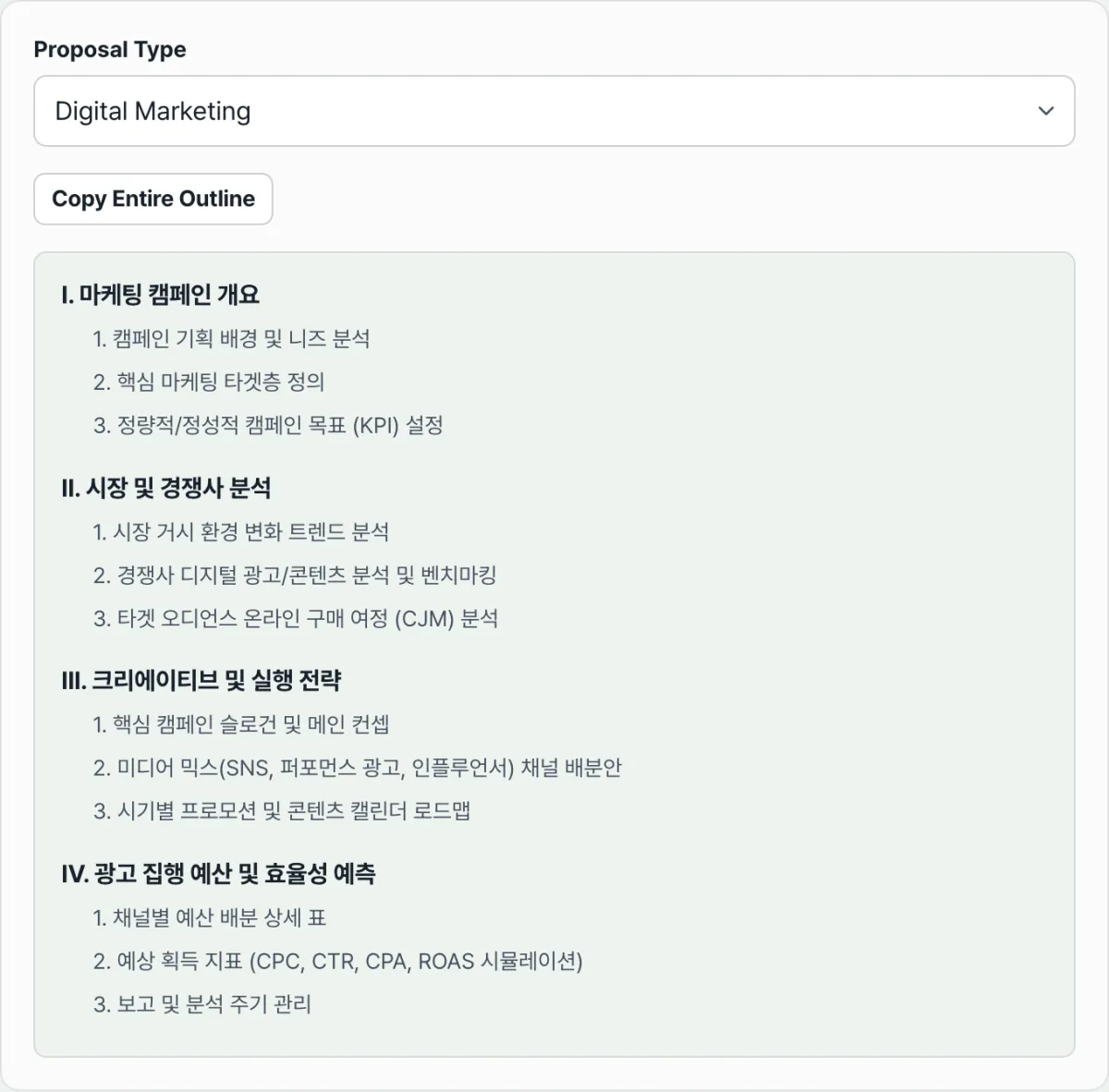
| Digital marketing agency | 4 | Market and competitor analysis, media budget allocation |
| Business partnership | 4 | Role division (R&R), revenue-sharing structure |
| Public bids and government projects | 4 | Basis and schedule, performance metrics |
If you're building one yourself, remember the flow this way: overview → current state and analysis → core execution plan → management and expected results. For IT builds, you add one more step after completion — the "support section" (training and maintenance) — which makes it five steps.
To work out the sub-items by hand every time, you'd have to recall 2–3 sub-items under each of the 3–4 top-level sections for each project type.
Check it with our tool. Rebuilding the standard outline and sub-items for all four project types by hand is a hassle.
Free · No sign-up · Instantly generate a standard outline for your project type
Where people get stuck
| Situation | What to check |
|---|---|
| The client specified an outline | Follow the specified outline and numbering exactly instead of the standard structure. |
| Your company template uses different item names | Keep the order of the top-level sections and change only the item names to your company's terms. |
| The project mixes two types | Use the type matching the main contract as the base skeleton, then add items from the other type underneath. |
| There's a page limit | Leave the top-level sections alone and merge only the sub-items to shorten it. |
Wrapping up
A proposal outline follows the flow in which reviewers score you. If the client specified an outline, that always comes first, and only when there's no specification do you fall back on the standard structure for the project type.
The standard structure isn't a finished product you submit as-is. It's a skeleton you refine to fit your company template and page limit. Pick a project type and the skeleton appears right away, so you can cut down on copying it over by hand.
Free · No sign-up · Instantly generate a standard outline for your project type
Frequently asked questions
What if the standard outline doesn't match what the client wants?
If the client laid out an outline in the RFP, that outline always takes priority. The standard structure covered here is a base skeleton to reference when no outline is specified.
Can I submit the generated outline as-is?
This outline is a standard structure widely used in the industry. Before you actually submit, you need to add, remove, or revise items to match the client's requirements or your company template.
What about a project that doesn't fit neatly into IT, marketing, partnership, or public?
Pick the closest type and use it as the skeleton, then add items specific to that project (for example, a training curriculum or a content production schedule) under the sub-items.
Do I have to fill in every sub-item?
Sub-items mark where the supporting material for each scoring item on the evaluation sheet lives. If an item is empty, reviewers will have a hard time finding where to look, even when the relevant content is in the body.
This article was adapted from our Korean original. Read the Korean original