
Beaufort Wind Scale Chart (0-12) and Wind Speed Unit Conversion
Contents
- The four wind speed units and how to convert between them
- What each Beaufort force (0–12) looks like
- How it works: the Beaufort empirical formula and the wind pressure (P) formula
- All 13 Beaufort forces and an outdoor safety matrix
- 5 common mistakes when reading a high wind forecast
- Safe Outdoor Wind Assessment: A 5-Step Field Workflow
- 7 Safety Tips for Windy Days
- Final Decision Tree: Should You Go Outside Today?
- Beaufort Wind Scale & Meteorology Cheat Sheet
- Frequently Asked Questions
When a forecast or a typhoon warning says "peak gust of 15 m/s," a marine forecast says "winds of 30 knots," or the news mentions "60 km/h gusts," it's often hard to picture how strong that wind actually is.
The Beaufort Wind Scale solves that. It's a long-standing global standard that maps wind force one-to-one onto physical things you can see around you — swaying trees, broken umbrellas, the state of the waves at sea — so a number you can't feel becomes something you understand at a glance.
Here's everything in one place: the 13-level system from 0 (calm) to 12 (hurricane) established by British Royal Navy Admiral Francis Beaufort in 1805, the formulas for converting between the four main wind speed units (m/s, km/h, knots, mph), and the safety thresholds for camping, drones, and boating.
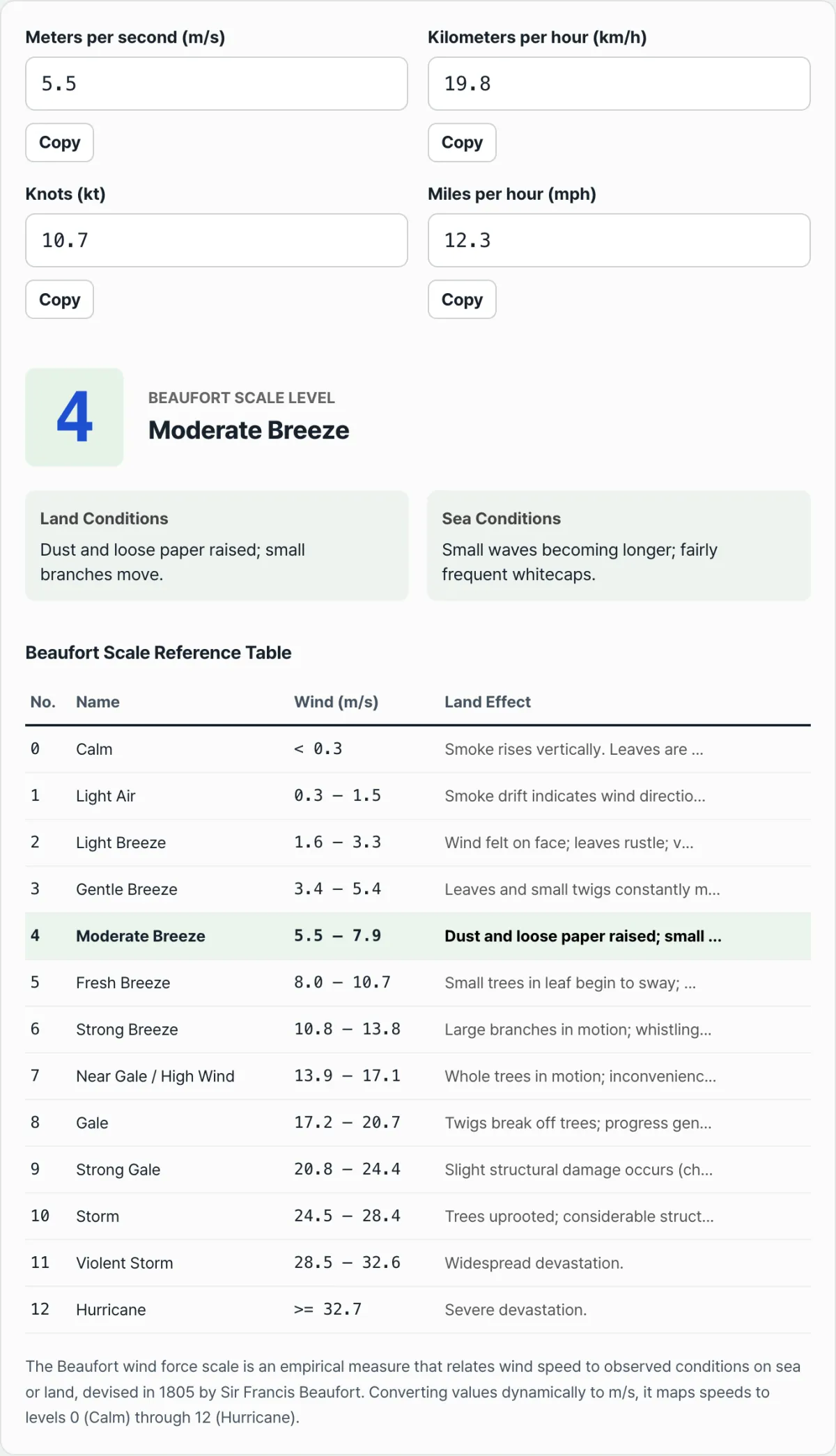
Key takeaways ① 13 levels (0–12): from "0 (no wind)" through "6 (umbrellas are a struggle, 10.8–13.8 m/s)" and "8 (branches break, 17.2–20.7 m/s)" to "12 (hurricane, 32.7 m/s and up)." ② Converting the four units: 1 m/s = 3.6 km/h ≈ 1.944 knots ≈ 2.237 mph. ③ Danger thresholds by activity: camping tarps can collapse at 8 m/s or more (Beaufort 5), and commercial drones risk losing control and crashing at 10 m/s or more (Beaufort 5–6). ④ Enter any number into the Beaufort Wind Scale Calculator and all four units sync instantly, so you can compare the Beaufort force and the land and sea conditions at a glance.
The four wind speed units and how to convert between them
Wind speed is measured in four main units, depending on the country and the industry:
- Meters per second (m/s): meters traveled in one second (the standard at the Korea Meteorological Administration and in science).
- Kilometers per hour (km/h): kilometers traveled in one hour (everyday use and road traffic).
- Knots (kt): one nautical mile (1.852 km) per hour (the global standard for ships and aircraft).
- Miles per hour (mph): the everyday unit in the US and UK (1 mph ≈ 1.609 km/h).
Exact conversion factors
- km/h = m/s × 3.6
- knots = m/s ÷ 0.514444 ≈ m/s × 1.94384
- mph = m/s ÷ 0.44704 ≈ m/s × 2.23694
What each Beaufort force (0–12) looks like
The Beaufort scale lists visual clues so you can judge how dangerous the wind is without an anemometer.
- Force 0–2 (calm to light breeze, 0.0–3.3 m/s): mild weather — smoke rises straight up and leaves rustle.
- Force 3–4 (gentle to moderate breeze, 3.4–7.9 m/s): flags flutter, dust blows, small ripples form — comfortable for outdoor activity.
- Force 5–6 (fresh to strong breeze, 8.0–13.8 m/s): holding an umbrella is hard and large branches sway. Take down camping tarps and stop drone flights.
- Force 7–8 (near gale to gale, 13.9–20.7 m/s): walking into the wind is hard and branches snap off. Small boats are held in port.
- Force 9–10 (strong gale to storm, 20.8–28.4 m/s): chimney tiles fly off and street trees are uprooted — real damage to structures.
- Force 12 (typhoon / hurricane, 32.7 m/s and up): extreme disaster — widespread destruction on land and the whole sea covered in white foam.
Free · just enter a wind speed to convert all four units and get the Beaufort force in one second
How it works: the Beaufort empirical formula and the wind pressure (P) formula
Here's the math linking wind speed, Beaufort force (B), and the physical load on an object.
1. Beaufort wind speed empirical formula
- B = 0: v = 0 m/s
- B = 6: v = 0.8360 × 61.5 ≈ 12.29 m/s
- B = 12: v = 0.8360 × 121.5 ≈ 34.75 m/s
2. Bernoulli wind pressure formula
- At an air density of ρ ≈ 1.225 kg/m3:
- When wind speed doubles, the wind pressure and destructive force on an object jump four times (v2).
- At 10 m/s, P ≈ 61.25 Pa. At 30 m/s (Beaufort 11), P ≈ 551.25 Pa — nine times the destructive force hammering a building.
All 13 Beaufort forces and an outdoor safety matrix
| Force (B) | Name (Korea Meteorological Administration) | Wind speed (m/s) | Wind speed (knots) | Signs on land | Outdoor / safety guidance |
|---|---|---|---|---|---|
| 0 | Calm | 0.0 ~ 0.2 | 0 ~ 1 | Smoke rises straight up | Safe for all activities |
| 1 | Light Air | 0.3 ~ 1.5 | 1 ~ 3 | Smoke drifts, weather vanes don't turn | Ideal for drones and camping |
| 2 | Light Breeze | 1.6 ~ 3.3 | 4 ~ 6 | Wind felt on your face, leaves rustle | Perfect day outdoors |
| 3 | Gentle Breeze | 3.4 ~ 5.4 | 7 ~ 10 | Flags flutter lightly | Great for sailing |
| 4 | Moderate Breeze | 5.5 ~ 7.9 | 11 ~ 16 | Dust and paper fly, small branches move | Drone beginners, be careful |
| 5 | Fresh Breeze | 8.0 ~ 10.7 | 17 ~ 21 | Leafy trees sway, waves form on water | Take down camping tarps, no drone flights |
| 6 | Strong Breeze | 10.8 ~ 13.8 | 22 ~ 27 | Umbrellas are hard to use, power lines whistle | Risky for small recreational boats to head out |
| 7 | Near Gale | 13.9 ~ 17.1 | 28 ~ 33 | Whole trees in motion, hard to walk | Marine wind advisory issued |
| 8 | Gale | 17.2 ~ 20.7 | 34 ~ 40 | Small branches break, walking is difficult | Watch for falling debris, shelter indoors |
| 9 | Strong Gale | 20.8 ~ 24.4 | 41 ~ 47 | Chimneys and roof tiles break, property damage | Brace for damaged signs and windows |
| 10 | Storm | 24.5 ~ 28.4 | 48 ~ 55 | Trees uprooted, rare inland | Do not go outside |
| 11 | Violent Storm | 28.5 ~ 32.6 | 56 ~ 63 | Widespread destruction of buildings | Move to a disaster shelter |
| 12 | Hurricane (typhoon) | 32.7 and up | 64 and up | Severe, catastrophic devastation | Top-level national emergency |
5 common mistakes when reading a high wind forecast
- Looking only at average wind speed and ignoring gusts: even when the average is 5 m/s, a gust can spike to 12–15 m/s, so always check the gust number.
- Treating surface wind and wind aloft as the same: at 50–100 m up (drone altitude) there's less surface friction, so the wind is often stronger than at ground level.
- Confusing knots with km/h: mistaking 30 knots for 30 km/h and letting your guard down (30 knots is 55.6 km/h — a strong gale).
- Insisting on pitching a large tarp: pitching a tarp above Beaufort 5 (8 m/s) with no windbreak and wrecking your tent.
- Overlooking the wind tunnel effect (building wind): gaps between tall city buildings and narrow mountain valleys can funnel stronger wind than the surrounding area.
Safe Outdoor Wind Assessment: A 5-Step Field Workflow
- Step 1 (Check the forecast wind speed): Look up the expected wind speed (in m/s or knots) for your starting point, hour by hour, on the Korea Meteorological Administration's Weather Nuri or the Windy app.
- Step 2 (Enter the number in this calculator): Pick the unit you're looking at and type the number. All four units are calculated automatically in one second.
- Step 3 (Match the Beaufort force and conditions): Read the Beaufort force you get (0–12) and the "Land Signs" card, then judge the risk.
- Step 4 (Decide whether to go out): At Beaufort 5 (8 m/s) or higher, pack up the drone and the tarp. At Beaufort 7 (14 m/s) or higher, cancel all on-water activity.
- Step 5 (Verify by eye on site): Once you arrive, compare how the nearby trees and flags are moving against the Beaufort scale table to confirm it's safe.
7 Safety Tips for Windy Days
- The 3.6 mental math trick: Roughly multiply meters per second by 4 and shave off a little to get km/h (e.g., 10 m/s ➔ 36 km/h).
- Knots are about double m/s: 10 m/s is about 19.4 knots, so doubling the m/s value gives you a rough knot count.
- Stake guy lines at 45 degrees: When the wind picks up, drive stakes deep into the ground at a 45-degree angle and pull the lines taut to spread the wind load.
- The truth about taping high-rise windows: Rather than taping an X across the middle of the glass, your first priority for preventing breakage is securing the gaps between the frame and the window so it can't rattle or shift.
- The 14-knot safety line for offshore fishing: Once the wind over the water passes 14 knots (about 7.2 m/s), whitecaps form and beginners are at sharply higher risk of seasickness.
- Shelter on the leeward side: In strong wind, pitch your tent or park your car on the leeward side — behind a hill or building where the wind is blocked.
- Add this calculator to your phone's home screen: Check the wind speed in three seconds before hiking, camping, fishing, or flying a drone.
Final Decision Tree: Should You Go Outside Today?
- Condition A (Beaufort 0–4, wind speed 0 – 7.9 m/s) ➔ Completely safe for all camping, drone flights, hiking, and fishing
- Condition B (Beaufort 5, wind speed 8.0 – 10.7 m/s) ➔ Take down large tarps, hold off on drone flights, reinforce dome tent stakes
- Condition C (Beaufort 6–7, wind speed 10.8 – 17.1 m/s) ➔ No boats leave the harbor, avoid mountain trails, watch for falling objects while walking
- Condition D (Beaufort 8 or higher, wind speed 17.2 m/s or higher) ➔ Cancel all outdoor activity and take shelter indoors
Beaufort Wind Scale & Meteorology Cheat Sheet
- Beaufort Wind Scale: A 13-level standard wind scale established by Francis Beaufort in 1805.
- Gust: A brief spike in wind speed, as opposed to the 10-minute average.
- Nautical Mile: A maritime distance unit defined as one minute of arc along Earth's meridian (1 NM = 1,852 m).
- Dynamic Pressure: The kinetic energy pressure exerted on an object's surface by the speed of a fluid (P = 0.5 ρ v2).
Frequently Asked Questions
Is the wind speed in the forecast an average or a maximum?
What you usually see in a local forecast is the 10-minute average wind speed. Out in the real world, gusts can blow stronger than that in an instant, so build in some margin.
Why do ships and aircraft use knots instead of km/h?
Ships and aircraft navigate on a latitude–longitude grid, and one knot is exactly the speed of one minute of latitude (1 nautical mile = 1.852 km) per hour. That 1:1 match makes it the easiest way to work out distances on charts and maps.
Is the wind speed I enter sent to a server?
Not at all. Every unit conversion and Beaufort match runs locally and instantly in the JavaScript engine inside your browser.
This article was adapted from our Korean original. Read the Korean original