
Daily Caffeine Limit and Half-Life: How Much Is Safe?
Contents
The Korean Ministry of Food and Drug Safety (MFDS) sets the maximum daily caffeine intake at 400 mg for adults, 300 mg for pregnant women, and 2.5 mg per kg of body weight for children and teens. If you count one Americano as 150 mg, an adult reaches the limit at about two and a half cups a day. But caffeine content varies a lot by product and size, so checking the label is the most accurate approach.
A moderate amount of caffeine can help you stay awake. But when several drinks add up, you may have trouble falling asleep, a racing heart, or anxiety. This article covers the MFDS guidelines, example calculations for each group, how long caffeine stays in your body (its half-life), and how to use the calculator.
Note The results in this article and in the calculator are general reference information, not a medical diagnosis. Sensitivity to caffeine varies a lot from person to person. If you have a condition such as an arrhythmia or an anxiety disorder, or you are pregnant, talk with a doctor before settling on how much to have.
Summary ① Maximum daily intake (MFDS): 400 mg for adults, 300 mg for pregnant women, and 2.5 mg per kg of body weight for children and teens. ② Half-life: The time it takes for the caffeine level in your blood to drop by half is commonly said to be around 5 hours, but it varies widely by person and circumstance. ③ Add the drinks you've had to the calculator, and it immediately shows your total caffeine and the percentage of your limit. Calculations happen only in your browser. If you refresh the page, the list resets, and nothing is saved to a server.
What Is the Daily Caffeine Limit for Each Group?
The Korean Ministry of Food and Drug Safety (MFDS) gives the maximum daily caffeine intake below. These numbers are not an amount you should aim for. They are an upper limit: don't go over them.
Adults
- No more than 400 mg per day
- Using the calculator's typical Americano value of 150 mg, two cups come to 300 mg, and three cups come to 450 mg, which is over the limit. A large size or an extra shot can have much more than this in a single cup.
Pregnant women
- No more than 300 mg per day
- During pregnancy, your body clears caffeine more slowly, and caffeine also passes through the placenta to the baby. Some health agencies abroad recommend 200 mg or less.
Children and teens
- No more than 2.5 mg per kg of body weight
- Example: For a teen who weighs 50 kg, the limit is 50 × 2.5 = 125 mg. One can of coffee (typical value 75 mg) plus one can of energy drink (typical value 80 mg) comes to 155 mg, which is over the limit.
How Much Caffeine Does the Calculator Assume for Each Drink?
The calculator uses the typical values below. Drinks with the same name can differ a lot in caffeine depending on brand, size, and brewing method. If you have a product label or the seller's information, use that number instead.
| Drink | Typical value |
|---|---|
| Americano | 150 mg |
| Espresso | 75 mg |
| Cold brew | 200 mg |
| Canned coffee | 75 mg |
| Energy drink | 80 mg |
| Green tea / black tea | 30 mg |
Does Afternoon Coffee Still Affect You at Night?
Half-life is the time it takes for the blood level of a substance to drop by half. Caffeine is commonly said to have a half-life of around 5 hours. But depending on whether you smoke, pregnancy, medications you take, and genetic differences, it can be as short as a few hours or twice that long or more.
If you assume a half-life of 5 hours, the math works out like this:
- 2 p.m.: You drink one Americano (150 mg).
- 7 p.m.: About 75 mg is left.
- Midnight: About 37.5 mg is left.
So if you have trouble falling asleep or are sensitive to caffeine, you can try working backward from your bedtime and cutting back after early afternoon. How early you need to stop differs from person to person, so the practical way to find out is to try different cutoff times over several days.
How Do I Use the Caffeine Calculator?
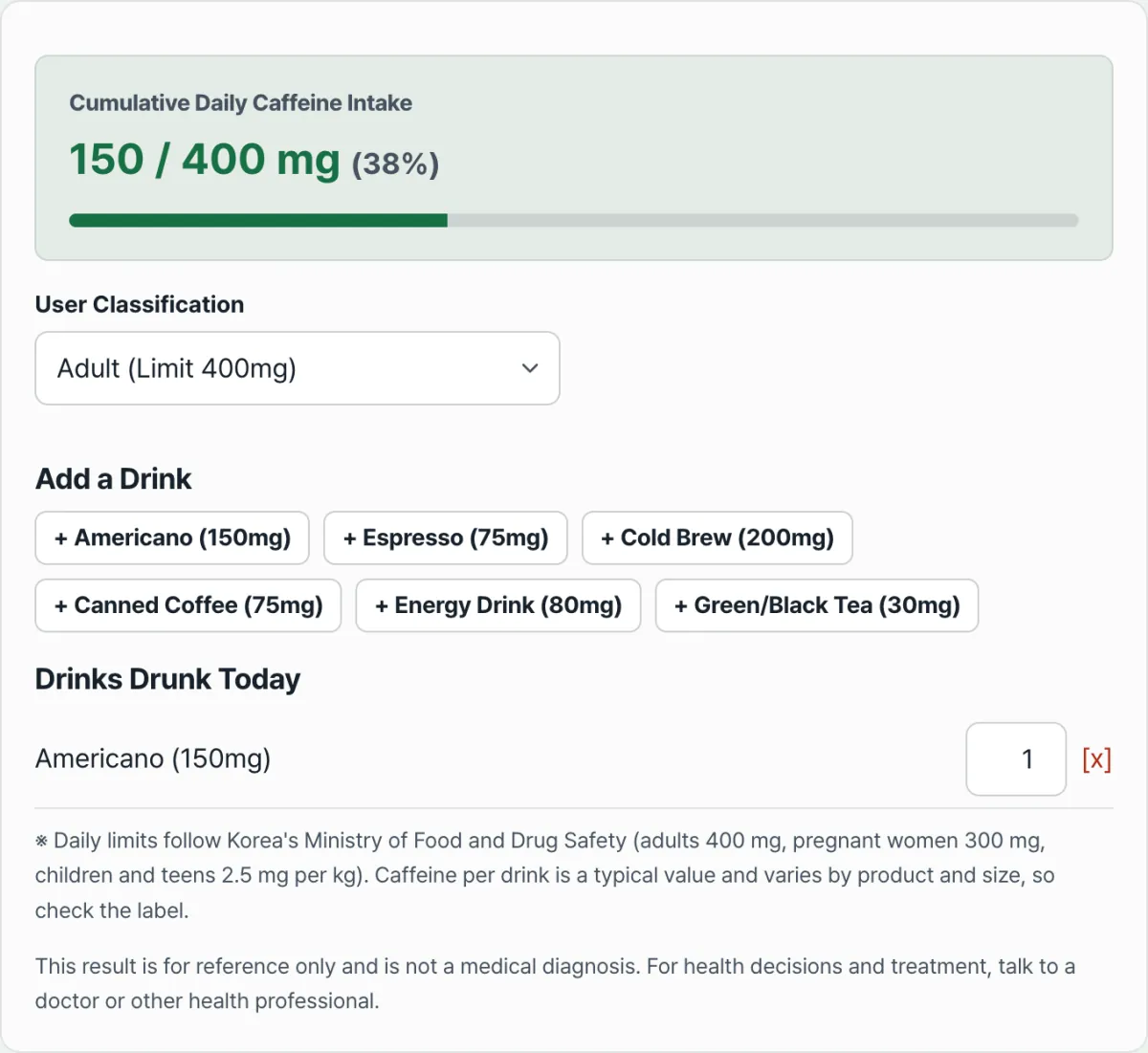
If adding up labels every time is a hassle, just add the drinks you've had to the calculator.
Free · No sign-up · See how much of your daily limit you've used as you add each drink
- Choose a user type: Pick adult (400 mg limit), pregnant woman (300 mg), or teen (based on body weight). For a teen, enter body weight (kg).
- Add drinks: Add what you drank from Americano, espresso, cold brew, canned coffee, energy drink, and green tea / black tea.
- Check the result: Your total caffeine (mg), your limit, and the percentage of your limit appear along with a bar. If you go over 100%, the number and the bar turn red.
Summary
According to the MFDS, the daily caffeine limit is 400 mg for adults, 300 mg for pregnant women, and 2.5 mg per kg of body weight for children and teens. Caffeine content differs from product to product, so check the label. If sleep is the problem, adjust when you drink it as well.
Free · No sign-up · See how much of your daily limit you've used as you add each drink
Frequently Asked Questions
Does decaf coffee have zero caffeine?
No. Decaf means most of the caffeine has been removed, but a small amount can remain. If you're very sensitive to caffeine or you're pregnant, keep in mind that several cups of decaf can add up a little at a time.
What should I do if my heart is racing from caffeine?
There's no antidote that clears caffeine quickly. The basic approach is to stop having more and wait for it to pass. Drinking water and resting comfortably is about all you can do. If the racing heart is severe, or comes with chest pain, dizziness, or trouble breathing, get medical care right away.
Why is the teen limit calculated by body weight?
Because the MFDS sets the maximum daily intake for children and teens at 2.5 mg per kg of body weight. Two people the same age can have different limits if their weights differ, so when you choose teen in the calculator, it asks for body weight.
Sources
- Ministry of Food and Drug Safety (Korea) press release, "To students preparing for the CSAT, be careful when consuming foods containing caffeine!" (2026-10-20) — https://www.mfds.go.kr/brd/m_99/view.do?seq=50421 (accessed 2026-11-17)
This article was adapted from our Korean original. Read the Korean original