
Coin Flip Probability: Law of Large Numbers & Independent Trials
Contents
1. Independent Trials and the Law of Large Numbers: Why Everything Drifts Toward 50%
In math, saying two events A and B are independent means the probability of event A happening doesn't raise or lower the probability of event B by any amount.
- Formula: The probability that B happens after A has happened, P(B|A), equals the plain probability of B, P(B), with no regard for A.
So even right after a miraculous 100 tails in a row, if the air pressure and the physics of the flip are the same, the 101st flip still has exactly a 1/2 (50%) chance of coming up heads. The coin has no memory of which side it landed on before.
Then why do statisticians everywhere declare that coin flip probability lands at 50% in the end? Because of the Law of Large Numbers, formalized by Jacob Bernoulli.
As the number of trials (n) grows, the gap between the observed relative frequency (the running ratio of heads) and the mathematical probability (μ) shrinks toward 0. In other words, if you keep increasing the number of trials without limit, the probability that the observed ratio stays within a tiny margin of error (ε) of the true probability eventually converges to 100% (1). (Here ε is an error bound that holds no matter how small a positive number you pick.)
- Example simulation flow (the random numbers change on every run, so the figures below are example values meant to show the trend):
- 10 flips example: 7 heads (70% ratio — the sample is small, so it can be far off from 50%)
- 100 flips example: 54 heads (54% ratio — as the sample grows, the error tends to narrow)
- 10,000 flips example: 5,003 heads (50.03% ratio — the larger the sample, the closer it tends to converge on 50%)
2. Gambler's Fallacy vs. Hot Hand Fallacy
When you watch coin flip statistics, two fun cognitive biases pop up from the human brain's instinct for pattern recognition.
Gambler's Fallacy
This is the illusion that the outcome of a previous trial will "correct" the probability of the next random event. It's the mindset of someone at a roulette table who sees black come up 8 times in a row and now bets on red. But a physical probability system has no self-correcting ability, so the next spin is still 50:50.
Hot Hand Fallacy
This is the opposite bias: "Heads came up 3 times in a row, so the coin has momentum. The next flip will probably be heads too" — overconfidence that a particular streak will continue. It's the same as assuming a basketball player who just made several shots in a row is abnormally likely to make the next one, but in a random probability event it's just a statistical illusion.
How to Use the Coin Flip Statistics Simulator
If you'd rather not spend all day wearing out your fingers flipping a coin 1,000 times and typing the results into Excel, use a real-time coin simulator to test and verify the Law of Large Numbers scientifically.
Free · no sign-up · up to 10,000 flips in a row, with a live 50% convergence chart
Using the tool is simple.
- Drag the simulation count slider left or right to set the number of flips (10 to 10,000). (The default is 1,000.)
- Press the Flip Coins button.
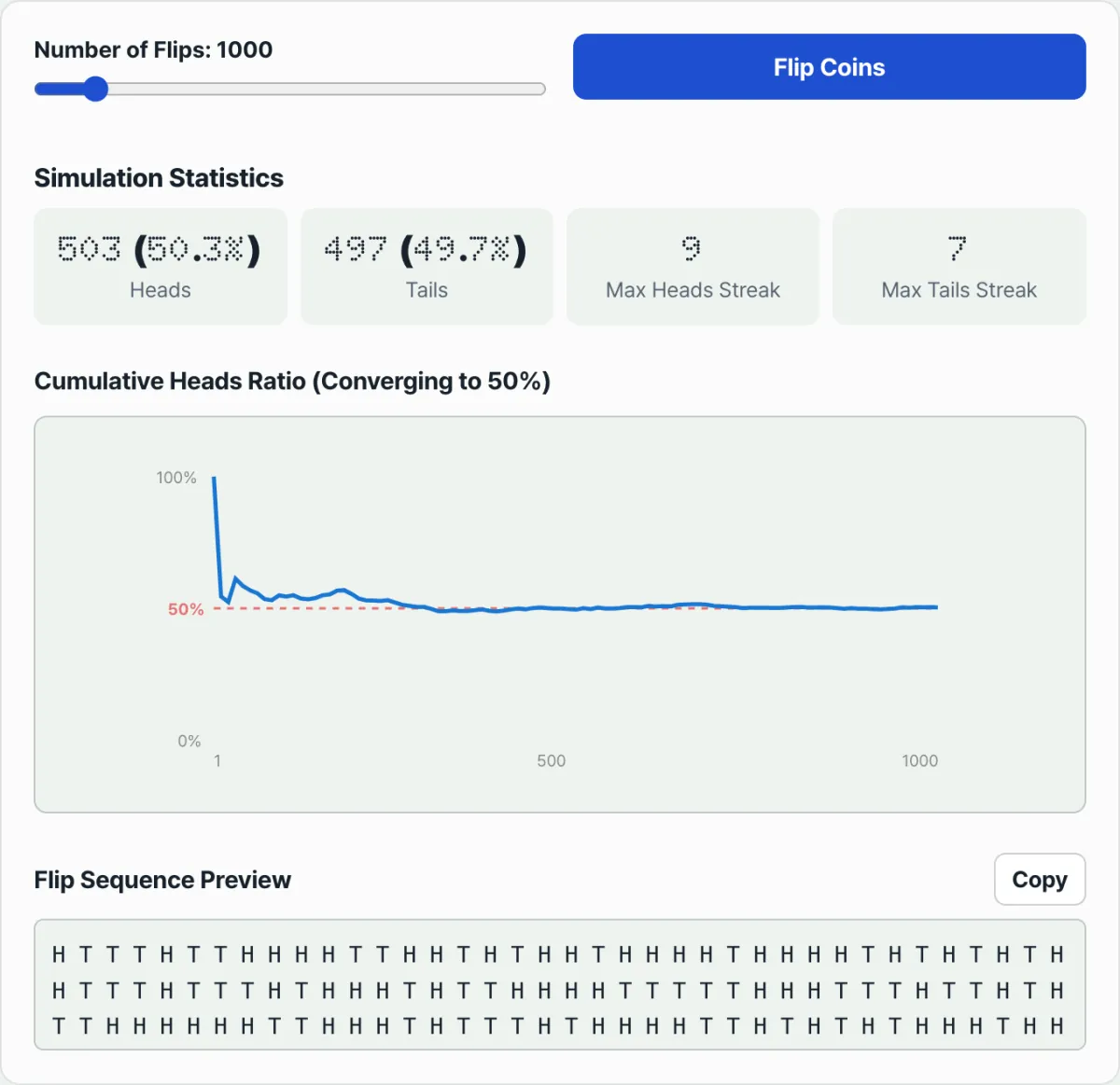
- Within a second of your input, up to 10,000 independent trials are computed, and the dashboard cards summarize, at a glance, the number of heads and tails with their precise percentages and the longest streak of heads or tails.
- In particular, the SVG line chart of the running heads ratio rendered at the bottom lets you watch a live visual spectacle of the Law of Large Numbers: the curve that swings wildly through the first 10 flips flattens out and converges toward the 50% reference line (dashed) in the middle as it passes 100 and then 1,000+ flips.
Summary
Coin flipping is more than a simple game. It's a great teaching tool that visually captures the essence of Bernoulli trials and independent events — the cornerstone of statistics. See the mathematical order hidden inside randomness (the Law of Large Numbers) for yourself with the simulation calculator, and build a sound statistical mindset that helps you overcome the gambler's fallacy — the illusion of intuition — in everyday life and in investment decisions.
Free · no sign-up · up to 10,000 flips in a row, with a live 50% convergence chart
Frequently Asked Questions
Can a coin flip have a slight bias, so the physical probability isn't exactly 50%?
Real coins in the natural world aren't ideal mathematically symmetric bodies. In a 2007 study with Holmes and Montgomery, Stanford statistician Persi Diaconis analyzed the physics of a mechanical coin-tossing machine and of precession of the rotation axis in midair, and showed mathematically that the side facing up when the flip starts can land face up slightly more often than 50% in theory. Later, in 2023, Bartoš and his research team confirmed this starting-side bias empirically at about 50.8% by filming roughly 350,000 human coin flips (350,757) in a large-scale experiment. To get results close to a pure mathematical 50%, a mechanical flipping machine or a computer random number simulation is more consistent with observing the Law of Large Numbers.
Can I apply binary coin simulation data to stock investing or gambling betting systems like Martingale?
In theory, Martingale betting (doubling your bet after every loss) always recovers your stake as long as you have unlimited capital. But real trading and casinos have table limits, and human capital is finite, so a long losing streak brings geometrically growing debt and the account converges on ruin. Stock and crypto price moves also aren't pure independent trials — they're linked to feedback from market sentiment and macro indicators — so it's best to avoid investing on a simple coin-flip substitution.
This article is written for informational purposes based on general probability theory and Jacob Bernoulli's definition of the Law of Large Numbers, and minute deviations may occur due to the periodicity limits of computer random number generation algorithms such as Mersenne Twister.
This article was adapted from our Korean original. Read the Korean original