
Coin Average Cost Calculator: Weighted Average and Break-Even
Contents
You've probably been there: you jumped headfirst into crypto (Bitcoin, Ethereum, and so on) or foreign stocks (Tesla, Nvidia, and the like), then hit a sudden market crash and found yourself staring at a losing account full of blue numbers.
When that happens, the survival tactic most investors reach for is buying more, known as "averaging down" (Average Down). But back-of-the-envelope averaging down that ignores your account and fees can be a fast track to a bigger debt load and no way out. Here's a clear explanation of the weighted-average formula behind averaging down and how trading fees affect your real break-even point.
Warning Crypto Investment Warning and Financial Disclaimer This crypto average cost calculation module and averaging-down analysis is a historical cost-averaging simulator: it lays out the quantities and prices you entered using a mathematical weighted-average formula. It does not reflect the crypto market's unlimited 24/7 volatility (MDD), shutdowns at individual exchanges and order-book gap risk, or delisting risk from regulatory changes. The calculator's output is not a financial guarantee that you will preserve principal or escape by buying more. Before you add to a position, reassess your risk tolerance and available cash.
Summary ① What averaging down is: When the price of an asset you bought falls below your original cost, you make additional purchases to dilute your cost basis across your total holdings (a weighted-average decline). ② The math: Your average cost is not a simple arithmetic average. It is set by the "Weighted Average Cost" formula, which multiplies each purchase price by its quantity, adds those values, and divides by total quantity. ③ Break-even including fees: Buy and sell fees at Upbit, Bithumb, or on fractional foreign-stock trades (roughly 0.05% to 0.25%) nudge your average cost slightly higher, so
average cost × (1 + round-trip fee rate)is your true net escape line. ④ With the Crypto Average Cost Calculator, you can enter your first buy price and quantity, the exchange fee rate, and the price and quantity of each additional buy. It instantly calculates your final weighted-average cost, total holdings, and total purchase amount after averaging down.
1. The Financial Math Behind Averaging Down: The Weighted Average Cost Formula
A common math mistake beginners make is buying 10 coins at 100 won and 5 coins at 200 won, then mentally averaging the cost to 150 won ((100 + 200) ÷ 2). Because the quantity (position size) at each price carries a different weight, you have to apply those weights to get your true average cost.
Weighted Average Cost formula:
Final average cost = (1st price × 1st quantity + 2nd price × 2nd quantity + … + nth price × nth quantity) ÷ (1st quantity + 2nd quantity + … + nth quantity)(Here, price means the buy price for each purchase, and quantity means the amount bought in that purchase.)Worked example:
- First buy: 100 coins at 1,000 won each (
100,000 woninvested) - Second buy (averaging down after a 50% crash): 300 coins at 500 won each (
150,000 woninvested) - Weighted-average calculation:
average cost = (100,000 won + 150,000 won) ÷ (100 coins + 300 coins) = 250,000 won ÷ 400 coins = 625 wonHow to read the result: Your average cost falls far below the simple average of 750 won, to 625 won. The coin no longer has to recover all the way to 1,000 won for you to get your principal back; a technical rebound to just 625 won would let you exit at break-even with no loss. That is your mathematical line of defense.
- First buy: 100 coins at 1,000 won each (
2. How Transaction Fees Add to Your Cost
To figure out how much cash you will actually keep the moment you hit sell, you need to factor in the buy fee and sell fee (including taxes) your exchange or broker takes.
- Real break-even price formula:
Real break-even price = weighted average cost × (1 + buy fee rate + sell fee rate) - If your crypto exchange charges 0.05% each way (0.1% round trip), and your averaged-down cost is 625 won, selling at exactly 625 won will still leave you with a small loss because the 0.1% fee is deducted from your balance. To cross true zero and move safely into profit, you need to fill your sell order at 626 won or more on the order book.
(Note: The Crypto Average Cost Calculator below takes one exchange fee rate and applies it to the purchase cost. It does not accept a separate sell fee or automatically calculate a real break-even sell price. Use the formula above yourself when you need that number.)
How to Use the Crypto Average Cost Calculator
If you're tired of punching decimal crypto amounts (such as 0.1345 BTC) and multiple rounds of averaging-down price multiplication into your phone's built-in calculator, try an average-cost simulator built for crypto.
Free · no sign-up · instantly simulate your weighted average cost for any added buy amount
The tool is quick and intuitive to use.
- Your current holdings: Enter the price and quantity of your first buy.
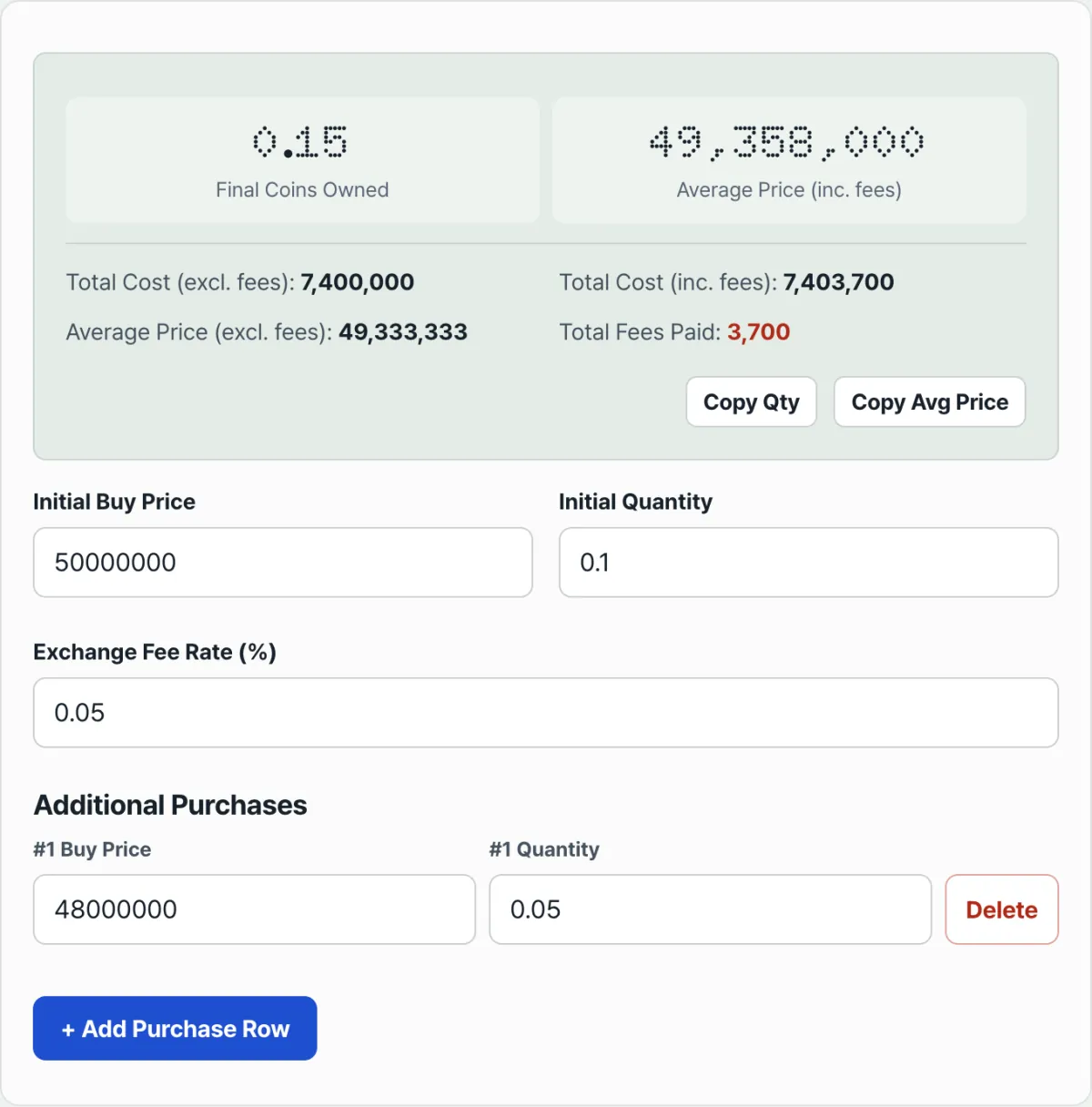
- Exchange fee rate (%): Enter your exchange's fee rate as a number. The rate is applied to the purchase cost of each buy, and the tool shows the average cost both with and without fees.
- Additional buy (averaging down) plan: Click the Add another buy button to enter the price and quantity for each new purchase. Add as many rows as you need or remove them with the delete button.
- As soon as you enter your numbers, the results area at the top of the screen shows total holdings, final weighted-average cost with and without fees, total purchase amount, and total trading fees. You can copy the figures with one click.
The Bottom Line
Averaging down is a powerful financial rescue tool that can lower your average cost in a crisis, but it is a double-edged sword: if the market keeps falling, you keep putting in more principal and can eventually get liquidated. Before you send a buy order, run the average-cost simulation to check your final average cost and total capital committed. That helps you avoid panic trading and defend your assets calmly and rationally.
Free · no sign-up · instantly simulate your weighted average cost for any added buy amount
Frequently Asked Questions
When averaging down, how should I split the amount I invest?
To dilute your average cost effectively, use pyramiding: put more money in as the price falls.
- For example, if you buy 1 million won of a stock at the first level and it falls 10%, averaging down with another 1 million won (a 1:1 ratio) moves your average cost only halfway between the two prices (-5%).
- But if you put in 2 million won (a 1:2 ratio) or 3 million won below the -10% level, you weight the lower position more heavily and pull your average cost down faster. Even a small market bounce can then make it easier to exit with a profit. This strategy only works if you have cash left to add during a decline, so it's generally recommended to keep a healthy cash cushion and plan ahead. (Some investors use a cash allocation of around 30%–50% as a guideline, but the right ratio depends on your finances and risk tolerance. This is reference information only.)
What is the key difference between averaging down and averaging up in stocks?
The two techniques move in opposite directions relative to the price trend when you put money in.
- Averaging down: A defensive move: you buy when the stock is falling to lower your average purchase price.
- Averaging up: An aggressive trend-following move: you buy more as the stock rises with the trend to grow your profits faster. Averaging up carries the risk of raising your average cost, so you should only enter when the stock is a market leader or has strong earnings momentum, and only after a careful average-cost simulation to avoid damaging your cost basis.
This article is based on the weighted average cost (WAC) formula from general investment finance and the principle of adding transaction fees. We assume no responsibility for execution differences caused by liquidity gaps in live order books on individual exchanges.
This article was adapted from our Korean original. Read the Korean original