
LTV vs CAC: Unit Economics Formula and Free Calculator
Contents
Once you found a startup or launch a new business and step onto the IR pitch stage to raise a large venture capital (VC) round, there's one scary question every investor asks.
"How is your LTV to CAC ratio holding up right now? Are your unit economics healthy?"
No matter how steeply revenue climbs, if the money you spend to bring in one customer (CAC) is bigger than the profit that customer brings in over their lifetime (LTV), the business piles up losses with every sale until it goes bankrupt. Let's dig into the math behind LTV and CAC — the compass for startup survival and growth — and the financial meaning of the LTV:CAC = 3:1 rule for judging health.
Note Financial & Investment Disclaimer The results from this LTV/CAC unit economics model are a general business valuation aid that runs on the financial and marketing estimates you enter. Actual profitability metrics can differ depending on seasonal swings in churn (seasonality), sudden shifts in new marketing channel efficiency, amortization of your own assets, and how broadly you attribute operating labor costs. Before you scale the business or commit capital, get a careful review from your CFO or a certified public accountant.
Summary ① CAC (Customer Acquisition Cost): total marketing and sales spend to acquire new customers, divided by the number of new customers. ② LTV (Customer Lifetime Value): the total expected net profit one customer brings in over the entire time they stay with your business. ③ Unit economics health line: in practice,
LTV ÷ CAC ≥ 3(LTV at least 3x CAC) is commonly used as the line where you can safely increase ad budget (it varies by industry). ④ With the LTV & CAC Calculator, you enter marketing cost, new customers, average order value, purchase frequency, and customer retention period, and you can instantly get a summary report of your business's unit health ratio
1. How the LTV and CAC Formulas Work
The basic math of unit economics is carefully teasing out the contribution margin generated by one unit — one new customer.
CAC (Customer Acquisition Cost) Formula
- Formula: CAC = total marketing and sales cost for a given period ÷ number of new customers acquired in the same period
- How to read it: Say you spent
10 million wontotal this month on Instagram ads and sales salaries, and500new customers signed up. Your CAC is exactly 20,000 won.
LTV (Customer Lifetime Value) Formula
- Formula (simple purchase-value version): LTV = average order value × annual purchase frequency (orders/year) × customer relationship length (years)
- How to read it: Say the average order value is
35,000 won, the customer buys6 timesa year, and the average relationship lasts3 years.- LTV: 35,000 won × 6 × 3 = 630,000 won How to read the result: over the life of the relationship, one customer brings in a total of 630,000 won in revenue value — a high-value customer. Note that this formula is not a sophisticated model that factors in margin or discount rates, so for profit-and-loss analysis that reflects real costs, treat it as a rough estimate that needs a separate financial review.
2. Why a 3:1 LTV:CAC Ratio Is the Line Startups Can't Cross
Startups have to carry heavy fixed costs — infrastructure, rent, developer salaries. That means a contribution margin ratio above 1:1 alone is not enough for the company to survive.
- LTV:CAC = 1:1: The cost of acquiring a customer equals what you earn from them over their lifetime, so marketing is pointless, and fixed costs push the company closer to bankruptcy every month.
- LTV:CAC = 3:1: This is the "scale-up golden line." As you spend on marketing to bring in more customers, contribution profit clears the fixed-cost threshold with room to spare, and the company lands safely on a path to profitability.
- LTV:CAC = 5:1: It means the business is either extremely efficient or spending too little on marketing, so growth has stalled. In that case, it's a signal to push marketing harder (raise CAC) and take market share.
Diagnose Your Business Efficiency with the LTV & CAC Calculator
If multiplying average order value, purchase frequency, and retention period — and tracking CAC trends — is too much to do in your head, try a simple business efficiency converter.
Free · no signup required · live check of your unit economics 3:1 ratio and scale-up grade
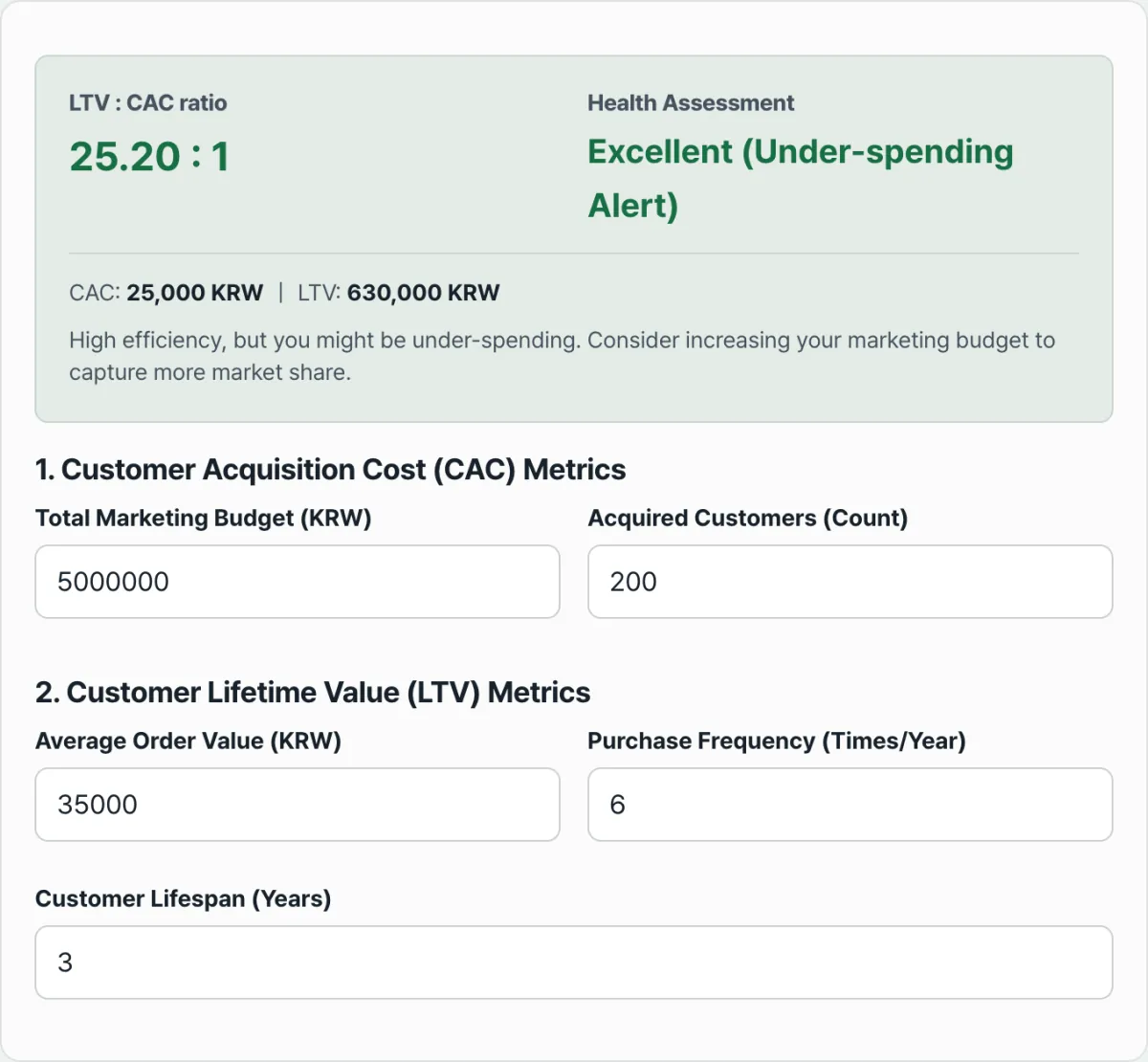
The tool is laid out clearly.
- CAC input area: Enter the total cost of acquiring new customers (ad spend, sales costs) and the number of new customers you acquired.
- LTV input area: Enter the average order value (won), annual order frequency (orders/year), and average customer relationship length (years) (the bigger all three numbers are, the higher LTV goes).
- The report dashboard on the right (or at the bottom) immediately charts your average CAC, your total average LTV, and the final LTV : CAC multiple that compares the two.
- It also shows live diagnosis and advice on your business's current health (at risk, needs improvement, good time to invest, underinvesting), so it supports your strategy planning.
Wrapping Up
Unit economics is a useful analysis tool for checking a business's "honest structural fitness" instead of being fooled by revenue numbers that look good on the surface. Before you spend your marketing budget, check the balance between acquisition cost and customer value with the LTV & CAC Calculator, and build your growth strategy around a healthy 3:1 line.
Free · no signup required · live check of your unit economics 3:1 ratio and scale-up grade
Frequently Asked Questions
What should I adjust to raise LTV (customer lifetime value)?
This calculator computes LTV as average order value × annual purchase frequency × customer relationship length, so improving any one of the three raises the result.
- Raise average order value: Bundle products or offer upsells to increase what each customer spends.
- Increase purchase frequency: Use repurchase coupons, subscription conversions, and reminder notifications to increase orders per year.
- Extend the relationship: Improve onboarding and strengthen customer support so customers stay longer instead of churning.
Keep in mind that this formula is not a sophisticated model that factors in margin or discount rates, so profit-and-loss analysis that reflects real costs needs a separate financial review.
Is it a good idea to keep cutting the ad budget just to lower CAC?
Simply cutting budget is short-sighted. If you slash the ad budget, you get fewer impressions, so the number of new customers (the denominator) drops too — and your CAC per customer can actually go up.
- Improve creative: Raising click-through rate (CTR) and conversion rate (CVR) on your ad creative gets you more customers on the same budget.
- Grow organic traffic: A referral program that increases the share of organic customers coming in without ad spend is another way to lower CAC.
This article was written with reference to modern startup financial performance evaluation theory and standard venture capital investment guidelines. Actual figures may vary somewhat depending on platform fee payment margins and channel attribution model settings.
This article was adapted from our Korean original. Read the Korean original