
CTR and CVR Calculator: Formulas for CPC and CPA
Contents
The Math Behind the Four Core Performance Marketing Metrics
To analyze ad performance from every angle, you need to understand how these four formulas play off each other.
1. CTR (Click-Through Rate)
This is the "first-impression score" that shows how much your ad message sparked interest.
- Formula:
CTR(%) = (clicks ÷ impressions) × 100 - How to read it: A low CTR means your creative (image, copy) isn't appealing, or your targeting is completely off.
2. CVR (Conversion Rate)
This is the "follow-through score" — how much of the traffic your ad brought in turned into real business results like revenue or sign-ups.
- Formula:
CVR(%) = (conversions ÷ clicks) × 100 - How to read it: If CTR is high but CVR is extremely low, it's a sign that people clicked on bait-y copy, then left because the landing page had thin information or the buying process was too complicated.
3. CPC (Cost Per Click) & CPA (Cost Per Action)
These are unit cost metrics that put a number on how much efficiency you get per dollar spent.
- CPC formula:
CPC = total ad spend ÷ clicks - CPA formula:
CPA = total ad spend ÷ conversions = CPC ÷ CVR (as a ratio)
As this formula proves, when CVR doubles, the cost of acquiring one customer (CPA) on the same budget drops by exactly half (50%). That's the scientific reason the golden target of marketing optimization is conversion rate optimization (CRO).
Ad Efficiency Diagnosis Matrix: A Prescription Guide
Realistic diagnoses and action tips for each of the four metric combinations you'll see when you put your marketing report into a dashboard.
- High CTR & Low CVR (lots of traffic, no conversions):
- Cause: The copy and creative are attractive, but your store's landing page loads too slowly, payment options are missing, or price is a barrier.
- Prescription: Improve landing page UX and shorten the path where users drop off.
- Low CTR & High CVR (little traffic, very high conversion rate):
- Cause: The ads aren't attractive so only a few people come in, but product loyalty or the persuasive landing page is excellent.
- Prescription: A/B test your ad copy and change up placement layouts to bring in more traffic.
- Low CTR & Low CVR (the worst case):
- Cause: The creative isn't appealing, the targeting band is wrong, and the product has no real draw.
- Prescription: Pause the entire ad set and go back to the drawing board on your core value proposition.
Analyzing Ad Performance with the CTR & CVR Calculator
If it's a hassle to plug raw numbers into a spreadsheet and hand-build the multiplication and division formulas every time you need a performance report, try a purpose-built calculator instead.
Free · no sign-up · enter impressions, clicks, and conversions to get all four KPIs at once
Using the tool is mechanical and simple.
- Base ad data: Enter total impressions over the period, total clicks on your creative, and the conversions (purchases, etc.) that resulted.
- Cost (optional): If you also want to see CPC and CPA, add the total ad spend you paid the agency or the platform. CTR and CVR are still calculated without it.
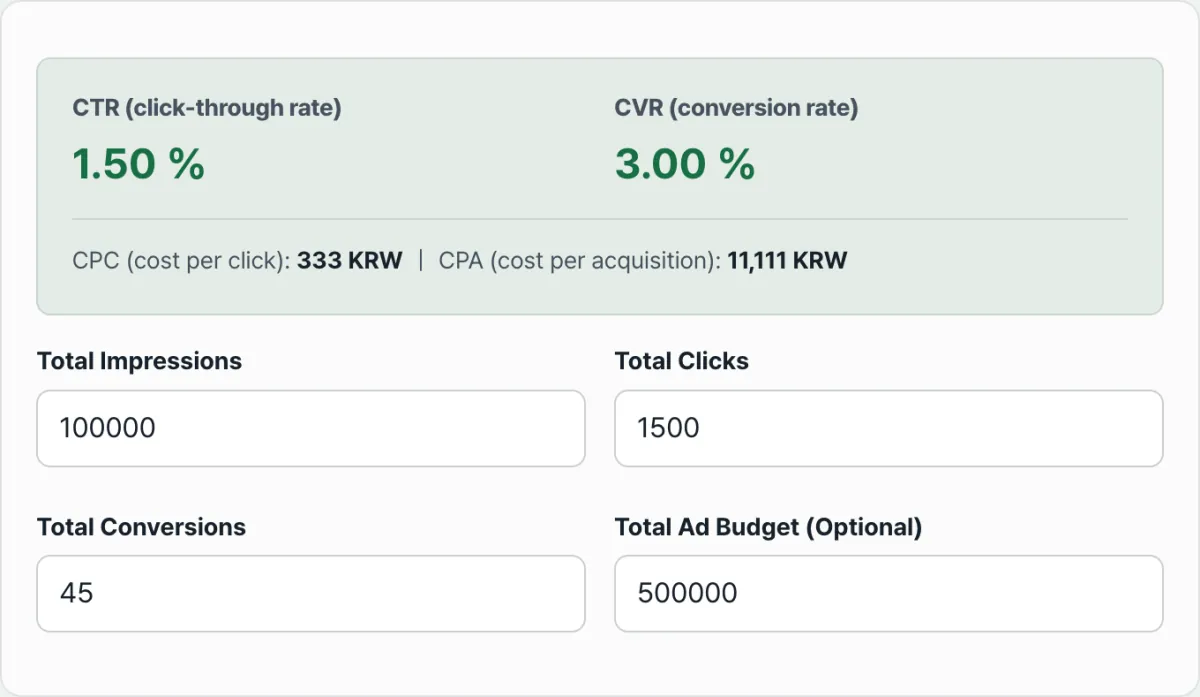
- The moment you type, the result cards show click-through rate (CTR) % and conversion rate (CVR) %, and if you entered ad spend, they also convert it to expected CPC and CPA unit costs.
- Plug the CTR and CVR numbers into the Ad Efficiency Diagnosis Matrix above and diagnose for yourself which of the four situations your campaign is in right now.
The Bottom Line
Winning at digital advertising isn't about burning a bigger budget to buy more impressions. It's a fight for efficiency — balancing CTR and CVR so your customer acquisition cost (CPA) drops. Before and after you plan new creative, use the CTR & CVR Calculator to calmly check your baseline scores, and lead performance marketing smartly enough to block wasted budget before it happens.
Free · no sign-up · enter impressions, clicks, and conversions to get all four KPIs at once
Frequently Asked Questions
What CTR and CVR benchmarks should my business aim for?
It varies a lot by industry and ad format (search ads vs. display banner ads). Generally, search advertising (SA) — where users actively type in a keyword and arrive on their own — tends to show higher CTR and CVR than display banner ads (DA), which people see passively while browsing a feed. But exact numbers shift a great deal with the platform, industry, season, and creative quality. Rather than chasing a specific percentage as if it were the right answer, we recommend using this calculator to consistently log your own past campaign numbers, build your own baseline, and compare campaigns before and after.
Are there proven creative tips to improve click-through rate quickly?
Put specific numbers and benefits into your ad copy instead of vague, flowery language.
- For example, instead of "Sign up now and get a discount," something like "Sign up now and get 3,000 won off instantly" gives people a clear number for what they gain. That shortens the time it takes them to decide whether to click, and practitioners often say it tends to help CTR. The size of the improvement depends on your industry, creative, and audience, though — so after you change the copy, compare CTR and CVR before and after with this calculator to confirm the real effect. That's the most accurate approach.
This article is based on general performance marketing KPI theory from ad economics. Actual conversion figures can be off due to gaps in cookie tracking on individual ad platforms (policies such as iOS ATT).
This article was adapted from our Korean original. Read the Korean original