
How to Count 10 Seconds Accurately Without a Timer
Contents
- Why 10 seconds in your head isn't 10 seconds on the clock
- How to count 10 seconds accurately without a timer
- When your error gets bigger, and how to shrink it
- The takeaway
- Under the hood: chronobiology and cognitive time perception
- Comparing mental time-estimation techniques
- 5 Fatal Mistakes That Throw Off Your Sense of Internal Time
- A 5-Step Calibration Workflow for Precise 10-Second Counting
- 7 Timekeeping and Pacing Tips
- Decision Tree for Choosing a Mental Timing Technique
- Key Terms Cheat Sheet for Pros
- Frequently Asked Questions
Close your eyes and count seconds in your head, and you'll often land pretty far off from real time. That gap isn't about practice. It comes from how people register time in the first place.
There are ways to count that cut the error without a timer, and a way to see your own error as a number.
The short version ① Your felt sense of time stretches or shrinks depending on how tense and how focused you are. ② Counting with a rhythm keeps the gap between seconds steadier than counting plain numbers, so the error shrinks. ③ Stop a stopwatch with the screen hidden and you can see your own error down to the millisecond.
Why 10 seconds in your head isn't 10 seconds on the clock
There is no tick-marked clock inside your brain. Instead, it estimates the passage of time from indirect signals — your breathing, the rhythm of the numbers you count in your head.
That estimate wobbles easily when you're nervous or your focus slips. It's the same reason your error balloons when you have to time something without looking at a screen.
How to count 10 seconds accurately without a timer
The most common fix is to tack a syllable onto each number so every count takes the same time to say, instead of rattling off bare numbers. Count short like "one, two, three" and each second stretches or shrinks with your speaking speed.
So you add a syllable to each number — "one-thousand, two-thousand, three-thousand" — to keep each beat about the same length. That keeps your pace from suddenly speeding up or dragging.
Testing yourself is simple too. Start any stopwatch, close your eyes, count to 10 the way above, then open your eyes and compare how many seconds actually passed.
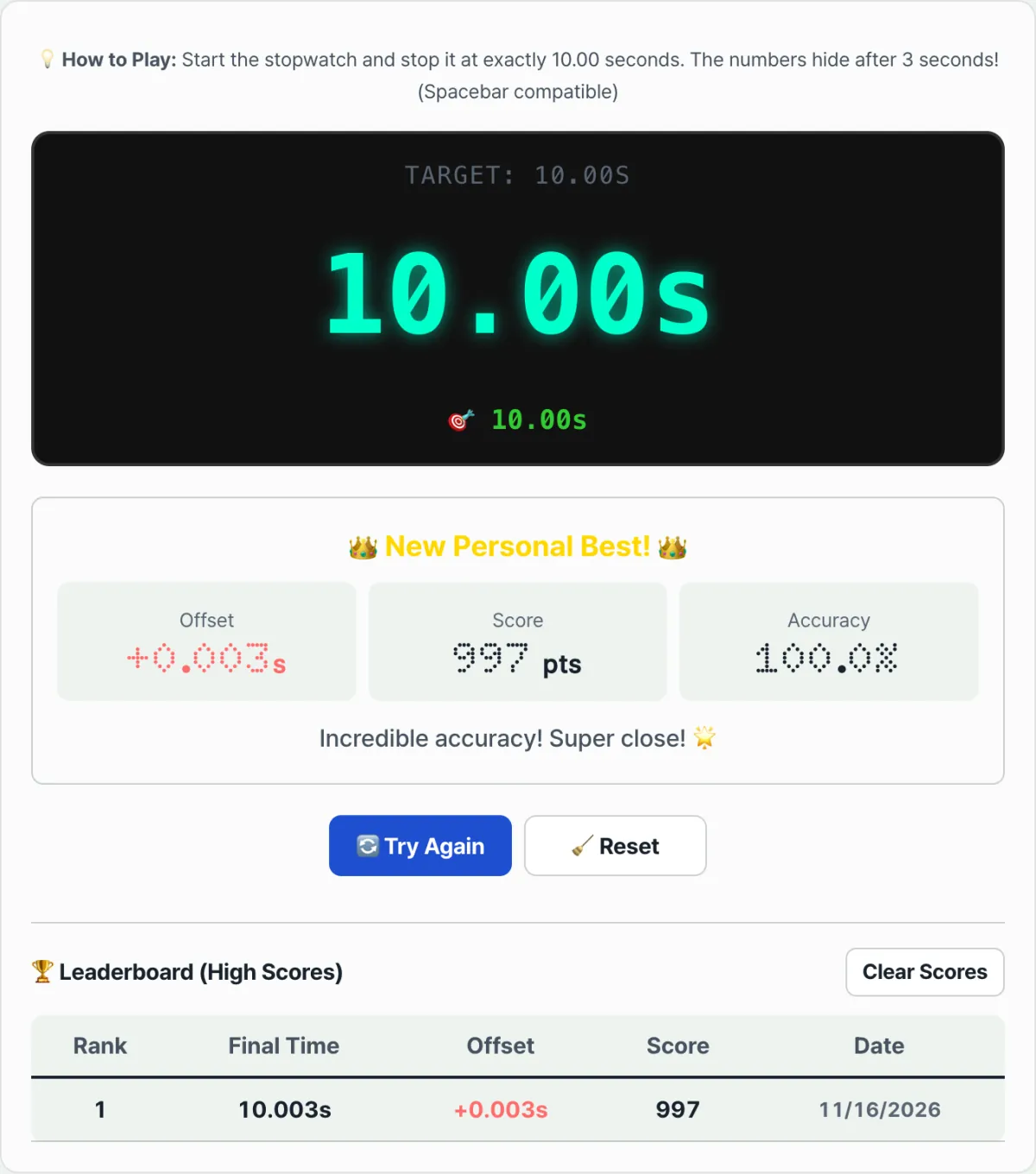
Check yourself with our free tool, Stop the Clock at 10 Seconds. If closing your eyes and then checking the stopwatch gets tedious, you can repeat the same test more easily on a screen that hides the numbers after 3 seconds.
Free · No sign-up · Your best score is saved in your browser
When your error gets bigger, and how to shrink it
| Situation | Error you'll usually see |
|---|---|
| When you're nervous | Time feels like it went faster than it did, so you stop early |
| When you're bored or understimulated | Time feels like it went slower than it did, so you stop late |
| When you count short bare numbers | Your speaking speed drifts and the error piles up |
| When you add syllables to build a rhythm | Each beat stays about the same length, so the error shrinks |
As the table shows, the direction of your error often flips depending on the situation. If you know which way you lean, you can nudge your next attempt slightly the other way.
The takeaway
Ten felt seconds run differently for every person, and differently from one day to the next. Counting with an added syllable and a steady rhythm cuts the error, and testing yourself over and over with the screen hidden shows you your own pattern.
Once you know which way your error leans, you can correct for it slightly on your next try.
Free · No sign-up · Your best score is saved in your browser
Under the hood: chronobiology and cognitive time perception
How your brain perceives and measures physical time goes well beyond simple sensation. It's governed by highly complex neurophysiological mechanisms. Why does time fly when you're stressed and crawl when you're bored? The answer is in how your body's internal clock works.
The pacemaker-accumulator model
Proposed by Treisman and Gibbon, this model is the best explanation we have of human cognitive time perception. According to it, your brain measures time in three main stages.
- Pacemaker: Emits signals (pulses) at a steady rate from an internal neural network.
- Attention switch: Closes when you consciously focus on tracking time, letting the pulses through.
- Accumulator: Counts the pulses that got through and decides "that much time has passed."
The effect of dopamine and arousal Emotional states like excitement, tension, and anxiety stimulate the sympathetic nervous system and send dopamine release in the brain surging. Higher dopamine levels speed up the pacemaker, so it fires far more pulses in a short window than usual. Only 1 second has actually passed, but the brain's accumulator has banked 1.5 seconds' worth of pulses. As a result, the brain assumes the target time has already passed and stops counting early.
Depression, boredom, and low body temperature The opposite happens when you're bored, depressed, or when the surrounding temperature drops and your body temperature falls: the pacemaker's pulse rate slows down. Because pulses build up slowly, 10 seconds may have actually passed while the accumulator has only gathered 7 seconds' worth. That makes time feel unusually slow, and you stop counting late.
Weber's law in psychophysics
Timing error isn't an absolute number — it scales with the ratio. According to Weber's law, the error (Δ T) when you estimate a target time (T) grows in proportion to T. As a formula, Δ T/T = k (where the constant k usually falls between 0.05 and 0.10). Put plainly: if you're off by about 0.5 to 1 second on a 10-second count, you'll naturally be off by 3 to 6 seconds on a 60-second count. That's the mathematical and neurological law behind it.
The phonological loop and sub-vocal cadence
The phonological loop, one component of working memory, handles the process of repeating words silently to yourself. Count with single-syllable numbers like "one, two, three" and the gap between your utterances is left to your brain's own judgment, so the tempo falls apart easily. Use a two-to-four-syllable anchor instead — "one-thousand, two-thousand" or "one-Mississippi, two-Mississippi" — and the physical time it takes to say it syncs up with the average human speech rhythm (about 4 syllables per second), which makes the interval between counts mechanically consistent. The effect is powerful.
Comparing mental time-estimation techniques
Here's a detailed comparison of four main ways to measure time without a timer: what each one does well, where it falls short, and how people use it in practice.
| Technique | Average error rate (10-second target) | Stability under stress | Cognitive load | Best real-world use cases |
|---|---|---|---|---|
| Silent pure counting | ±15% ~ 20% | Very fragile (tempo speeds up easily) | Low | Estimating short everyday waits |
| Syllable-rhythm counting ("one-thousand, two-thousand") | ±2% ~ 5% | Excellent (the spoken rhythm acts as a buffer) | Medium | Cooking (searing a steak), pulling espresso, pacing a speech |
| Resting pulse sync | ±5% ~ 10% | Unstable (your pulse itself rises when you're tense) | High (takes intense focus to feel the pulse) | Meditation, freediving, precise counts while your heart rate is steady |
| Musical tempo recall (metronome, 60/120 BPM) | ±3% ~ 7% | Excellent (auditory memory holds the tempo) | Low to medium | CPR (100~120 BPM), pacing reps in weight training |
As the table shows, under extreme stress or tension the riskiest choice is plain number counting, which leans on cognitive judgment. In real situations, methods that lean on your body's own motor rhythm (speech, beat) — like syllable-rhythm counting or musical tempo recall — are far steadier.
5 Fatal Mistakes That Throw Off Your Sense of Internal Time
These are the five most common mistakes that break accurate counting and scramble your body clock.
- Failing to adjust your tempo when adrenaline kicks in: When you're nervous or excited, your counting speeds up. If you count at your normal feel, you'll usually stop short of the real time. Once you know you're in a stressful situation, you have to consciously slow your counting tempo — and most people skip that step.
- Stretching vowels unevenly to count single-syllable numbers: Trying to hit one second by dragging out the end of a single-syllable number — "oneeee, twoooo, fouuuur" — is wildly inaccurate. There's no objective standard for how long you hold a vowel, so it comes out different every time.
- Counting off irregular breathing: A lot of people use each inhale and exhale as their one-second reference, but breathing swings from 12 to 20-plus breaths per minute depending on your emotions and how active you are. It's an unreliable yardstick.
- Ignoring physical fatigue and circadian rhythm: Ten seconds at 10 a.m. with a clear head and ten seconds at 3 a.m. after an all-nighter are not the same thing — the brain processes them at completely different speeds. When you're exhausted, your internal pacemaker slows down and your count runs behind, but you don't notice and keep measuring against the same baseline.
- Overlooking the stimulant effect of caffeine and energy drinks: A high dose of caffeine or an energy drink excites the central nervous system and artificially speeds up your brain's internal clock. After two or more cups of coffee, it's easy to forget that the world's clock now seems to run "slower" than your own sense of time.
A 5-Step Calibration Workflow for Precise 10-Second Counting
A systematic five-step training routine to zero out — calibrate — your own accurate sense of 10 seconds.
- Measure your baseline error with a blind stopwatch: Start with a timer that hides the screen (a blind timer) and count 10 seconds the way you normally would. Note where you tend to stop — 8.5 seconds, 11.2 seconds — to see your reference point and your bias.
- Standardize your own verbal anchor: Build a personal anchor of three to four syllables, such as the Korean "il-cheon, i-cheon, sam-cheon" or "il-cho-sen-da, i-cho-sen-da." Whether you say it out loud or sub-vocalize it in your head, the rhythm has to stay exactly the same every time.
- Sync to a 60 BPM audio metronome: Turn on a 60 BPM metronome on your phone and silently read your anchor words along with the tick. Repeat until the metronome beat and the rhythm in your head line up perfectly and the cadence is burned into your neural pathways.
- Cross-test under different physical states: Don't only test while sitting comfortably. Do 30 jumping jacks or squats to spike your heart rate, then immediately measure 10 seconds on the blind timer (a stress simulation). Feeling for yourself how badly the rhythm falls apart when you're physically worked up is what matters.
- Calculate and correct your personal drift factor: If you find you tend to stop about one second early when you're excited, give yourself a correction rule for the real thing: "When I'm nervous, I hold the last count a touch longer than usual." That cancels out the error.
7 Timekeeping and Pacing Tips
Field-tested timekeeping tips from professionals who work with time — athletes, news anchors, baristas, and others.
- The four-phoneme magic of "il-cheon" and "one-Mississippi": At the average human rate of articulation, the Korean "il-cheon, i-cheon" or the English "one-Mississippi" makes a near-perfect one-second interval. It's the best magic spell there is. Train that tempo into your muscles.
- Lock a motor rhythm into your extremities: Counting only in your head leaves you wide open to your brain's illusions. Tap a fingertip or a toe in tiny motions and tie the rhythm to physical movement — your motor cortex gets involved and cuts the timing error dramatically.
- Use your resting heart rate as a metronome: If your normal resting heart rate is around 60 BPM (one beat per second), you can use an advanced technique: focus on the pulse you can feel at your jaw or wrist and use it as your one-second reference.
- Use a reverse-compensation strategy after caffeine: Right after an espresso or a concentrated energy drink, your brain's pacemaker speeds up and time feels like it's flying. Deliberately count about 5% slower than your usual rhythm to offset the error.
- Know that temperature governs your brain's tempo: Your internal clock slows in extreme cold and speeds up in midsummer heat or inside a sauna. Just being aware that ambient temperature changes how you feel time can help you avoid errors.
- Memorize a life-saving pop song tempo for emergencies: In an urgent CPR situation, don't count seconds — play a 100–103 BPM song in your head. Doing chest compressions to the chorus of the Bee Gees' "Stayin' Alive" (103 BPM) or "Baby Shark" (100 BPM) gives you the most perfect lifesaving tempo.
- Run regular self-checks with a blind timer: The way golfers practice putting every day to keep their touch, use the "Stop the Clock at 10 Seconds" blind stopwatch regularly to check whether your sense of time has drifted to one side.
Decision Tree for Choosing a Mental Timing Technique
How long the interval is changes how much cognitive load your brain can carry. Pick the best method for the situation.
- Is the interval ultra-short, 1 to 10 seconds?
- YES → Use syllable-rhythm counting ("il-cheon, i-cheon"). Short intervals hold your focus, so spoken rhythm maximizes accuracy.
- Is the interval medium-length, 10 to 60 seconds?
- YES → Use breath cycles or pulse sync. Past this point, counting numbers in your head means you'll lose track in the middle or your breathing tangles and the tempo collapses. It works better to group one steady deep breath (about 4–5 seconds) as a single unit and count those.
- Is the interval long, 1 to 5 minutes or more?
- YES → Use landmark milestones. Once you're into minutes, tracking time by pure counting is beyond human ability. Set behavior-based milestones, like "roughly a minute has passed once I've covered three of these speech slides."
Key Terms Cheat Sheet for Pros
- Internal pacemaker: The neurological rhythm generator in the basal ganglia and substantia nigra that measures the passage of time using dopamine signals.
- Time perception: Not physical, absolute time, but the psychological flow of time as your brain subjectively feels and interprets it.
- Sub-vocal cadence: The steady beat and rhythm produced when you pronounce words silently in your head. It's a powerful reference point for estimating time.
- Weber's Law: The psychophysical law that the smallest detectable change in a stimulus is proportional to the size of the original stimulus. Used to explain the error rate in time estimation.
- Dopamine arousal: The phenomenon where dopamine released during tension or excitement sharply accelerates the pulse rate of your internal clock.
- Phonological loop: The working-memory system in the brain that holds and rehearses auditory and verbal information for short periods.
- Blind timer: A special timer designed to block visual feedback so you can test your pure cognitive sense of time.
Frequently Asked Questions
Q1. In an emergency or a panic, why does time feel like it's flying by, while when you're bored it feels like it's stopped?
The brain's pacemaker-accumulator model explains this perfectly. In a panic or under extreme stress, your survival instinct triggers a burst of adrenaline and dopamine. These chemicals wildly speed up the tempo of the brain's internal clock (the pacemaker). In other words, only one second has passed in reality, but the brain fires off a huge number of neural pulses and decides that two or three seconds have already gone by. So barely any external time has passed, yet the time in your head seems to have raced ahead—a "misperception" that makes you stop counting too early or rush. Conversely, when you're bored, your neural activity slows and pulses come very slowly, so one real minute stretches out into three long, painful minutes.
Q2. Why is adding syllables like "one-Mississippi" or "one-thousand, two-thousand" so much more accurate than just counting "one, two, three"?
Our brains keep a much steadier rhythm when controlling physical motor sensation (pronunciation) than when reciting a list of numbers. This comes down to the brain's "phonological loop": your nervous system is optimized to pronounce about three to four syllables per second in ordinary speech. "One, two, three" are single syllables, so your brain has to fill the gaps (silence) with imagination, which creates error. But "one-thousand, two-thousand" or "one-Mississippi" take about one second of physical time to say. In other words, you replace the abstract concept of time with an objective ruler—the physical movement of your articulatory organs—so accuracy rises dramatically.
Q3. Is it true that you'll be off if you time yourself right after drinking coffee (caffeine) or outside in the dead of winter?
Yes, it's true. The human body clock is like a very delicate chemical and thermodynamic sensor. Caffeine is a powerful central nervous system stimulant. It affects dopamine receptors and artificially speeds up neural signal transmission. After you drink coffee, your internal clock runs fast, so your perceived time moves faster than actual time. Body temperature is also a decisive variable. According to the classic research of psychologist Hoagland, patients with a high fever perceived one second as much shorter than usual. Conversely, when the surrounding temperature is very low and your body temperature drops, the brain's chemical reaction rate itself slows down, so your internal clock runs slow. So when you need to measure important timing, the pros' trick is to deliberately compensate based on how alert you are and what your body temperature is.
This article was adapted from our Korean original. Read the Korean original