
Keyword Density Explained: The Real Formula and Its Limits
Contents
You've probably heard someone say that "a keyword density of 1–2% is about right." Plenty of people writing blog posts or product pages set that number as a target, count characters as they go, and squeeze the keyword in. But there's no verified evidence anywhere that this particular percentage determines your actual search ranking.
Summary ① Keyword density is just a simple calculation: "number of times a word appears ÷ total token count × 100." ② The "ideal percentage" number isn't a verified ranking standard — it's closer to a widely repeated rumor. ③ The real use of this metric isn't ranking optimization. It's checking yourself for awkward repetition in your copy.
What keyword density actually is
The definition is simple. Keyword density is the share of your total word (token) count taken up by a particular word. Written as a formula, it's just "occurrences of that word divided by total token count, times 100."
So far this is purely arithmetic. What any search engine does with that number is a separate question. The first thing this article wants to nail down is that the calculation itself isn't in dispute.
What you learn by counting by hand
The most primitive way to check this number is to paste your text into a word processor and use Find to count occurrences of a word one at a time. For the total word count, you can use whatever character or word count stat the program gives you.
The problem is that this is a hassle even when you're counting a single word. You have to sort out forms with particles and endings attached, and if you want to check several words, you repeat the whole process for each one. The longer the text gets, the closer exact counting comes to impossible.
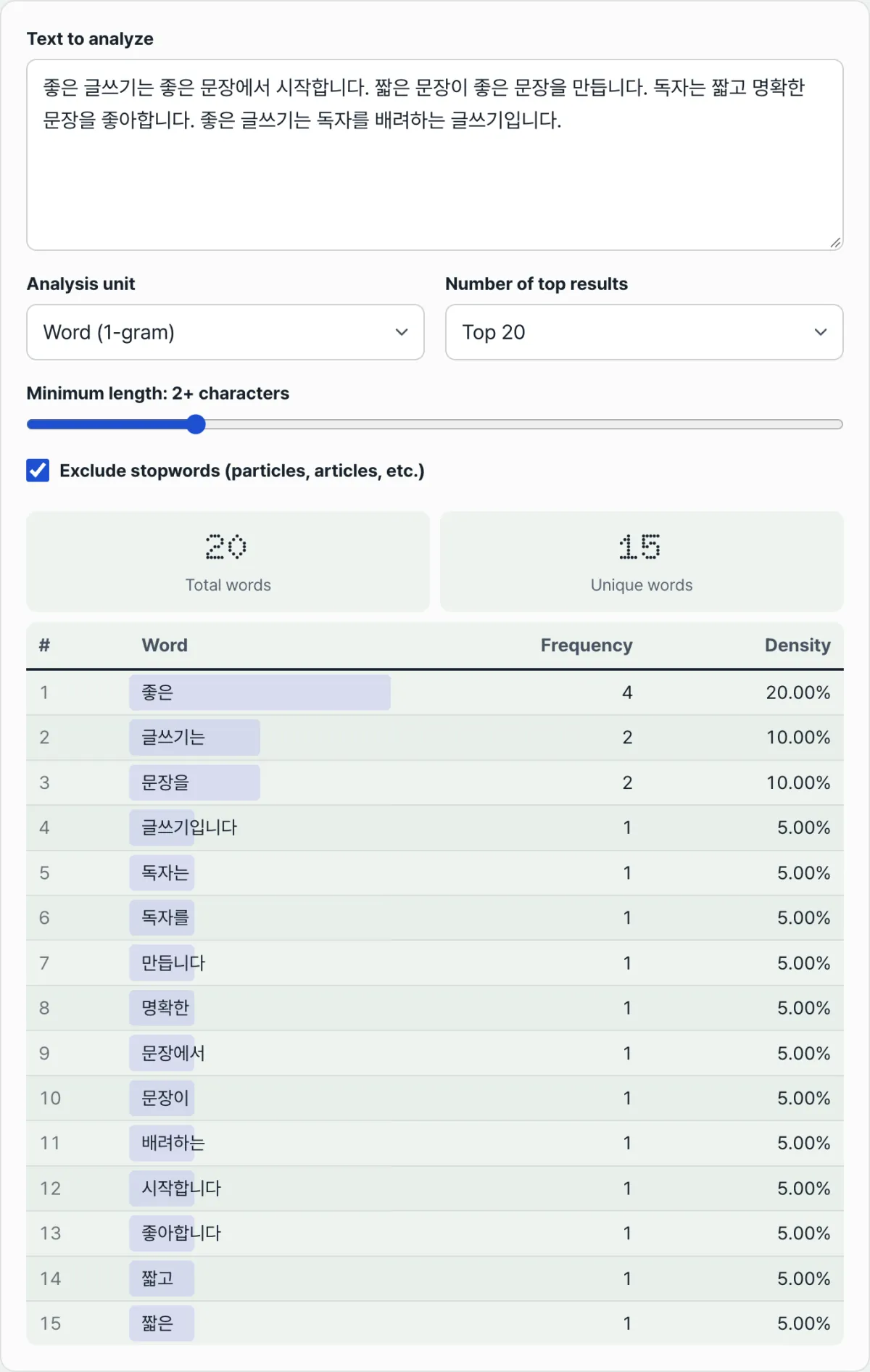
Paste your body text and see each keyword's count and density (%) in a table right away.
Where does "1–2% is ideal" come from?
It's hard to trace exactly which official document or verified experiment this number came from. Search engines don't publish the formulas they use to rank pages, and none has ever officially said that filling a certain percentage of your text with a word gives you an advantage.
If anything, search engines have moved in the opposite direction: rather than counting how many times a word shows up in a sentence, they judge relevance by understanding context and the topic as a whole, which is far more sophisticated. In other words, the idea that you can turn a single "density %" number like a ranking dial is closer to an unverified rumor that spread on its own.
So is the number useless?
It's not that the metric means nothing. It's that you have to point it somewhere other than ranking optimization. When one word's density comes out noticeably high, that's a sign you may have repeated it just to force it in.
When the same expression repeats too many times in a short piece, it reads as awkward and unnatural to a person long before any algorithm gets involved. And in practice, writing like that tends to be weaker overall.
So the honest way to use this tool isn't to check "how many more percentage points of this word do I need?" It's to check "does this read naturally, and did I force a word in?" If one word lands unusually high in the rankings, reread that section and treat it as a signal to vary your wording.
What you only see at the phrase level
A single word can look like it's in a normal range while the same phrase keeps repeating in your text. For example, if you use the same two-word combination — say, "fast and convenient" — in paragraph after paragraph, word-level density alone won't make that stand out.
That's when switching to Phrase mode, which counts words in pairs, gives you a much more accurate read. If the same pairing keeps showing up near the top, it means you've been copying the same sentence pattern instead of varying your wording.
The takeaway
- Keyword density is a simple calculation — "occurrences ÷ total token count × 100" — and that calculation itself is solid fact.
- The specific "1–2% is ideal" figure isn't a verified ranking standard. It's a widely repeated rumor, and search engines judge relevance in far more sophisticated ways.
- The honest use of this metric isn't ranking optimization. It's checking yourself on whether your copy reads naturally instead of forcing a word in over and over.
- Even if Word mode looks fine, switching to Phrase mode can surface a separate problem of repeated phrasing.
- You need to filter out stopwords like particles, word endings, and articles to see meaningful words' proportions without distortion.
Paste your body text and see each keyword's count and density (%) in a table right away.
Frequently asked questions
What keyword density is best for SEO?
There's no verified number. Search engines haven't published an official ideal percentage, and today's search engines judge relevance from context and the topic as a whole far more precisely than by counting word occurrences. Rather than hitting a character count target for a specific %, it's safer to use "does this read naturally?" as your standard.
Will I lose out if I don't use the keyword at all?
If you never mention the main topic word in your copy, readers will have a hard time telling what the piece is about. But that's not a matter of hitting a density percentage. It's a matter of writing natural sentences that make the topic clear.
When should I use Word mode versus Phrase mode?
Word mode is the right choice for seeing how often one particular word is used across the whole piece. Phrase mode is more useful for checking whether a two-word expression repeats as-is — that is, whether whole sentence patterns are being copied. Alternating between the two lets you catch different kinds of repetition problems.
Do I have to turn on the stopword filter?
If you don't filter out stopwords like particles, word endings, and English articles and prepositions, those words will dominate the top of the list and hide the proportions of the words that actually matter. If your goal is to see the real topic words in your copy, turning the stopword filter on gives you much more accurate results.
This article was adapted from our Korean original. Read the Korean original