
MBTI Compatibility Chart: How 16x16 Matrix Grades Are Calculated
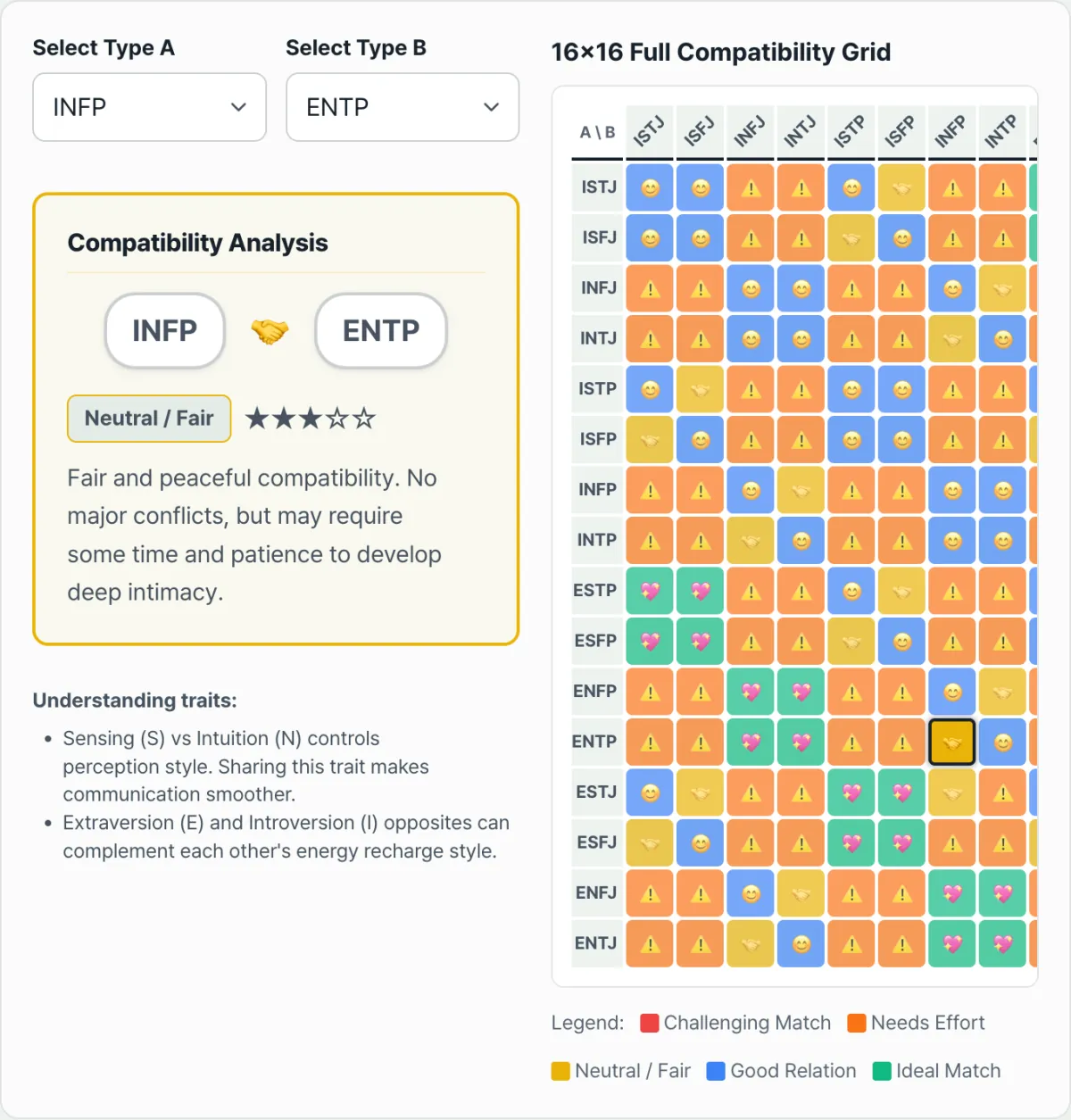
The 16x16 grid in the MBTI compatibility chart isn't something someone colored in by eye. It's the result of a fixed rule that compares the four letters (E/I, S/N, T/F, J/P) of two types and computes one of five grades. Once you know the rule, you can work out by hand why any combination gets the grade it does, without even opening the chart. Below, I'll walk through the scoring order exactly as it runs.
Summary ① Two identical types always get grade 4, "Good Match" — not the top grade, 5. ② Only 16 fixed combinations get the top grade, "Ideal Match." Everything else is scored by other rules, regardless of that list. ③ If a pair isn't on the ideal list, the grade depends on whether S/N (the second letter) matches and how many of the other three letters match.
The Problem
Search for an MBTI compatibility chart and you'll find plenty of color-coded grid images, but few explain why two given types get a given color. So people look up their type and the other person's type, check the color, and move on — never learning what calculation produced that color.
The more confusing part is that grade names and criteria vary from one source to the next. One source splits compatibility into three grades, another into five, so if you compare two charts side by side, the same pair can look like it got different results.
This post sticks to the one scoring rule our tool actually uses and explains, step by step, which letters of the two types it compares to set the grade.
The Solution
Our tool's scoring rule follows the order below, so you can do the math by hand without the tool.
Step 1 — Are the two types exactly the same? If the two types are identical (for example, INFP and INFP), the pair is scored right away as grade 4, "Good Match." Being the same type does not make it the top grade, grade 5, "Soulmates."
Step 2 — Is the pair one of the 16 fixed combinations? Only the 16 combinations below get the top grade, grade 5, "Ideal Match." This list is fixed in advance as pairs where S/N (Sensing/Intuition) stays the same while E/I (Extraversion/Introversion) and J/P (Judging/Perceiving) are swapped. If a pair isn't on the list, it can't get grade 5 no matter how many letters it shares.
- 8 Intuitive (N) pairs: INFP-ENFJ, INFP-ENTJ, INFJ-ENFP, INFJ-ENTP, INTJ-ENFP, INTJ-ENTP, INTP-ENFJ, INTP-ENTJ
- 8 Sensing (S) pairs: ISFP-ESFJ, ISFP-ESTJ, ISTP-ESFJ, ISTP-ESTJ, ISFJ-ESFP, ISFJ-ESTP, ISTJ-ESFP, ISTJ-ESTP
Step 3 — If it's neither of the above, check S/N first If the second letter of the two types (S or N) differs, the pair is scored by default as grade 2, "Needs Work." The one exception is INFP and ESTJ, which gets grade 3, "Fair Match." That single pair is the only exception hard-coded into the tool, and every other pair with mismatched S/N is grade 2, no exceptions.
Step 4 — If S/N matches, count how many of the other three letters match When S/N matches, count how many of the remaining three letters (E/I, T/F, J/P) are the same. Two or more matches means grade 4, "Good Match." One match means grade 3, "Fair Match." Zero matches means grade 2, "Needs Work."
For example, compare ISTJ and ESFJ: both are S, and of the remaining letters only J/P matches, so the match count is 1, which gives grade 3, "Fair Match." ISTJ and ENFP, on the other hand, split on S versus N and don't qualify for the exception above, so they go straight to grade 2, "Needs Work."
Apply these four steps in order and you can reproduce the grade for any cell in the grid yourself. When you check with our tool, picking two types instantly shows you the same result in both the card and the grid.
Pick two types or click a cell in the grid to see its compatibility grade and explanation instantly.
Common Sticking Points
| Situation | What the calculation actually gives |
|---|---|
| You picked the same type as yourself | Not the top grade 5, but grade 4, "Good Match" |
| The INFP-ESTJ pair | The only exception: it gets grade 3, "Fair Match" despite mismatched S/N |
| Other pairs with mismatched S/N | Aside from that one exception, all are grade 2, "Needs Work," and none move up to grade 3 |
| You can't find any red cells in the grid | The legend's lowest grade, grade 1 (red), exists only as a color definition and never appears as an actual computed result |
| Does switching Type A and Type B change the result? | The rule itself is symmetric and order-independent, so swapping A and B gives the same grade |
The Bottom Line
- Identical types get grade 4, "Good Match," and only the 16 fixed combinations get grade 5, "Ideal Match."
- If a pair isn't on the ideal match list, check S/N first. If it differs, every pair is grade 2 except the one exception (INFP-ESTJ).
- If S/N matches, count how many of the other three letters match: 2 or more is grade 4, 1 is grade 3, and 0 is grade 2.
- These grades are just a calculation rule built into the tool. They aren't a verified measure of whether a real relationship will work out. Treat this as fun reference material, and judge real relationships through conversation and experience.
Pick two types or click a cell in the grid to see its compatibility grade and explanation instantly.
Frequently Asked Questions
If a pair isn't among the 16 ideal matches, does that mean it's a bad match?
No. The ideal match list is just 16 combinations set aside for the single top grade, grade 5. Even if a pair isn't on it, it can still get grade 4, "Good Match," as long as 2 or more of the remaining three letters match. Grades drop only when S/N differs (grade 2) or when just 1 letter matches (grade 3).
Why does the card on the left change when I click a cell in the grid?
Each cell in the grid works as a button that sets the two types for that row and column as Type A and Type B. The combination for the cell you clicked is reflected in the dropdowns at the top left, and the result card below recalculates instantly by the same rule, updating the grade, description, and star rating together.
Do these grades predict real relationship success?
No. This chart is only a structure that counts how much two four-letter codes overlap and whether a pair belongs to the 16 fixed combinations. It isn't a statistic or research finding that has verified real relationship outcomes. Use it as fun reference material, and don't rely on it to judge real relationships.
This article was adapted from our Korean original. Read the Korean original