
Dice Doubles Probability Formula and 40-Space Board Simulation
Contents
When you're building a board game like Blue Marble or Monopoly, or a mobile board-movement event, you need to implement two rules correctly: the probability of rolling Doubles with two dice, and the rule that sends you to Jail after three doubles in a row. This post covers how to calculate the doubles probability formula and the 40-space looping board movement formula yourself, plus how to check both right away with a simulator tool.
Summary ① The probability of rolling doubles (both dice showing the same number) is 6/36 = 1/6, or about 16.67%. ② A token moves around the 40-space board using the formula (current position + sum of the dice) mod 40. ③ If you roll doubles three times in a row, the token is forced to move to Jail (space 10), and the doubles streak resets to 0.
Why Board Game Dice Rules Need to Be Implemented Correctly
In board games like Blue Marble or Monopoly, you roll two six-sided dice at the same time and move your token around a 40-space board by the total. If both dice show the same number, that's Doubles, and you get to roll again. If you roll doubles three times in a row, you go to Jail. To reflect these two rules correctly in a game, you first need to understand the probability and the movement formula.
Calculating Doubles Probability and the 40-Space Movement Formula Yourself
When you roll two independent six-sided dice, D1 and D2, there are 36 possible outcomes in the sample space. The doubles combinations, where both dice show the same face, are (1,1), (2,2), (3,3), (4,4), (5,5), and (6,6) — six in total. So the probability of rolling doubles is:
P(doubles) = 6/36 = 1/6 ≈ 16.67%
The probability of each possible sum (S) also depends on how many combinations produce it.
- Highest probability (sum = 7): (1,6), (2,5), (3,4), (4,3), (5,2), (6,1) — 6 combinations in total, for a 6/36 (16.67%) probability.
- Lowest probability (sum = 2 or 12): (1,1) and (6,6), with 1 combination each, for a 1/36 (2.78%) probability.
Token movement can be expressed with a modulo operation: add the dice sum (S) to the current position (P_curr), then take the remainder after dividing by 40 to get the next position (P_next).
P_next = (P_curr + S) mod 40
Implementing It in JavaScript
Here's how the doubles bonus and the three-doubles-in-a-row Jail rule look in JavaScript:
let currentPosition = 0; // Board positions 0–39
let doubleStreak = 0;    // Consecutive doubles count

function rollDiceAndMove() {
  const d1 = Math.floor(Math.random() * 6) + 1;
  const d2 = Math.floor(Math.random() * 6) + 1;
  const sum = d1 + d2;
  const isDouble = (d1 === d2);

  if (isDouble) {
    doubleStreak++;
  } else {
    doubleStreak = 0;
  }

  // Force move to Jail (space 10) after 3 doubles in a row
  if (doubleStreak === 3) {
    currentPosition = 10;
    doubleStreak = 0;
    return { d1, d2, sum, isDouble, nextPos: 10, inJail: true };
  }

  // 40-space wrap-around using modulo
  currentPosition = (currentPosition + sum) % 40;

  return { d1, d2, sum, isDouble, nextPos: currentPosition, inJail: false };
}
Tuning the Dice Display and Bonus Rules
- Dice shuffle animation: You don't need a 3D spinning dice animation. You can create the visual effect of a dice throw just by rapidly changing the pip symbols at short intervals (for example, every 80ms) while the dice are rolling, then stopping.
- Pass Go salary bonus check: It's a good idea to also implement event logic that checks
(P_curr + sum >= 40)and awards the Pass Go bonus when the token moves past the starting space (Go), for example from space 38 to space 5.
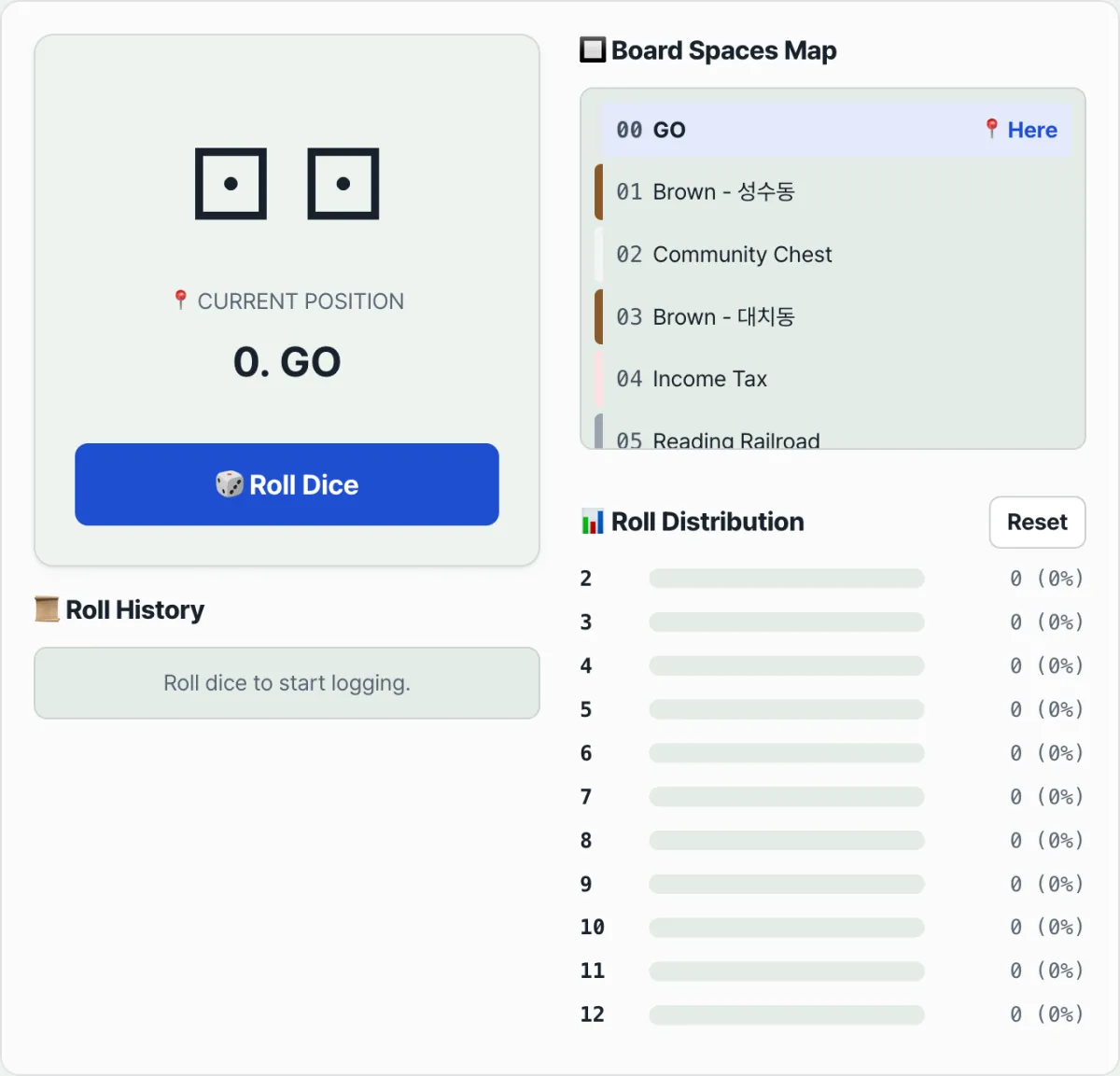
You don't have to calculate the formulas by hand or write code. With our free Monopoly Dice Roll Simulator, you can check doubles probability and 40-space movement results right away. Check it with our tool.
Roll two dice and watch the doubles chances and the token moving around the 40-space board in real time.
Dice Probability Summary Table
| Category | Combinations | Probability |
|---|---|---|
| Doubles (matching faces) | 6/36 | About 16.67% |
| Sum of 7 (most frequent) | 6/36 | About 16.67% |
| Sum of 2 or 12 (least frequent) | 1/36 | About 2.78% |
The Takeaway
The probability of rolling doubles with two dice is 6/36 (about 16.67%). If you roll doubles three times in a row, you are forced to move to Jail. A token moves around the 40-space board using the formula (current position + sum of the dice) mod 40. If you'd rather not work through the formulas and code yourself, you can use the simulator tool to check the probability distribution and movement results right away.
Roll two dice and watch the doubles chances and the token moving around the 40-space board in real time.
Frequently Asked Questions
What is the most likely sum when you roll two dice?
With two six-sided dice, a sum of 7 has the highest probability at 6/36 (16.67%). A sum of 2 or 12 has the lowest probability at 1/36 (2.78%) each, and the overall distribution forms a triangle (a discrete triangular distribution) that peaks at 7 and slopes down symmetrically on both sides.
What happens if you roll doubles three times in a row?
If you roll doubles three times in a row, you get the penalty of being forced to move to Jail (space 10), and your consecutive doubles count resets to 0.
What can I check in the simulator?
Each time you press the Roll Dice button, the simulator rolls two dice once. You can see whether the two dice match to make doubles, and whether the three-in-a-row Jail penalty triggers. You can also check your token's current position in the 40-space board list and compare it with a graph of the cumulative probability distribution for dice sums.
This article was adapted from our Korean original. Read the Korean original