
Online Dice and Coin Flips: How to Check If They're Fair
Contents
You've probably rolled dice or flipped a coin online, felt like the results kept landing on one side, and wondered whether the tool was rigged. When you're splitting into teams or deciding an order, it seems trivial, but you start to wonder whether the odds are really fair. You can check that yourself, no expertise required.
Summary ① With only a few trials, even a truly fair coin or die can naturally produce a lopsided result ② Unlike the Math.random() commonly used on the web, a cryptographic random generator such as crypto.getRandomValues() is designed for unpredictability and uniform distribution ③ If you repeat the test and count the ratios yourself, you can see with your own eyes whether any given method is actually fair
Why Do Online Dice and Coin Results Look Lopsided?
Flip a coin 10 times and get 7 heads, and it's easy to feel the tool is broken. But even a truly fair coin produces that kind of skew over a small number of flips. As the number of trials grows, the results creep closer to the theoretical 50-50.
The other cause is the way the random numbers are generated. Math.random(), commonly used in web pages, is implemented differently in each browser, and it wasn't built to be validated for statistical quality. crypto.getRandomValues(), by contrast, uses an operating-system-level random source and is designed for unpredictability and uniformity.
If you don't separate these two causes, you end up confusing a normal coincidence ("I only flipped a few times and it skewed") with a real problem ("the generation method itself is biased").
How to Check Fairness: Count the Ratios Yourself
Whichever online dice or coin tool you use, fairness should be judged by the ratio after many repetitions, not by a single result. With a coin, flip at least 100 times, count the heads and tails separately, and calculate heads as a percentage of the total.
With a die, count how many times each face came up and divide by the total number of rolls. If one face shows up unusually often, increase the number of rolls and check whether the gap narrows. If it was simple luck, the results move closer to the theoretical value as you roll more. If the bias is real, the gap won't close.
The problem is that doing this by hand is a hassle: you have to write down every result and calculate percentages each time. Getting a trustworthy ratio means repeating dozens or hundreds of times, and it's easy to lose count along the way.
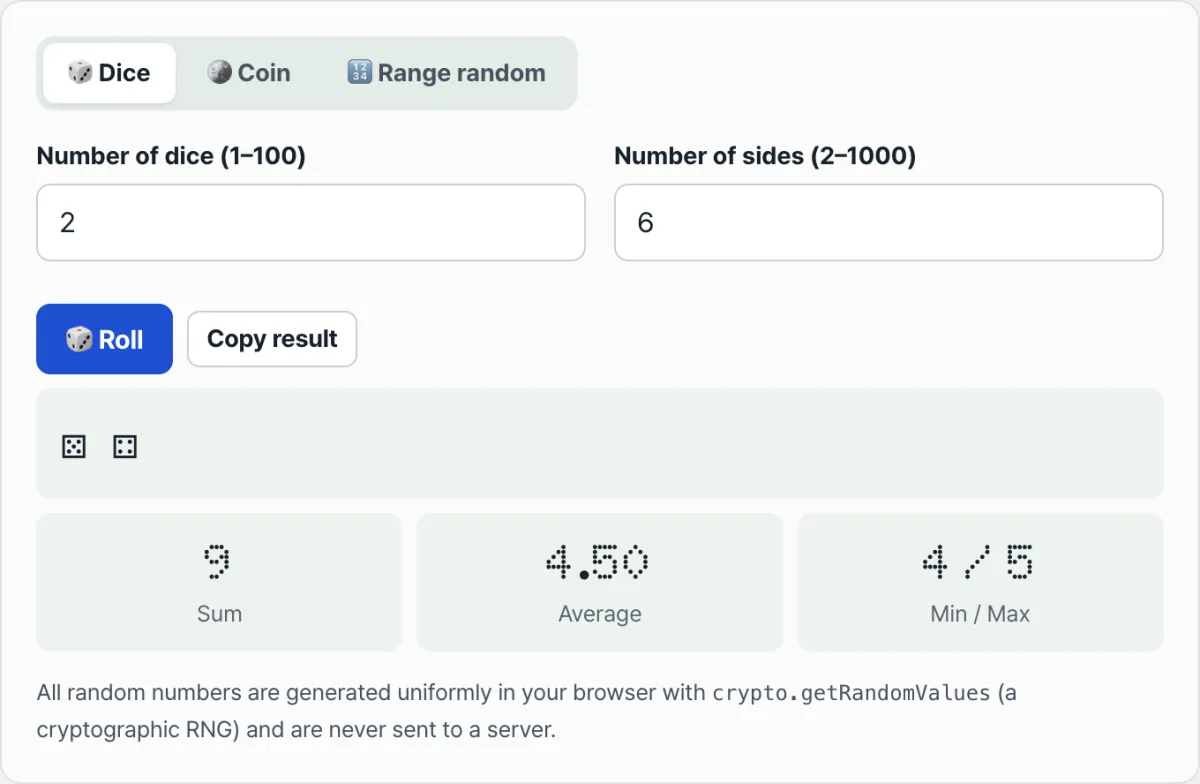
Check it with our tool. Set the number of dice or coins to several and roll them all at once, and the totals and averages, or the heads-and-tails ratio, are calculated automatically along with each result.
Free · no sign-up · roll, flip, and draw right in your browser
Common Sticking Points
| Situation | Why it happens |
|---|---|
| Calling it biased after only 5–10 flips | With few trials, results can skew by chance — repeat at least a few dozen times for the ratio to stabilize |
| Pressing one coin at a time, over and over | Rolling several at once calculates the total and ratio for you, which is far easier |
| Using range random for lotteries or number draws | If you don't check "Pick without duplicates," the same number can come up more than once |
| Leaving the die face count fixed at 6 | The face count can be set from 2 to 1000, so you can check other face counts for board games just as well |
As the table shows, most cases where results look odd come down to too few trials or a setting that wasn't checked. Rolling several at once and looking at the ratios together cuts down on this kind of misunderstanding.
The Short Version
When online dice or coin results look lopsided, it's usually just the natural effect of too few trials. Real fairness has to be checked with the ratio over many repetitions, not with a single result.
A tool that uses a cryptographic random generator is designed so that heads and tails, or each face, have equal probability in theory. So the surest way to verify it is to keep increasing the number of trials and watch whether the ratio approaches that.
Free · no sign-up · roll, flip, and draw right in your browser
Frequently Asked Questions
What's actually different between Math.random and cryptographic randomness?
Math.random() uses the browser's internal pseudorandom generator and is fast, but it isn't meant to guarantee statistical unpredictability. crypto.getRandomValues() uses the operating system's random source and is designed for unpredictability and uniform distribution, so each value is made to come up with equal probability.
I flipped a coin 10 times and got 7 heads. Is the tool broken?
No. With few trials, even a truly fair coin often produces lopsided results. The accurate way to judge is to increase the number of flips — 100, 1000 — and check whether the heads ratio moves closer to 50%.
What's the best way to use a random picker when dividing into teams?
In the range random feature, set the number of picks to the number of people and check "Pick without duplicates." You'll get non-overlapping numbers in one go, and you can use that order directly to form groups or set a sequence.
This article was adapted from our Korean original. Read the Korean original