
Name Picker Wheel: Is It Really Random? How to Check
Contents
When you run an online spinner to pick a presenter or a cleaning-duty person at a meetup, and the same person keeps coming up, you start to wonder if it's rigged. Behind the flashy spinning animation, you can't tell how the winner was actually decided unless you look at the code. This post lays out how to check any online drawing tool yourself.
Summary ① Most random wheels pick the winner before the animation starts, then work backward to a rotation angle that stops on that spot. ②
Math.random()andcrypto.getRandomValues()differ in where the random numbers come from and how they handle bias. ③ Slice size and text length don't affect your odds — the angle is always 360 degrees divided by the number of items.
"Is this rigged?" Why the suspicion comes up
A wheel splits a circle into slices, spins, and shows where it stops. But when the same name keeps coming up after several spins, participants start suspecting the program is favoring certain items before they ever think about probability.
In reality, 5 items means 20% each and 10 items means 10% each, every time, drawn independently. Just as flipping a coin 10 times and getting heads 7 times doesn't mean the coin is rigged, a handful of results can't tell you whether there's bias.
The catch is that the spinning you see and the calculation that decides the result are separate things. What's on screen is a performance spinning toward an outcome that's already been chosen. The real thing to verify is the random number used to pick that outcome.
How to check whether an online drawing is actually fair
If you don't want to just trust the tool, there are two things to check. One is running enough trials to build statistics. The other is checking which random function the code uses.
Spin the same list many times and count the ratios
Take a list of 5 items, spin it about 30 times, and record how many times each item wins. It won't come out to exactly 20% each, but by the law of large numbers, the more trials you run, the closer each item's win rate should get to 1/n.
If a pattern where one item shows up unusually often keeps going past 30 or 50 spins, that's when you have grounds for suspicion. Declaring bias from a few lucky results isn't statistically well supported.
Check the page source for the random function
Open your browser's developer tools (F12) and look at the page source or the running scripts to see whether it uses Math.random() or crypto.getRandomValues(). Math.random() is a pseudorandom generator designed for statistical distribution, while crypto.getRandomValues() uses cryptographically secure random numbers provided by the operating system.
Another thing to check is whether it handles modulo bias, which appears when you divide by the number of items using a remainder operation. Dividing a random value directly by the item count gives some values a slightly higher chance of landing, a tiny bias. To remove it, you need rejection sampling: discard values above a limit and draw again.
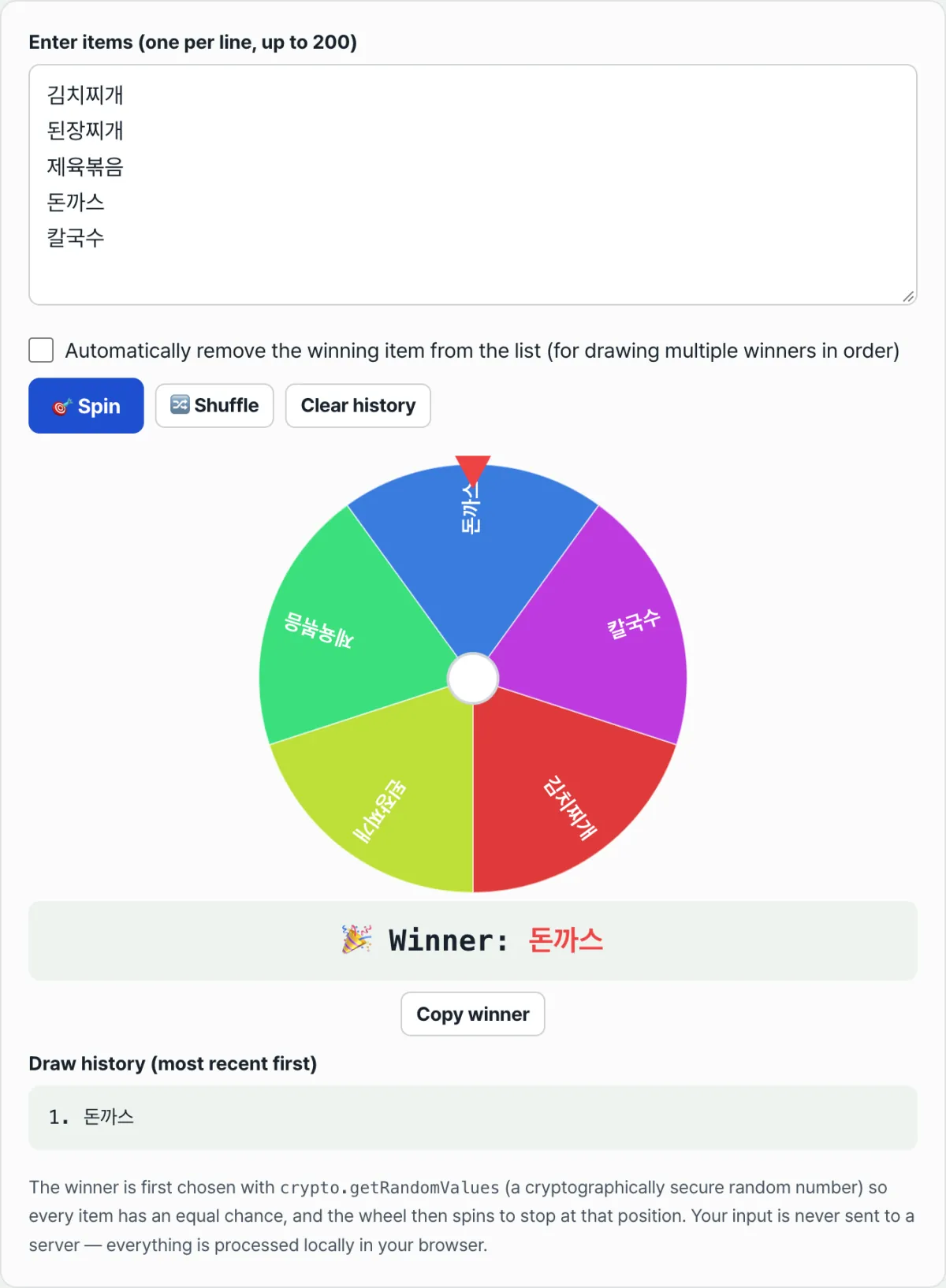
Check it with our tool. Instead of opening developer tools, digging through source, and counting by hand dozens of times, you can use a wheel right now that publishes its method: cryptographic random numbers plus rejection sampling.
Free · no sign-up · fair draws powered by cryptographic randomness (crypto.getRandomValues)
Common points of confusion about wheels
| Question | The facts |
|---|---|
| Do different slice sizes mean different odds? | No. A slice's angle is always fixed at 360 degrees divided by the number of items, and the length of an item's text has no effect on the angle calculation. |
| A long name gets cut off on screen — does that affect the odds? | No. Only the visible text gets shortened to a fixed length for display. It has nothing to do with the winning calculation. |
| If the same person wins twice in a row, is it rigged? | No. Each spin is an independent trial unrelated to previous results, so the previous winner has the same chance as anyone else. |
| Are the odds the same when picking several people in order? | Remove the winner from the list and spin again, and the same equal odds apply each time based on the number of items left. |
The bottom line
Whether an online wheel is fair isn't about how it felt after a few spins. You check two things: a statistical check to see whether win rates converge on 1/n over repeated trials, and a technical check of which random function the code uses.
Slice size, text length, and who won last time have nothing to do with the probability calculation. What matters is whether the calculation itself uses cryptographic random numbers and rejection sampling.
Free · no sign-up · fair draws powered by cryptographic randomness (crypto.getRandomValues)
Frequently asked questions
What's the difference between Math.random and crypto.getRandomValues?
Math.random() is a pseudorandom generator built by the JavaScript engine for statistical distribution, and its seed or algorithm doesn't guarantee cryptographic security. crypto.getRandomValues() uses a cryptographically secure random number generator (CSPRNG) provided by the operating system, which makes the values harder to predict.
Do different slice sizes change the odds of winning?
No. When the wheel is drawn, each slice's angle is always calculated as 360 degrees divided by the total number of items. With 6 items, every slice is 60 degrees, and even if long text looks shortened on screen, that has nothing to do with the angle calculation.
How do I pick several people in order?
Turn on the option that automatically removes a winning item from the list, then spin repeatedly. Each time someone is picked, the remaining item count drops by one, and the same equal odds apply based on how many are left at that point.
Are the names I enter stored on a server?
No. Everything from entering items to the random draw to showing the result happens inside your browser and is never sent to a server. If you refresh the page, your drawing history disappears with it.
This article was adapted from our Korean original. Read the Korean original