
Tarot Card Deck Structure: Why 78 Cards Split 22 + 56
Contents
There are 78 tarot cards not because of some magic number, but because you add 22 Major Arcana cards to 56 Minor Arcana cards. The 56 Minor Arcana cards split again into 4 suits — Wands, Cups, Swords, and Pentacles — and each suit holds 14 cards (10 number cards + 4 court cards). This article breaks down how 78 divides into 22 + 56, and checks the sub-structure below that, all in numbers.
Summary ① 78 tarot cards = 22 Major Arcana (numbered 0–21) + 56 Minor Arcana. ② The 56 Minor Arcana cards are 4 suits — Wands, Cups, Swords, Pentacles — × 14 cards each (10 number cards + 4 court cards). ③ The deck itself is 78 cards, but once you count upright and reversed, each card can express up to 2 states.
The problem: 78, 56, and 22 get confusing when you only look at the numbers
When you first meet tarot, terms like 78 cards, Major Arcana, and Minor Arcana all show up at once, so the numbers blur together. The more familiar you are with a standard deck of playing cards (52 cards), the more likely that is.
Some decks sold in stores are trimmed versions that bundle only the 22 Major Arcana cards. It's common to think that's "a full tarot set" and then get confused later when you run into a proper 78-card deck.
Another frequent question is, "If each card can be upright or reversed, isn't a 78-card deck used like 156 cards?" That confusion comes from not separating the physical card count from the number of states a card can express.
The fix: split 78 into 22 + 56 and count it by hand
You can count the structure of a 78-card deck in order without any tool. Start with the 22 Major Arcana, then the 56 Minor Arcana.
Counting the 22 Major Arcana
These are the 22 numbered cards, from The Fool (0) to The World (21). Each card has a number and a unique name, so if you lay them out in order you can spot a missing card right away.
Counting the 56 Minor Arcana
They split into 4 suits: Wands, Cups, Swords, and Pentacles. Each suit has 10 number cards (Ace, 2–10) plus 4 court cards (Page, Knight, Queen, King), for 14 cards per suit.
14 cards per suit × 4 suits = 56 cards
56 Minor + 22 Major = 78 cards
Compare that with a standard deck of playing cards (52 cards) and the difference is clear. Playing cards are 4 suits × 13 cards (Ace–10 + Jack, Queen, King), but the tarot Minor Arcana has one extra court card, the Page, which makes it 14 per suit — and then the 22 Major Arcana cards are added on top of that.
If you own a tarot deck, you can actually sort and count it in that order. Separate the 22 Major Arcana, stack each of the four suits at 14 cards for 56, and you can confirm whether the deck really has 78.
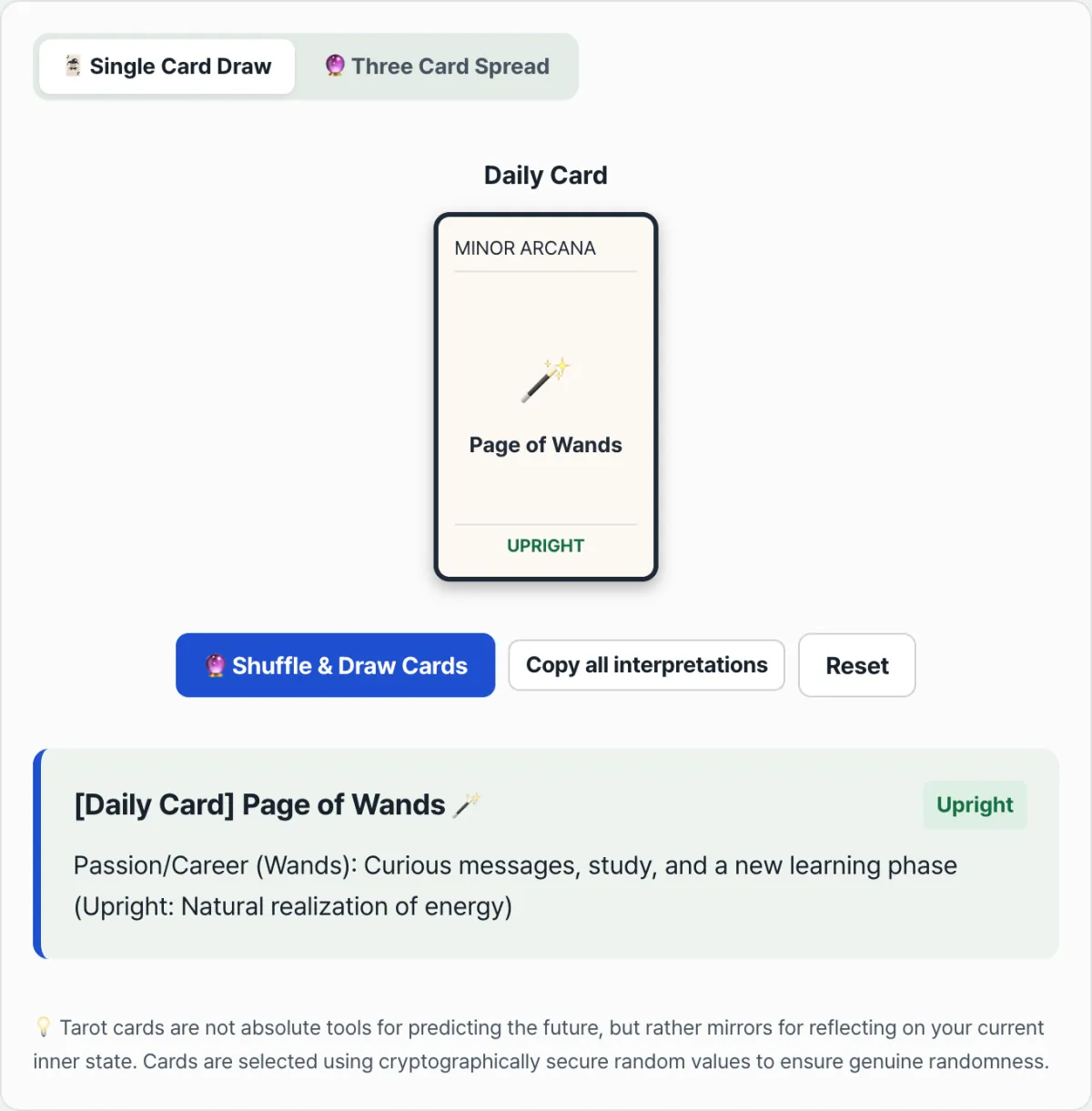
Counting by hand every time, or checking each drawn card's direction (upright or reversed), is a hassle. You can see how this structure actually works with the tool below.
Free · no sign-up · when you pull a card, it shows whether it's Major or Minor Arcana and whether it's upright or reversed
This tool draws from the full 78-card deck. Within a single spread, cards already drawn are removed from the deck, so even a three-card spread won't repeat the same card.
Each time you draw, upright or reversed is also set at random. Whether the drawn card is a Major Arcana card, or which suit and number it is if it's a Minor Arcana card, is shown on the card's face.
Where people get stuck
| Situation | Cause | How to check |
|---|---|---|
| You thought the Minor Arcana was 52 cards (4 suits × 13), but it's 56 | Unlike playing cards, the court cards are 4 including the Page (14 per suit) | Count whether the court cards are Page, Knight, Queen, King — 4 of them |
| You mistook a "22 Major Arcana cards" product for a full 78-card deck | Trimmed products exist that bundle only the Major Arcana | Check the product description for whether it includes the Minor Arcana (56 cards) |
| You worry the same card will show up twice in a three-card spread | You assume each draw samples from all 78 cards with replacement | Check whether cards already drawn are removed within a spread |
| You read "156 upright and reversed" as meaning there are 156 cards | You're mixing up the physical card count (78) with the number of card × direction combinations (78×2) | Calculate by separating the card count from the number of states a card can express |
Recap
The 78 tarot cards are the sum of 22 Major Arcana and 56 Minor Arcana. The 56 Minor Arcana cards are the result of the 4 suits — Wands, Cups, Swords, Pentacles — each filling 14 cards (10 number cards + 4 court cards).
Once you know this structure, you can check for yourself whether your deck is a proper 78-card set and whether cards are drawn without repeats in a spread.
Free · no sign-up · when you pull a card, it shows whether it's Major or Minor Arcana and whether it's upright or reversed
FAQ
Why exactly 14 cards per suit in the Minor Arcana?
It's easier to understand by comparing with a standard deck of playing cards (4 suits × 13 cards, Ace–10 + Jack, Queen, King). The tarot Minor Arcana has one extra court card, the Page, giving you Page, Knight, Queen, King — 4 cards — which makes it 14 per suit, one more than playing cards.
Is there a fixed reason the Major Arcana starts at 0?
That the cards are numbered from The Fool (0) to The World (21) is a structural fact. Why 0 was assigned to The Fool, though, is a matter of interpretation that decks and guidebooks explain differently, so this article only covers the numbering itself.
How does the tool decide upright or reversed?
Each time it draws a card, the tool uses a cryptographically secure random number to decide upright or reversed along with the card. The fact that the deck itself is 78 cards stays the same regardless of direction.
This article was adapted from our Korean original. Read the Korean original