
Dice Notation Explained: How to Read 2d6+3 and Roll d100
Contents
TRPG rulebooks and character sheets spell out notation like "2d6+3" and "1d20+5" exactly as written. If you don't know what the numbers on either side of the letter d mean, or what the modifier tacked on the end is for, even working out a single damage roll takes time. This post covers the rules for reading dice notation and the actual way to add it up, sticking to facts I verified in code.
Summary ① In "NdM", N is the number of dice and M is the number of faces. The ±K after it is a modifier you add to or subtract from the total. ② d4, d6, d8, d12, and d20 are all regular polyhedra with congruent faces. Only d10 is a pentagonal trapezohedron, so its shape is different. ③ d100 is usually rolled by combining two ten-sided dice, but an online roller that draws a single integer from 1 to 100 gives the same odds.
Why "2d6+3" notation feels confusing at first
TRPG scenarios and monster stat blocks spell it out plainly, like "Longsword attack: 1d8+3." The first time you see it, you can't tell which of 1, 8, and 3 is the count, which is the face range, and what the 3 is even doing there.
The notation isn't a rule each game makes up. It's a convention shared across tabletop RPGs. Even so, beginners end up searching for it every time or guessing at the math, and it's easy to get the result wrong.
How to calculate dice notation
The structure is always fixed in the order "N" + "d" + "M" + "±K". N is the number of dice you roll, d is the symbol for "dice", M is the number of faces on each die, and ±K is a modifier you add to or subtract from the total of all the dice.
For example, "2d6+3" means roll two six-sided dice, add the two results, then add 3 to that total. If the dice come up 3 and 5, you get 3+5=8, add the modifier of 3, and the final value is 11.
If there's no modifier, as in "1d20", you drop the ±K entirely. If the modifier is negative, you write it as "1d20-2" with the minus sign and handle it as subtraction.
d100 (percentile) notation is a little different
Physical dice sets often include two identical pentagonal trapezohedron (ten-sided) dice as a pair. One is marked 00, 10, 20 … 90, and the other is marked 0 through 9. You add the two values to get a result between 1 and 100. If 00 and 0 come up together, by convention that reads as 100.
Online dice rollers skip those two steps and draw an integer from 1 to 100 directly. The range of possible values and the odds for each value are mathematically the same as rolling the two physical dice.
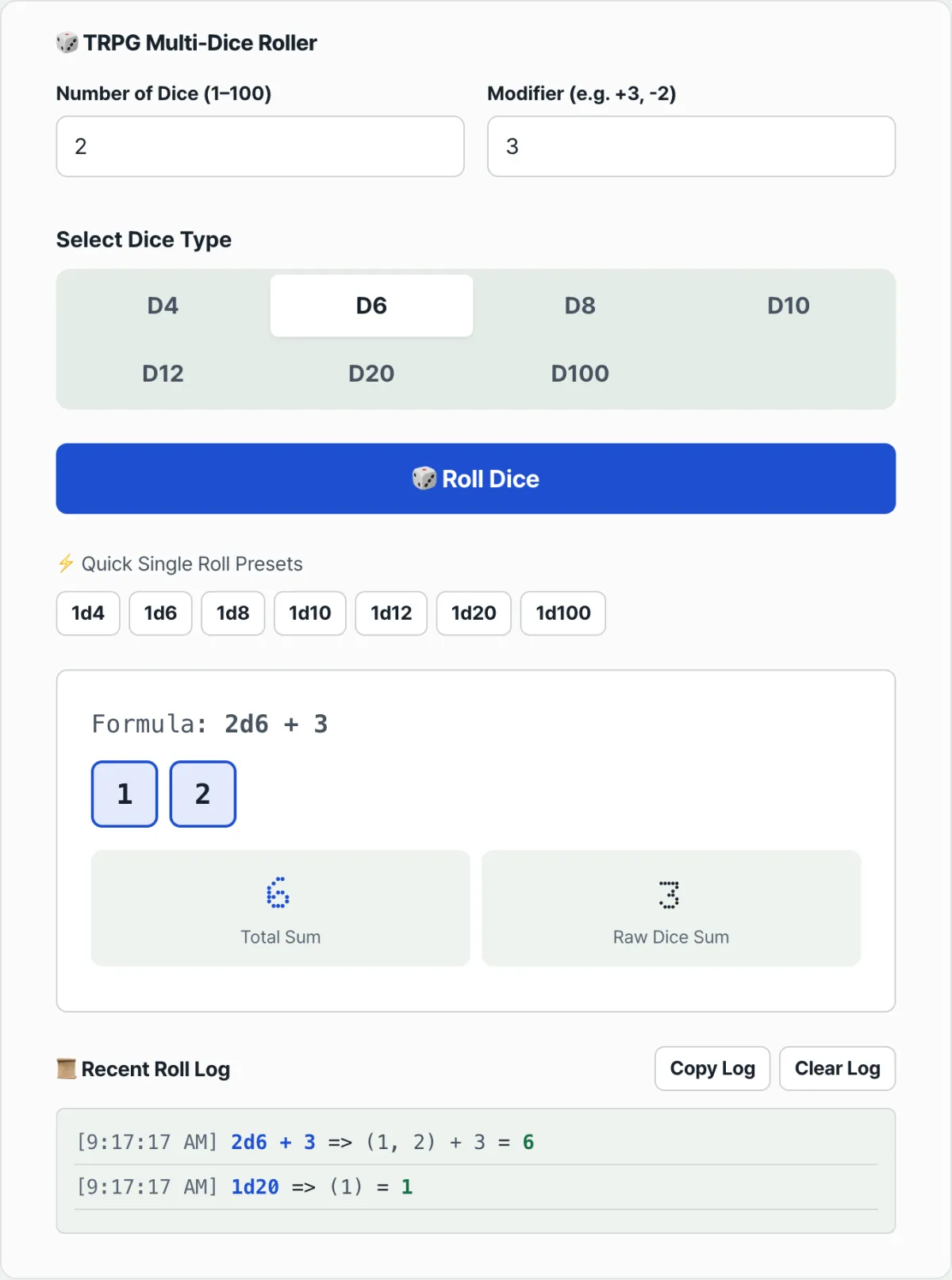
Try it with our free tool, TRPG Multi-Dice Roller. Instead of working the notation out in your head and rolling several dice by hand, you just enter the number of dice, the number of faces, and the modifier, and you see the math and the log in one place.
Free · No sign-up · Enter count, sides, and modifiers to get the result and log
Common sticking points
| Question | Answer |
|---|---|
| What if there's no number before the "d" (like d20)? | It means one die, the same as "1d20". By convention the 1 is dropped. |
| What does the "=>" arrow in the log mean? | The left side is the notation (the formula), the parentheses hold the individual dice that actually came up, and the "=" after that points to the final total with the modifier included. |
| How does the notation change if the modifier is 0? | You don't write ±0. You drop the trailing part and just write "1d20". In the log too, a modifier of 0 shows no sign. |
| Does critical success or failure count as part of the notation? | No. The notation "1d20" only describes the range of results. Which number counts as a critical hit is a separate rule in each game. |
The short version
Dice notation combines four elements in a fixed order: "N" for the count, "d" for the symbol, "M" for the number of faces, and "±K" for the modifier. Add up all the dice and apply the modifier, and that's your final value.
Whether you follow the convention of rolling two physical dice for d100 or draw a single integer online, the odds come out the same. Read the notation correctly and the math works the same however you roll.
Free · No sign-up · Enter count, sides, and modifiers to get the result and log
Frequently asked questions
In "2d6+3", what do the first number and the number after the d mean?
The 2 in front is how many dice you roll. The 6 after the d is how many faces each die has. Add the two dice together, then add the +3 modifier, and you have your final value.
Why are the only die sizes 4, 6, 8, 10, 12, 20, and 100?
The 4-, 6-, 8-, 12-, and 20-sided dice are the five shapes you can make as regular polyhedra with congruent faces. The 10-sided die isn't a regular polyhedron, so it uses a pentagonal trapezohedron shape instead. A 100-sided die is hard to make physically, so it's usually replaced by two ten-sided dice.
How does a die with no modifier show up in the log?
If the modifier is 0, you don't write "±0". You drop the trailing part and just write "1d20". In the actual roll log, a modifier of 0 adds no sign and no number. Only the count and the faces remain.
Does an online dice roller give results as evenly as physical dice?
When it uses the browser's cryptographic random number function instead of a pseudorandom generator designed for statistical spread, there's no bias toward any particular face, and every face keeps the same chance of coming up.
This article was adapted from our Korean original. Read the Korean original