
CPM vs. WPM: Why Your Typing Speed Numbers Differ
Contents
This post is for anyone who measured their typing speed, saw "CPM 320" on one site and "64 WPM" on another, and can't tell which number reflects their real skill. The short answer: both are the same record, just in different units.
Only two rules create that gap. One is the WPM convention of counting 5 characters as one word. The other is that in Korean, the number of characters on screen is not the same as the number of key presses.
Summary ① WPM is calculated with the "5 characters = 1 word" convention. So the same record comes out at one-fifth of the character-based count (CPM). ② Korean is built by combining jamo, so typing the 3 characters in
한국어takes 8 key presses on a dubeolsik (two-set) keyboard. Which one you count changes the "keystroke count." ③ This tool's CPM is based on completed characters and leaves out typos. Don't compare it directly with a typing-practice score that counts jamo.
Why the same skill produces numbers that are far apart
A typing practice program gives you a three-digit number, but when you measure the same skill on an English typing site, it drops to two digits. Your skill didn't suddenly shrink — the unit of measurement is different.
Korean adds one more wrinkle. In English, one key press makes one character. In Korean, you press two or three jamo to complete a single character. So from the start, "how many characters did I write" and "how many times did I press a key" are different values.
In other words, before you compare typing-speed numbers, you have to match two things: ① word-based or character-based, and ② if character-based, completed characters or jamo.
How to calculate it without a tool: a stopwatch and two divisions
All you need is one sentence, a stopwatch, and two divisions.
Step 1 — Count the characters. Count the characters you typed correctly. Spaces count as one character each (the WPM convention includes spaces).
Step 2 — Convert the time to minutes. If you timed in seconds, divide by 60. For 8 seconds, 8 ÷ 60 = 0.1333 min.
Step 3 — Do the division.
CPM = characters typed correctly ÷ time taken (minutes)
WPM = CPM ÷ 5
For example, if you correctly typed 41 characters in 8 seconds, 41 ÷ 0.1333 = 307.5, which rounds to a CPM of 308. WPM is 307.5 ÷ 5 = 61.5, which rounds to 62. This makes it clear that these are two numbers from one single record.
It works in reverse too. Multiply a WPM you saw somewhere by 5 to get character-based CPM, or divide character-based CPM by 5 to get WPM.
The catch: doing it by hand, you miscount characters, and you also have to check separately how many characters you got wrong.
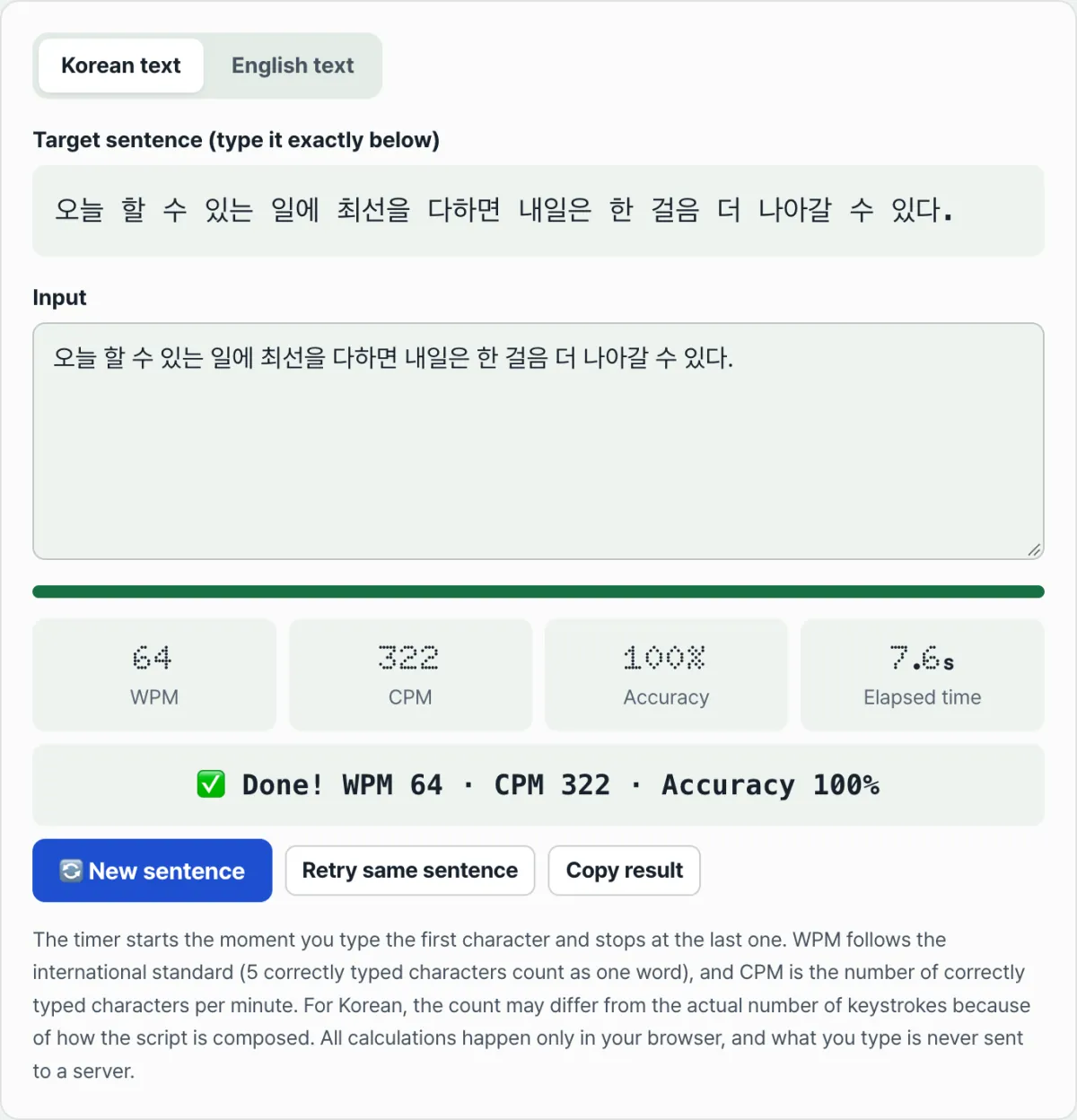
Check it with our free tool, Typing Speed Test (WPM). Type the sentence exactly as given and WPM, CPM, accuracy, and elapsed time all appear on one screen.
It runs right in your browser with no install or sign-up, and nothing you type is sent to a server.
Where Korean really splits: characters vs. key presses
On a dubeolsik (two-set) keyboard, one Korean character is built from an initial consonant + a vowel (+ a final consonant). Without a final consonant it's 2 key presses; with one, 3 is the default.
| Input | Characters shown on screen | Dubeolsik key presses |
|---|---|---|
한국어 | 3 | 8 (ㅎㅏㄴ / ㄱㅜㄱ / ㅇㅓ) |
typing | 6 | 6 |
Compound vowels and double final consonants add more. ㅘ is ㅗ+ㅏ, two presses, and ㄳ is ㄱ+ㅅ, also two presses. In English, by contrast, one character is one key, so the two values are always the same.
So when someone says "keystrokes" in Korean, it can mean a count of completed characters or a count of key presses. Naturally, counting jamo gives you the bigger number.
For inputs that also use Shift, like double consonants, the counting method can differ from program to program. So there's no point in trying to match scores from different programs down to the digit.
How this tool counts
Here are the rules, written out as they are.
- CPM: Based on completed characters. Jamo are not counted separately.
- WPM: The same character count divided by 5. That's why the CPM on screen is always 5 times the WPM — any difference is due to rounding.
- Typos: Only characters that match the given sentence at that position are counted. Wrong characters are left out of WPM and CPM.
- Accuracy: Correct characters ÷ characters you typed.
- Timer: Starts the moment you type the first character and stops on the last one. When you fill the sentence to the end, it finishes automatically.
On screen, correct characters turn green, wrong ones get a red background, and the next position to type has a blue underline. In Korean, a character still being composed can briefly look like a mismatch, but it turns green once the character is complete.
When you finish, WPM / CPM / accuracy / time are summarized in one line, and you can grab them as-is with the Copy Results button. Switch between the Korean sentences and English sentences tabs to compare the two languages under the same rules.
The takeaway
- WPM follows the convention of counting 5 characters as one word. Character-based CPM ÷ 5 = WPM, and WPM × 5 = character-based CPM.
- To do it by hand, get CPM from
correct characters ÷ time taken (minutes), then divide by 5 for WPM. - Korean is built by combining jamo, so the 3 characters in
한국어take 8 key presses. Completed characters and jamo were never the same number to begin with. - This tool counts completed characters and leaves out typos, so it's normal for your score here to be lower than a typing-practice score that counts jamo.
- To compare, compare like with like. The surest way is to measure several times with the same tool and watch how your own record changes.
It runs right in your browser with no install or sign-up, and nothing you type is sent to a server.
Frequently asked questions
How much is 500 CPM in WPM?
It depends on what that 500 is counting. If it's 500 CPM on a completed-character basis, divide by 5 and you get 100 WPM. If it's on a jamo (key press) basis, you first have to convert it to a character count, so you can't just divide by 5. Mix the two and you'll get a number far higher or lower than reality.
My CPM here is lower than my typing-practice score
That's because the basis is different. This tool counts completed characters and doesn't count jamo separately. On top of that, characters you get wrong are dropped from the calculation. Rather than trying to reconcile two programs' numbers, measuring repeatedly in the same tool gives you a more accurate read on how your skill changes.
Do spaces count as characters?
Yes. Spaces in the given sentence count as one character too, and if you put them in the right position they're counted. This matches the WPM convention of including spaces when treating 5 characters as one word.
What happens to my score if I make a typo?
Each position is compared with the given sentence, and characters that don't match aren't counted. That pulls WPM and CPM down together. Accuracy is correct characters divided by the characters you typed, so even if you type a lot in the same time, a lot of wrong characters drops all three numbers at once.
This article was adapted from our Korean original. Read the Korean original